
I. Executive Summary
HGH (1-43) is the N-terminal 1 to 43 fragment of the 191-residue human growth hormone sequence, supplied as a synthetic research peptide under CAS 96827-07-5 with a molecular mass of the order of 4.5 to 5 kDa depending on the exact sequence variant. It is a custom synthesis product rather than a commodity: it is made to order by peptide CDMOs for research and analytical customers under controlled quality and compliance conditions. This paper addresses that B2B reality and not any consumer or therapeutic use.
The compliance perimeter is the starting point, not a footnote. As a fragment, HGH (1-43) has no approved therapeutic indication in the European Union, the United States, China or elsewhere. It is supplied as Research Use Only material, is not for human or veterinary use, and is not a finished consumer product. Human growth hormone itself is a prescription biologic in those markets and is prohibited in sport under section S2 of the World Anti-Doping Agency prohibited list, which covers peptide hormones, growth factors and related substances.
The material must therefore never be marketed into bodybuilding, anti-ageing, performance or consumer-injection channels, and suppliers are expected to screen customers, obtain end-use declarations and refuse non-qualified orders. Within that perimeter, the commercial question is conventional CDMO diligence: synthesis, purification, analytical validation, containment, cold chain and documentation.
II. Product Deep Dive: Molecular Mechanisms and Production Evolution
2.1 Physicochemical Properties and Mechanisms
Three features determine how the fragment behaves: its length, which places it at the boundary between stepwise synthesis and fragment condensation; the amphipathic, helix-forming tendency it inherits from the parent hormone; and its susceptibility to aggregation and oxidation.
- Length and aggregation behaviour: At more than forty residues the fragment sits at the practical limit of comfortable stepwise solid-phase assembly and is often approached through fragment condensation of shorter segments. Longer hydrophobic stretches promote on-resin aggregation and incomplete coupling, which is the principal source of deletion sequences. In solution, amphipathic character drives concentration-dependent aggregation and adsorption to surfaces.
- Oxidation, deamidation and sequence-specific impurities: The fragment contains methionine, histidine and aromatic residues, so methionine and histidine oxidation, and deamidation where asparagine is present, are the routine degradation pathways. Alongside them sit deletion sequences from incomplete coupling, truncated sequences from premature chain termination, and any diastereomers introduced during activation. A specification that reports only a single HPLC purity number does not distinguish any of these, which is why the related-substance profile is the real product definition.
2.2 Synthesis and Manufacturing Technologies
Supply is contract manufacture. Two route classes are used depending on scale and specification: stepwise solid-phase assembly, and convergent fragment condensation in which protected segments are coupled in solution or on resin. No procedural detail is given here; the differentiating work is impurity control, purification and analytical release.
- Stepwise assembly and fragment condensation: Stepwise Fmoc solid-phase assembly suits small Research Use Only campaigns and analogue work, with coupling efficiency monitored step by step and aggregation managed through resin selection, solvent system and temperature. Convergent fragment condensation of purified segments suits larger or higher-specification campaigns, because impurities in a segment can be removed before coupling rather than carried to the end. Route choice is an economic and impurity decision, not a chemical preference.
- Purification, counter-ion control and isolation: Crude material is purified by preparative reversed-phase HPLC, sometimes preceded by ion-exchange capture, then desalted, with the trifluoroacetate counter-ion either exchanged to acetate or retained at a declared level. Sterile filtration and low-bioburden filling precede lyophilisation under controlled shelf temperature and vacuum. Because the fragment is handled under an occupational exposure band, purification and isolation run in contained equipment with defined cleaning and waste-inactivation procedures.
2.3 Core Application Matrix
- Research-use biochemical reagent: Supply to university, institute, CRO and biotech laboratories for in-vitro research on growth hormone structure, receptor interaction and analytical method development, under an explicit Research Use Only statement excluding human and veterinary use.
- Analytical reference and assay standard: Use as a characterised standard for developing and validating HPLC, LC-MS and immunoassay methods, for system suitability, and for characterising related substances in growth hormone and fragment programmes.
- Contract synthesis intermediate: Use as a defined intermediate or comparator in contract peptide programmes run by CDMOs for pharmaceutical and biotechnology customers, where assigned content and impurity profile determine downstream stoichiometry.
III. Global Market Supply-Demand Landscape and Export Trends
3.1 Demand Drivers and Market Shifts
Demand is narrow, specification-heavy and entirely institutional. It comes from academic and industrial research on growth hormone biology, from analytical method development in biopharmaceutical quality control, and from CDMO programmes that require characterised fragments as comparators or intermediates. There is no legitimate consumer channel, and any demand that presents as consumer, performance or anti-ageing oriented must be refused rather than served.
3.2 Capacity Distribution and Export Flows
Capacity sits with peptide CDMOs able to run long sequences under containment, not with catalogue reagent houses. China and India host the largest concentration of long-peptide synthesis capacity and cost-competitive GMP experience; the United States and Europe host the high-specification campaigns and the analytical service laboratories that support characterisation. Export flows are small-volume, high-value and documentation-intensive, with end-use declarations and know-your-customer records accompanying every order.
3.3 Market Bifurcation and Pricing Dynamics
Pricing is driven by specification and compliance overhead rather than by raw material cost. The steepest cost drivers are the related-substance and deletion-sequence limits, the endotoxin specification, the counter-ion form, the depth of method validation, and the cost of contained handling and documented waste inactivation. A campaign requiring a validated impurity method, low endotoxin and full documentation can cost a multiple of a default Research Use Only lot released on a single HPLC purity figure.
IV. In-depth Analysis of Global Compliance and Regulatory Barriers
This molecule carries a heavier compliance burden than a conventional research peptide, because the parent hormone is a prescription medicine and a prohibited substance in sport. Buyers and suppliers should treat the perimeter as a documented system: regulatory status of the parent, anti-doping classification, the Research Use Only boundary, end-use screening and occupational containment.
4.1 European Market: REACH, CLP, and Sector-Specific Directives
- Prescription-medicine framework and WADA section S2: Human growth hormone is authorised as a prescription medicine in the European Union and is supplied only against a medical prescription; a fragment supplied for research is not that medicine, has no approved therapeutic indication and must not be presented as one. In sport, growth hormone and its releasing factors are prohibited at all times under section S2 of the World Anti-Doping Agency prohibited list, which covers peptide hormones, growth factors and related substances, and national anti-doping organisations enforce the same standard. Suppliers should state this in writing on every quotation.
- REACH, CLP and occupational exposure control: Substance-level REACH and CLP obligations apply to the material as placed on the EU market, together with the safety data sheet. Because the fragment is pharmacologically active by structure, responsible manufacturers assign an occupational exposure band and a health-based exposure limit derived from the available data, and operate weighing, purification and cleaning within that band with containment, procedural controls and training. Buyers should require the assigned band, the basis for it and the containment measures in place.
4.2 North American Market: TSCA, EPA, and FDA Regulations
- FDA status and restrictions on non-medical distribution: In the United States human growth hormone is a prescription biologic, and federal law restricts its distribution to uses authorised by a medical practitioner for the treatment of a disease or other recognised medical condition, with criminal penalties for other distribution. A synthetic fragment supplied for laboratory research is not an approved drug and must not be promoted, packaged or positioned for human use, and no representation of therapeutic or performance benefit should travel with the material.
- TSCA, Research Use Only and end-use screening: The substance itself is addressed under TSCA inventory and reporting provisions. The supply channel operates on a Research Use Only designation that is contractual rather than regulatory, supported by documented know-your-customer review, an end-use declaration naming the institution and the research purpose, and a documented refusal process for orders outside that purpose, including orders from bodybuilding, anti-ageing, performance or consumer-injection channels. Records should be retained and auditable, because they are the evidence that the perimeter was held.
4.3 The Critical Hurdle: Quality Control and Safety Limits
Compliance Warning: The decisive specification is the related-substance profile. Require a peptide content assay with a stated basis and method, identity confirmation by high-resolution mass spectrometry and amino-acid analysis, and a related-substance profile that resolves deletion sequences, truncated sequences, oxidation products and diastereomers with individual and total limits. Fix residual trifluoroacetate or acetate, residual solvents by ICH Q3C, water by Karl Fischer titration, elemental impurities against ICH Q3D, and endotoxin appropriate to the declared use. Require method validation evidence referencing ICH Q7, Q11 and Q1A and, where relevant, Q6B, not merely test results.
V. Green Trade Barriers and ESG in Manufacturing
Long-peptide manufacture is solvent- and energy-intensive, and here it also carries a containment load: contained weighing and purification, dedicated cleaning, and documented inactivation of peptide-bearing waste before disposal.
5.1 Carbon Footprint and Circular Economy
A credible supplier reports solvent consumption per gram of purified peptide, acetonitrile recovery, lyophilisation energy and Scope 1 and 2 emissions with Scope 3 partly characterised. Levers include solvent recycling in preparative chromatography, heat recovery on freeze-dryers and right-sizing the contained area rather than maximising containment, which reduces HVAC load. Waste streams containing active peptide require documented inactivation before disposal, and that step should appear in the supplier's environmental permit rather than in an internal instruction.
5.2 Sustainable Sourcing and Traceability
Traceability covers the amino-acid and resin inputs, the synthesis and purification site and the analytical release site, with batch genealogy from raw-material lot to released lot, retained samples and documented change control covering route, resin, solvent and site. Because the material is diversion-sensitive, chain of custody also means controlled access to retained material, inventory reconciliation, and documented destruction of rejected or returned lots rather than reintroduction into stock.
VI. Supply Chain Resilience and Export Logistics
The material is a lyophilised, hygroscopic and cold-sensitive peptide, so logistics turns on frozen or refrigerated cold chain, moisture exclusion and chain-of-custody documentation rather than on dangerous-goods classification. Temperature excursions are the most common cause of disputes and are usually a pack-out failure rather than a synthesis failure.
6.1 Packaging Standards and Moisture/Contamination Control
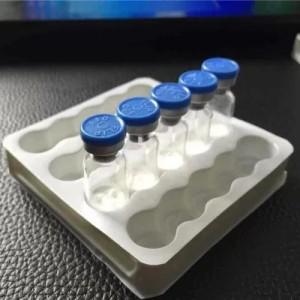
- Primary containment and moisture barrier: Fill lyophilised material into amber glass or high-barrier containers with induction-sealed or PTFE-lined closures under controlled humidity, with desiccant and nitrogen or dry-air headspace as specified, a content-corrected fill weight, minimal headspace, and tamper-evident labelling on every container to support inventory reconciliation.
- Frozen cold chain and monitoring: Ship frozen at minus 20 degrees Celsius or below, or refrigerated where stability data supports it, using validated insulated shippers with lane- and season-appropriate phase-change material or dry ice where the lane requires it, and a calibrated logger on every qualifying shipment. Define lane, pack-out, excursion protocol and acceptance criteria in the quality agreement, and confirm that dry-ice shipments meet IATA documentation requirements for solid carbon dioxide.
6.2 Dangerous Goods Identification and Transit Protocols
The peptide itself is not normally assigned a UN dangerous-goods classification, and most consignments travel under IATA, IMDG or ADR as general cargo with a safety data sheet; where dry ice is used, the consignment becomes a dangerous-goods shipment for that component. Documentary controls matter equally: correct Harmonized System classification for peptide substances, consistency between the commercial invoice, safety data sheet and certificate of analysis, and controlled delivery to a named institutional recipient rather than to an individual.
VII. Enterprise Global Expansion Strategy Guide
Three decisions determine whether a programme on this fragment is defensible: whether the compliance perimeter is documented, whether the analytical package is validated, and whether supply is held to a single specification under confidentiality.
- Make the compliance perimeter a documented system: Record the regulatory status of the parent hormone in each destination market, the World Anti-Doping Agency classification, the Research Use Only designation, the occupational exposure band with its basis, and the end-use declaration and know-your-customer procedure. Require a documented refusal process for non-qualified orders and retain the evidence, because an unwritten perimeter is not a perimeter when a regulator or customer auditor asks.
- Invest in the analytical package before volume: Require validated identity by high-resolution mass spectrometry and amino-acid analysis, a content assay on a stated basis, and a related-substance method demonstrated to resolve deletion, truncation, oxidation and diastereomer impurities, plus residual solvent, water, elemental impurity and endotoxin testing. Reference ICH Q7 and Q11 for GMP scope, Q1A for stability and Q6B where biotechnological specification concepts apply, and require notification of route, resin, solvent or site change.
- Single specification, dual source, protected methods: Qualify two geographically independent CDMOs, typically one Chinese or Indian and one United States or European, against one specification covering assay, impurities, counter-ion, endotoxin and cold chain. Protect the route and the analytical methods through confidentiality and technology-transfer terms, and align on retained samples, inventory reconciliation and documented destruction of rejected material.
VIII. Conclusion
CAS 96827-07-5 is a demanding custom-synthesis product whose difficulty lies in impurity science, containment and compliance rather than in the sequence itself. Any competent long-peptide CDMO can assemble the fragment; what separates usable supply from unusable supply is whether deletion and truncation sequences are resolved and limited, whether oxidation and diastereomer impurities are specified, whether counter-ion, water and endotoxin are declared, and whether the methods behind the numbers are validated.
The compliance perimeter is non-negotiable. The fragment has no approved therapeutic indication, is supplied only for research use, and is not for human or veterinary use or for sale as a finished consumer product, while the parent hormone remains a prescription medicine and a substance prohibited in sport under section S2. No dosing, no performance or anti-ageing guidance and no consumer framing belongs anywhere in the chain. Buyers and CDMOs that document the perimeter and validate the methods can run a defensible programme.
IX. Industry Resource Connection and Supplier Ecosystem
Powered by Guidechem
This white paper is exclusively compiled by the Guidechem Intelligence Team based on global customs data, regulatory databases, and industry research. Guidechem is a leading global B2B chemical platform, dedicated to connecting global buyers with verified, high-quality manufacturers.
Relying on Guidechem's extensive global database, we have mapped the core participants in the current global HGH (1-43) supply chain:
- China long-peptide synthesis capacity: China hosts the largest concentration of long-peptide synthesis capacity, with CDMO clusters around Shanghai, Hangzhou, Nanjing, Suzhou and Chengdu offering solid-phase and fragment-condensation capability at scale. Strengths are capacity, lead time and cost; diligence should target deletion-sequence control, method validation and compliance documentation.
- India cost-competitive long-peptide CDMOs: Indian peptide CDMOs around Hyderabad, Bengaluru, Ahmedabad and Pune combine cost-competitive long-peptide capability with growing GMP documentation discipline and are frequently used for research and comparator campaigns. Diligence should concentrate on data integrity, endotoxin and elemental-impurity testing, containment practice and frozen cold-chain export performance.
- United States high-specification analytical ecosystem: The United States concentrates high-specification peptide CDMOs, analytical service laboratories and research-reagent distribution, with strong capability in high-resolution mass spectrometry, amino-acid analysis and validated method development, plus mature institutional know-your-customer practice. Capacity is smaller and pricier, but documentation depth and domestic logistics are usually why buyers pay the premium.
Disclaimer: The content of this white paper is compiled based on public market data and regulatory information available as of 2026. Global chemical regulations are subject to dynamic adjustments. In actual export operations, enterprises must consult professional regulatory advisors or relevant competent authorities to obtain the latest compliance guidance.


 EN
 Agricultural News
 Food News
 Industrial News
 Cosmetic News
 Pharmaceutical News
 Science News



 2YRS

