-
We detected your language preference as English. Would you like to switch to the English version for a better experience?
Switch to English
Stay here


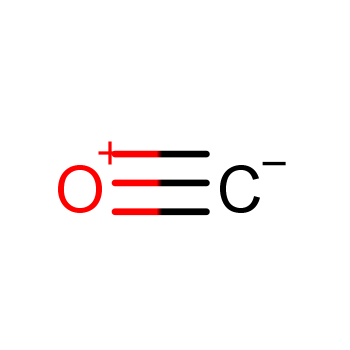
To determine whether carbon monoxide (CO) is polar or nonpolar, the classification itself needs care. As drawn in the CO Lewis Structure Guide, carbon and oxygen are joined by a triple bond and each atom retains one lone pair, giving the formal-charge arrangement °C≡O+.
As a diatomic molecule CO is necessarily linear with C∞v symmetry. There is no second bond to cancel against and no perpendicular component to resolve, so a nonzero dipole is unavoidable: μ = 0.110 D. Both atoms are conventionally described as sp-hybridized in the Lewis/VSEPR framework. What makes the molecule instructive is the direction — the negative end is on carbon, opposite to what electronegativity alone would predict, because the formal-charge contribution slightly outweighs the bond-polarity contribution.
The industrial reading is that CO should be treated as a nonpolar process gas with a small residual dipole. Its gas-phase permittivity is essentially unity, it is almost insoluble in water, and its hazards and reactivity arise from coordination chemistry rather than from any bulk dielectric or solvation behaviour.
CO is not used as a solvent. Its industrial role is as the C1 building block of syngas chemistry and as a ligand in organometallic catalysis, and both roles follow from the electron distribution at carbon rather than from bulk polarity.
In syngas chemistry CO is combined with hydrogen over catalysts to produce methanol, or with methanol to produce acetic acid via carbonylation, and it participates in hydroformylation to give aldehydes and alcohols. In ironmaking, CO is the actual reductant that strips oxygen from iron oxides in the blast furnace. None of this depends on the 0.110 D dipole: it depends on CO being a competent σ-donor/π-acceptor at carbon.
That same carbon-local donor ability is why CO is a severe catalyst poison. It binds strongly to nickel, iron and other transition metals, displacing the intended reactants and deactivating active sites. Feedstock specifications for downstream catalytic units therefore often impose tight CO limits even where CO is a desired reactant elsewhere in the same complex.
Because CO is almost insoluble in water and does not acidify it, absorption-based removal is ineffective. Industrial control relies instead on catalytic conversion, pressure-swing adsorption, methanation or selective oxidation, and on materials that resist carbonyl formation — notably the avoidance of nickel and iron alloys in high-pressure CO service, where volatile metal carbonyls can form.
Its toxicity mechanism is likewise coordination chemistry, not polarity: CO binds haemoglobin with roughly two hundred times the affinity of oxygen and also inhibits cytochrome oxidase. Practical consequences are that odourless CO detection and ventilation are mandatory, and that CO cannot be managed by the same absorption approaches used for acid gases such as SO2 or HCl.
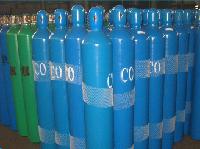
For procurement, the certificate of analysis should state purity, the CO2 and hydrogen limits, total sulfur, moisture, and any carbonyl-forming metal limits, together with cylinder material, valve standard and fill pressure — rather than a generic “high purity CO” designation.
The comparison below separates homonuclear from heteronuclear diatomics, which is the decisive distinction for whether a zero dipole is possible at all. Note how small CO's moment is alongside genuinely polar gases.
| Compound | Dipole Moment | Approx. Gas εr | log P / XlogP | Water Solubility Behavior | Industrial Sourcing |
|---|---|---|---|---|---|
| CO | 0.110 D | ≈1.00065 | XlogP ≈0.7 | Very low (≈0.0028 g/100 g at 20 °C) | High; toxic flammable gas, cylinder or bulk |
| N2 | 0 D | ≈1.0006 | Not meaningfully comparable | Low | Very high; inerting and purge grades |
| NO | 0.159 D | ≈1.0006 | Not meaningfully comparable | Low | Industrial; NOx streams |
| CO2 | 0 D | ≈1.0009 | XlogP ≈0.9 | Moderate; pressure dependent | Very high; multiple grades |
| HCl | 1.109 D | ≈1.0039 | Not meaningfully comparable | Very high; forms hydrochloric acid | High; anhydrous and aqueous grades |
CO and N2 have almost identical molecular masses and boiling points, which is why they are difficult to separate by physical means, yet their polarity classification differs fundamentally. N2 is homonuclear with an inversion centre and a rigorously zero dipole; CO is heteronuclear and cannot be zero. Separation must therefore rely on chemical or adsorptive differences, not on polarity-driven partitioning.
“Carbon monoxide is where I send anyone who thinks polarity is just electronegativity. Oxygen is the greedy atom, yet the negative end of the molecule is the carbon, because the formal charges win — and the result is a tenth of a Debye. In the plant that means you treat it as a nonpolar gas for separation and solubility purposes, while never forgetting that it binds metals through carbon, which is what makes it both an excellent ligand and a serious poison.”
In the European Union, ECHA lists CAS 630-08-0 / EC 211-128-3 as a REACH-registered substance with harmonised classification as a toxic and flammable gas. Supply must be accompanied by the appropriate classification, labelling and packaging documentation, and users must document exposure controls.
In the United States, the current OSHA PEL is 50 ppm (55 mg/m³) as an 8-hour TWA; NIOSH lists a REL of 35 ppm TWA with a 200 ppm ceiling and a revised IDLH of 1,200 ppm; ACGIH lists a TLV of 25 ppm. Because CO is odourless and colourless, continuous detection is the primary control in any area where combustion, reforming or CO handling occurs.
CO is also a criteria air pollutant subject to ambient air quality standards and to emission limits for combustion sources, which is why catalytic converters, boiler tuning and flue-gas CO monitoring are regulated rather than voluntary. For sites generating CO as a by-product, continuous emission monitoring is frequently a permit condition.
From a sustainability standpoint CO sits at the centre of carbon-utilisation strategies: converting captured CO2 or waste-derived CO into methanol, fuels or chemicals can reduce net emissions, but the balance depends on the hydrogen source and process energy. Because CO is also a toxic emission, any utilisation route must demonstrate both carbon benefit and rigorous containment.
Buyers should specify purity, moisture, CO2, hydrogen, oxygen, nitrogen, total sulfur and carbonyl-forming metal limits, along with cylinder material and valve standard, fill pressure, and the delivery configuration appropriate to the consumption rate.
Because CO is acutely toxic and flammable, and because it forms volatile metal carbonyls, the commercial discussion should address detection and ventilation provisions, prohibition of nickel and iron alloys in high-pressure service, and the transport and regulatory documentation required for the destination market. For catalyst-protected units, CO and sulfur limits usually govern acceptance.
Looking for commercial bulk supplies or technical documentation for Carbon Monoxide (CAS 630-08-0)?
Formally polar, effectively nonpolar. Any heteronuclear diatomic must have a nonzero dipole, and CO measures only 0.110 D. Most practical process discussions treat it as nonpolar.
The carbon end. Although oxygen is more electronegative, the formal-charge distribution opposes the bond dipole slightly more strongly, so the net negative pole sits on carbon — consistent with the fact that CO binds metals through carbon.
Toxicity is unrelated to polarity. CO binds haemoglobin with far higher affinity than oxygen and also inhibits cytochrome oxidase, so the hazard is coordination chemistry at the iron centre, not bulk solvation behaviour.
Very poorly, roughly 0.0028 g per 100 g of water at 20 °C, and unlike CO2 it does not react appreciably with water. Absorption-based removal is therefore ineffective.
The current OSHA PEL is 50 ppm as an 8-hour TWA; NIOSH lists 35 ppm TWA with a 200 ppm ceiling and a revised IDLH of 1,200 ppm; ACGIH lists a TLV of 25 ppm. Local requirements may be stricter.
Not by simple water scrubbing. Control relies on catalytic conversion to CO2, pressure-swing adsorption, methanation, selective oxidation, or copper-based liquid absorbents designed for carbonyl chemistry.
No. Snyder P′ applies to conventional liquid chromatographic solvents. For CO the meaningful descriptors are dipole moment, gas permittivity and, above all, its coordination behaviour.
|
 |
 |
 |
 |
 |
 EN
EN
 Agricultural News
 Food News
 Industrial News
 Cosmetic News
 Pharmaceutical News
 Science News