-
We detected your language preference as English. Would you like to switch to the English version for a better experience?
Switch to English
Stay here


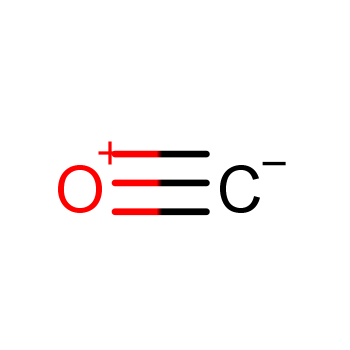
The carbon monoxide Lewis structure is C≡O, a triple bond (one σ and two π bonds) with one lone pair on each atom; the molecule is linear, carbon is sp-hybridized, the C≡O axis is 180°, and although formally charge-separated in the best resonance form, CO has only a small dipole and is best described as only weakly polar.
 Figure 1: Lewis Structure of Carbon monoxide (CO)
| Chemical Formula | CO |
| CAS Number | 630-08-0 |
| Total Valence Electrons | 10 |
| Lewis Structure | C≡O with one lone pair on each atom |
| Electron-Domain Geometry | Linear |
| Molecular Geometry | Linear (diatomic) |
| Hybridization Model | sp (both atoms) |
| C≡O Bond Angle | 180° |
| Polarity | Weakly polar (small dipole) |
Carbon monoxide is a deceptively simple diatomic that is central to industrial reduction and C1 chemistry. Its dominant use is as a reducing agent in metallurgy: in blast furnaces and direct-reduction processes, CO reduces metal oxides (notably iron ore) to the corresponding metals.
CO is also a key component of syngas (with H2), which is catalytically converted to methanol, to hydrocarbons via Fischer–Tropsch, and to acetic acid and related oxygenates through carbonylation. It serves as a fuel gas, a chemical intermediate for phosgene and isocyanates (under strict control), and a ligand in organometallic chemistry because of its strong π-acceptor character.
Counting valence electrons for CO: carbon is in Group 14 and contributes 4 valence electrons; oxygen is in Group 16 and contributes 6 valence electrons.
Total valence electrons = 4 from C + 6 from O = 10 electrons.
A single C–O bond uses 2 electrons, leaving 8. Placing three lone pairs on each atom leaves carbon with only 2 bonding electrons (no octet). To satisfy both octets, the bond order must increase.
The best Lewis representation is a triple bond C≡O with one lone pair remaining on each atom. The triple bond uses 6 electrons, leaving 4 electrons as one lone pair on carbon and one on oxygen. In the dominant resonance form carbon carries a formal negative charge and oxygen a formal positive charge (:C≡O:), the reverse of the electronegativity expectation.
CO is diatomic, so its geometry is trivially linear — two atoms define a straight line and the bond axis is 180°. There are no lone-pair-vs-bonding-angle complications as in triatomic molecules.
From a VSEPR standpoint, each atom has one bonding domain plus one lone pair; the bonding axis is linear by definition. The interesting structural story in CO is not the angle but the triple bond and its electron distribution.
For a diatomic molecule there is a single bonding axis; the lone pairs on C and O lie along that axis on opposite sides of the bond. Repulsion between the lone pairs and the bonding pair simply reinforces the linear arrangement.
Both carbon and oxygen in CO are described as sp-hybridized. One sp hybrid on each atom forms the σ component of the triple bond; the remaining two p orbitals on each atom form the two perpendicular π components. The second sp hybrid on each atom holds the lone pair.
This sp picture naturally yields a linear molecule with a short, strong triple bond (the strongest stable bond between two atoms).
Formal charge = valence − nonbonding − ½ × bonding. Carbon in :C≡O:: 4 − 2 − ½×6 = −1. Oxygen: 6 − 2 − ½×6 = +1. The dominant resonance form is therefore :C≡O:+ with a negative charge on carbon — a counterintuitive but experimentally supported result.
Carbon monoxide is only weakly polar. The C≡O bond is polar, but the dominant Lewis form :C≡O: places a formal negative charge on carbon and positive on oxygen, so the electrostatic and bond-dipole contributions partly oppose each other.
The resulting molecular dipole is small (about 0.11 D) and points from oxygen toward carbon — the opposite direction to what simple electronegativity would predict. For most practical purposes CO is treated as effectively nonpolar, though it binds strongly to metal centers via its carbon lone pair.
"CO is the classic exception that proves the rule. Its dipole is tiny and points the ‘wrong’ way because the dominant Lewis structure :C≡O: puts the negative charge on carbon. The molecule's chemistry — its strong binding to metals through carbon — follows directly from that electron distribution."
Interpretation consistent with MO theory and coordination-chemistry descriptions of carbon monoxide.This unusual polarity and the carbon lone pair make CO an excellent π-acceptor ligand in organometallic chemistry (metal carbonyls), while its reducing power drives metallurgical and syngas processes. The same triple bond that makes CO reactive also makes it a potent and dangerous toxin by binding hemoglobin.
| Species | Formula | Bond Order | Electron Domains | Geometry | Polarity |
|---|---|---|---|---|---|
| Carbon monoxide | CO | 3 (triple) | 2 per atom | Linear | Weakly polar |
| Carbon dioxide | CO2 | 2 (each C=O) | 2 (central C) | Linear | Nonpolar |
| Nitrogen | N2 | 3 (triple) | 2 per atom | Linear | Nonpolar |
| Nitric oxide | NO | 2.5 | 2 per atom | Linear | Polar |
| Dinitrogen monoxide | N2O | mixed | 2 (central) | Linear | Polar |
:C≡O: with one lone pair on each atom. A triple bond satisfies both octets and gives formal charges of −1 on C and +1 on O.
CO is only weakly polar. The dipole is small (~0.11 D) and points O→C because the dominant form :C≡O: puts negative charge on carbon.
Both C and O are sp-hybridized. One sp forms the σ bond, two p orbitals form the two π bonds, and the second sp holds the lone pair.
10 valence electrons. Four from carbon plus six from oxygen.
The CAS number is 630-08-0. PubChem (CID 281) and NIST identify this with CO.
Technical scope: Lewis structures, VSEPR and hybridization are model-based descriptions for chemical communication; real bonding in CO is best described by molecular orbitals (σ donation + π back-donation). CAS 630-08-0 identifies the substance. CO is highly toxic and must be handled under controlled gas-safety conditions.
 |
|
 |
 |
 |
 |
 EN
EN
 Agricultural News
 Food News
 Industrial News
 Cosmetic News
 Pharmaceutical News
 Science News