Dioscin, as an important natural product, has garnered significant attention in both traditional medicine and modern research. With its unique chemical structure and various potential health benefits, it has become a focal point of research in the medical field. Dioscin finds widespread applications in traditional herbal medicine and demonstrates its importance and value in modern scientific research. This paper introduces the definition of dioscin and its significance in traditional medicine and modern research, while also outlining its chemical structure, solubility, and potential health benefits to provide readers with a better understanding of the characteristics and applications of this beneficial substance.
Dioscin, also known as diosgenin 7-O-glucoside, is a flavonoid glucoside derived from citrus fruit peel. It is a non-prescription dietary supplement for intravenous injection, used to help treat hemorrhoids or chronic venous diseases, primarily affecting the legs.
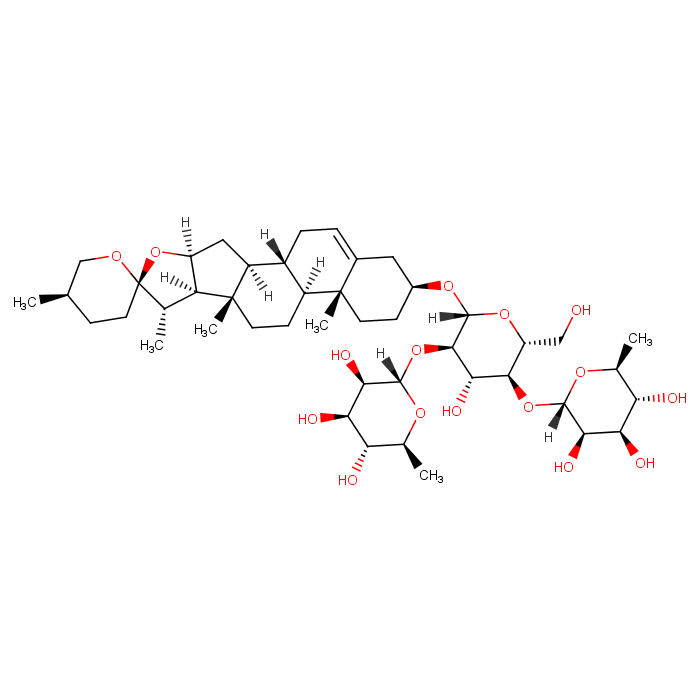
Dioscin is composed of a spiroglycoside consisting of three sugars, α-L-rha-(1->4)-[α-L-rha-(1->2)]-β-D-glc, linked to the third position of the diosgenin glycoside core by a glycosidic bond. It exhibits properties as a metabolite, antifungal agent, antiviral agent, antitumor agent, anti-inflammatory agent, hepatoprotective agent, apoptosis inducer, and tyrosinase (EC) inhibitor. It is a spirostan glycoside, a spiroketal, a hexacyclic triterpene, and a trisaccharide derivative, functionally related to diosgenin. It is derived from a hydrogenation of a saponin.
The structural formula of dioscin is shown in the figure below. As depicted, dioscin contains active hydroxyl groups, providing favorable conditions for binding. Multiple hydroxyl groups and double bonds can participate in hydrogen bonding, dipole-dipole interactions, and π-π interactions. With a sufficiently large structure, it can shield the acidic Si-OH residues' effects on the stationary phase, improving the separation process. The planar rigid structure of dioscin can also enhance stereo selectivity by providing a larger contact surface for solute molecules.
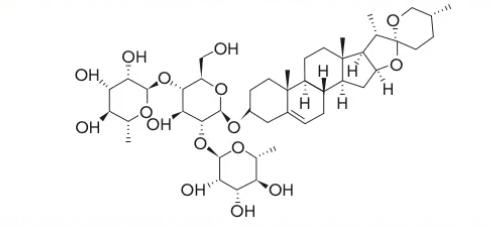
Dioscin is a spirostan glycoside. This means it consists of two main components:
Steroidal nucleus, a steroid molecule with a characteristic four-ring structure.
Glycoside chain, a sugar chain attached to the steroid nucleus.
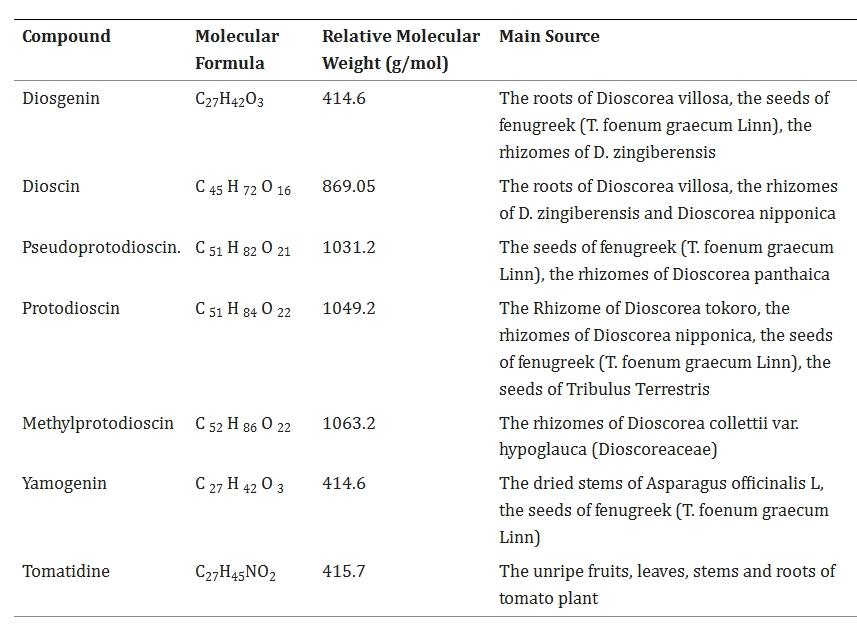
The molecular formula of dioscin is C45H72O16. This formula specifies the exact number of each element (carbon, hydrogen, and oxygen) comprising a dioscin molecule.
This rigid structure forms the basis of the molecule. It consists of four fused carbon rings and exhibits hydrophobic (water-repelling) characteristics. This property allows dioscin to interact with cell membranes, which are also composed of hydrophobic molecules.
Dioscin possesses several hydroxyl groups dispersed within its structure. These groups can participate in hydrogen bonding, a weak interaction that allows dioscin to interact with other molecules.
Various methods have been developed to produce dioscin, with the most direct and effective method being obtained from diosgenin via a five-step process. The synthesis begins with the glycosylation reaction between a tmsotf-catalyzed diosgenin and a phenyl trifluoroethyl-protected amino glucose donor. The reaction yields the corresponding 3-O-β-glucoside with a 92% yield. Subsequently, sequential removal of the phenyl acetyl group and selective 3',6'-OPiv protection yields the 2',4'-diol acceptor with a 60% yield. Coupling of the acceptor 71 with the acetylated l-rhamnopyranosyl n-phenyl trifluoroethylacetate (72) produces the desired monodeoxytrisaccharide derivative with a 66% yield, whose overall deprotection yields dioscin (67).

Dioscin, a typical saponin, is widely found in the Dioscoreaceae, Liliaceae, Caryophyllaceae, and Rosaceae families, especially in the Dioscoreaceae family, including species like Japanese yam (Discorea nipponica Makino), Dioscorea zingiberensis C. H. Wright, and Dioscorea panthaica Prain et Burkill. It is a natural steroid saponin with a rich history of use in various traditional healing systems, particularly Traditional Chinese Medicine (TCM). According to TCM, dioscin is believed to have expectorant properties, muscle-relaxing effects, stimulate blood circulation, aid digestion, and promote diuresis. Let's delve into its effects and explore its historical applications.
In TCM, dioscin is present in plants such as yam (Dioscorea) and Japanese fairy bells (Gastrodia elata). TCM literature mentions its uses:
(1) Respiratory Issues: Herbal remedies containing dioscin glycosides are used to treat coughs, asthma, and bronchitis because of their expectorant properties, believed to help clear phlegm from the lungs.
(2) Musculoskeletal Issues: It is believed to relax muscles, promote blood circulation, and may help alleviate pain associated with conditions like arthritis.
(3) Other Uses: TCM may also employ dioscin glycosides for their diuretic (increasing urination) and blood circulation-promoting properties.
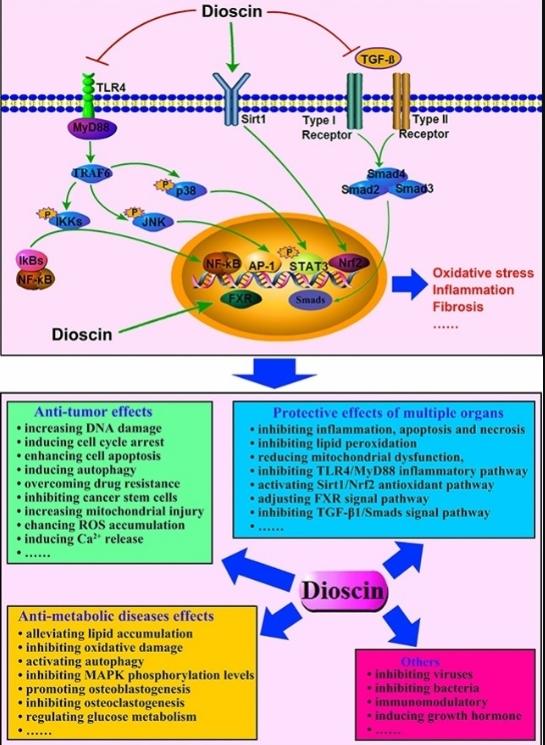
In recent years, with advancements in scientific technology, new extraction and isolation techniques have been applied to the study of dioscin, revealing increasingly diverse pharmacological effects. Modern pharmacological research confirms that dioscin has desensitizing, anti-inflammatory, lipid-lowering, anti-tumor, hepatoprotective, and antiviral effects. After oral administration, dioscin metabolizes into diosgenin, the active ingredient, which is an important raw material for synthesizing steroid hormone drugs. Therefore, research on dioscin is both valuable and promising.
Modern science is delving into the reasons behind dioscin's historical uses. Studies indicate it has broad pharmacological activities, including:
(1) Anti-cancer Properties: Dioscin has been shown to induce cancer cell death and inhibit proliferation.
(2) Anti-inflammatory and Antioxidant Effects: Dioscin has the potential to reduce inflammation and combat free radical damage, showing promise in the treatment of diseases like arthritis and cardiovascular conditions.
(3) Neuroprotective Potential: Recent research has found dioscin to have neuroprotective abilities, potentially aiding in the treatment of neurodegenerative diseases like Alzheimer's.
(4) Other Potential Benefits: Research is investigating the effects of diosgenin on diabetes, cholesterol levels, and even bone health.
Compared to synthetic drugs, diosgenin has several potential advantages:
(1) Natural Source: Diosgenin extracted from plants may be more readily tolerated by the human body, potentially resulting in fewer side effects.
(2) Multi-target Properties: Diosgenin may impact multiple biological pathways, providing a broader range of therapeutic benefits.
Most research on diosgenin is still in the preclinical stage. For example, most studies on diosgenin's effects on insulin are conducted in animal models or cell cultures. Some clinical studies involve human subjects, but their results are not yet conclusive. Further investigation is needed to elucidate the exact mechanisms of action, therapeutic potential, and clinical applications.
Dioscin is supplied as a crystalline solid. It can be dissolved in selected solvents to prepare stock solutions. Dioscin is soluble in organic solvents such as ethanol, dimethyl sulfoxide (DMSO), and dimethylformamide (DMF), under inert gas purging. The solubility of dioscin in these solvents is approximately 10 mg/ml, 20 mg/ml, and 5 mg/ml, respectively. Dioscin is sparingly soluble in aqueous buffer solutions. To achieve maximum solubility in aqueous buffer solutions, dioscin should first be dissolved in DMSO and then diluted with the chosen aqueous buffer. Using this method, dioscin's solubility in a 1:2 DMSO:PBS (pH 7.2) solution is approximately 0.3 mg/ml. It is not recommended to store aqueous solutions for more than a day.
This article provides a comprehensive introduction and analysis of dioscin's definition, importance, and potential health benefits. Dioscin, as an important natural product, demonstrates its unique value and potential in both traditional medicine and modern research. Its diverse health benefits include antioxidant, anti-inflammatory, antimicrobial effects, bringing positive impacts on human health. Therefore, we encourage readers to explore dioscin supplements or products actively to reap potential health benefits.
[1] https://pubchem.ncbi.nlm.nih.gov/compound/119245
[2] Gu X, Sun K, Han Y, et al. Evaluating Two Dioscin-Based Silica Stationary Phases and their Application to Achiral and Chiral Separations[J]. 2021.
[3] https://www.sciencedirect.com/topics/chemistry/dioscin
[4] Yang Y, Laval S, Yu B. Chemical synthesis of saponins[J]. Advances in carbohydrate chemistry and biochemistry, 2014, 71: 137-226.
[5] Xu L N, Wei Y L, Peng J Y. Advances in study of dioscin--a natural product[J]. Zhongguo Zhong yao za zhi= Zhongguo zhongyao zazhi= China journal of Chinese materia medica, 2015, 40(1): 36-41.
[6] https://cdn.caymanchem.com/cdn/insert/11834.pdf
 |
 |
|


 3YRS
3YRS

