-
We detected your language preference as English. Would you like to switch to the English version for a better experience?
Switch to English
Stay here


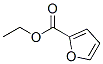
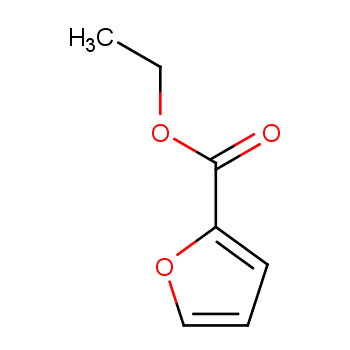
Synthesis of ethyl 2-furoate is a challenging and significant chemical synthesis task. Selecting appropriate catalysts and reaction conditions is crucial during the synthesis process.
Overview: Furoate compounds are unique flavor substances discovered in the 1980s. Ethyl 2-furoate is known for its banana aroma, mainly found in coffee, peanuts, grapes, and pork liver. It can be used in food flavoring, daily-use flavoring, and tobacco flavoring. Although furoate flavorings have been developed in countries like the United States and Japan, they have not yet been produced in China. Given that China is a large agricultural country with abundant furfural raw material sources, it is significant to use furfural to prepare furoic acid and further synthesize ethyl 2-furoate. Research and development in this field are expected to bring new opportunities and challenges to China's flavor industry.
Recent literature reports indicate that concentrated sulfuric acid has been used as a catalyst to synthesize ethyl 2-furoate. However, the use of concentrated sulfuric acid leads to issues such as equipment corrosion, environmental pollution, and multiple side reactions, resulting in decreased product purity. To address this issue, researchers have attempted to use SnCl4·5H2O as a catalyst to synthesize ethyl 2-furoate. In recent years, solid superacids have become a hotspot in catalyst research due to their extremely high acidity. Furthermore, solid superacids are easy to separate, recycle, non-polluting, and non-corrosive, making them promising for application in synthetic reactions.
Wang Xuesong and colleagues synthesized ethyl 2-furoate using self-made furoic acid and ethanol, with SO4^2-/TiO2 solid superacid as the catalyst. They investigated the reaction temperature, reaction time, catalyst amount, and the molar ratio of the acid to ethanol. The results showed that the optimal reaction conditions were a molar ratio of acid to ethanol of 1:4, catalyst amount of 1.5g (when the amount of furoic acid is 0.05mol), reaction time of 6-7 hours, and reaction temperature of 60℃. The specific steps are as follows:
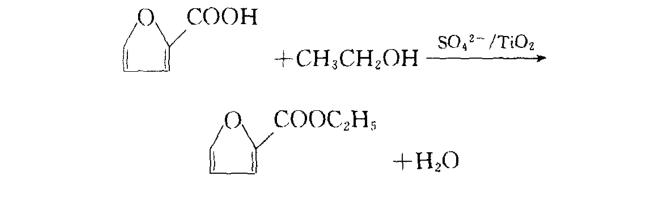
In a 100 mL three-necked flask equipped with a reflux condenser, thermometer, and electric stirrer, add 11.2 g (about 0.1 mol) of furoic acid, a predetermined ratio of ethanol, 20 mL of benzene, a quantitative amount of self-made SO4^2-/TiO2 solid superacid catalyst, and an appropriate amount of zeolite. Heat under reflux to promote the reaction. After the reaction, transfer the mixture to 100 mL of water and extract four times with 30 mL of ether each time. Combine the ether layers, wash them with saturated NaCl solution, dry with anhydrous MgSO4, and filter. Distill under atmospheric pressure to recover ether, and cool the remaining solution to precipitate light yellow crystals. Recrystallize the crude product from 95% ethanol solution to obtain white crystals.
[1] Wang Xuesong, Zhang Guohua, Wang Huan. Study on the Synthesis of Ethyl 2-furoate Catalyzed by SO4^2-/TiO2 Solid Superacid [J]. Journal of Huaihai Institute of Technology (Natural Science Edition), 2003, (03): 45-47.
|
 EN
EN
 Agricultural News
 Food News
 Industrial News
 Cosmetic News
 Pharmaceutical News
 Science News

 3YRS
3YRS