-
We detected your language preference as English. Would you like to switch to the English version for a better experience?
Switch to English
Stay here


Musk T, as a vital synthetic fragrance, holds a pivotal position in the fragrance industry's production processes. With technological advancements, the ethylene brassylate synthesis methods for Musk T continue to innovate and improve to enhance yield and quality. This article explores various synthetic methods of Musk T, analyzing their respective advantages, disadvantages, and prospects in practical applications. Through a deep understanding of these methods, more scientific and sustainable solutions can be provided for Musk T production.
Musk T is an advanced fixative with non-toxic, pure aroma, and long-lasting fragrance characteristics. It exhibits excellent rounding and fixing effects in fragrance blending, making it suitable for various high-end perfumes, shampoos, premium soaps, and other products. Domestic applications of Kunlun musk (Musk T) started early but were limited by outdated production techniques, resulting in low yield, unstable quality, and high costs. In recent years, the development of technology for fermentative ethylene brassylate synthesis of high-carbon diacids from petroleum products has provided ample raw materials for Musk T production in China. Simultaneously, with the rapid development of society, economy, culture, and technology, people gradually realize the ecological and human hazards of nitro compounds, gradually reducing and eliminating their use, creating new broad prospects for the development of Musk T.
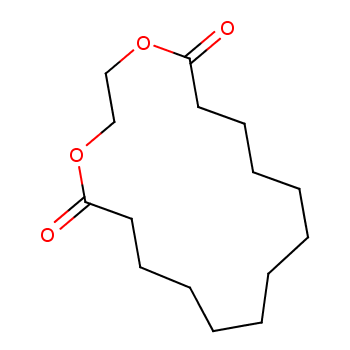
Musk T, also known as Kunlun musk domestically, with the chemical name dodecanoic acid, ethylene ester, also called Ethylene Brassylate, CAS number 105-95-3, is a colorless or slightly yellow viscous liquid.
(1) Castor oil is used as the starting material, cracked to produce dodecanoic acid, which is then polymerized and depolymerized to form the musk. This method was adopted by Jiangsu Jingjiang Solvent Plant and Tianjin Perfume Plant before the 1980s, producing Musk T products in small batches for the domestic market. However, the yield was low, the source of raw materials was insufficient, the cost was high, and the production volume was small.
(2) Chemical synthesis of dodecanoic acid, followed by polymerization and depolymerization to form Musk T. In recent years, Germans have used this method to produce Musk T, which was once competitive in price. However, since the biofermentation synthesis of dodecanoic acid has significantly reduced the production cost of raw materials, this method has gradually lost its cost advantage.
(3) Petroleum normal alkane is used as the starting material, and dodecanoic acid is obtained by biofermentation. It is then polymerized, depolymerized, and closed-looped. Compared with the first two methods, this method has no competitiveness in terms of cost and quality. Therefore, manufacturers at home and abroad mainly use this technological route.
(1) Separate polymerization reactor and depolymerization reactor; without stirring; batch distillation; vacuum filtration for decolorization. Originally Tianjin Perfume Factory, Jiangsu Jingjiang Solvent Plant.
(2) Separate polymerization reactor and depolymerization reactor; with scraping anchor stirring; batch distillation; vacuum filtration for decolorization. Institute of Fushun Chemical Industry, Liaoning Beizhen, etc.
(3) The polymerization reactor and the depolymerization reactor are combined into one; with frame stirring; batch distillation; vacuum filtration for decolorization. Shenyang Jixin Biological Products Factory, etc.
(4) Early-stage raw material pretreatment equipment; separate polymerization reactor and depolymerization reactor; solvent extraction tank; with spiral shear stirring; reflux distillation; European-style filtration for decolorization. Shenyang Dongbei Rubber and Plastic Materials Co., Ltd.
The raw materials for preparation are dodecanoic acid (also known as Brazil acid) and ethylene glycol. Dodecanoic acid CAS: 505-25-2, molecular formula C13H24O4, is obtained by the biofermentation of straight-chain alkanes; Ethylene glycol CAS: 107-21-1, molecular formula (CH2OH)2. Musk T is prepared from the raw materials dodecanoic acid and ethylene glycol through a two-step reaction process. The first step is the dehydration condensation of dodecanoic acid and excess ethylene glycol at high temperature to obtain a long-chain polymer with a certain degree of polymerization. The excess ethylene glycol is recovered by vacuum distillation and directly used in the next batch of reactions; the second step is the high-temperature depolymerization and cyclization of the long-chain polymer under the action of a catalyst to obtain the lactone compound of the diacid, namely the product Musk T.
Musk T is a key component of the perfume industry, renowned for its delightful floral and fruity aromas. It is used in perfumes, cosmetics, and household products.
Musk T is being explored for its potential effects on various biological processes. Studies suggest it may have antibacterial activity against specific bacteria and fungi. However, further research is needed to confirm these findings and understand their potential mechanisms.
Musk T has been studied for its potential roles in regulating cell signaling pathways and influencing gene expression. These preliminary findings suggest potential applications in cancer research and drug discovery, but further research is crucial.
The oral LD50 of Musk T is greater than 5.0 g/kg body weight. Ten rats were dosed at 5.0 g/kg body weight and observed for 14 days. One fatality occurred. Clinical symptoms included mild drowsiness (RIFM, 1973a).
The dermal LD50 of Musk T is greater than 5.0 g/kg body weight. Ten rabbits were dosed at 5.0 g/kg body weight and observed for 14 days. No fatalities or clinical symptoms occurred (RIFM, 1973a).
When applied once to human volunteers at a concentration of 10%, Musk T did not cause skin irritation. Fifty individuals (38 females, 12 males) with a history of allergic rhinitis, allergic asthma, contact allergy, or allergic eczema were tested. Musk T was applied to the backs of the volunteers under occlusive patches in a 50 mL ethanol/diethyl phthalate (1:1, v:v) vehicle. Forty-eight hours after patch removal, assessments were made at 48, 72, and 96 hours. A 0.3% sodium dodecyl sulfate solution served as a positive control.
In a study specifically designed to evaluate skin irritation, applying 10% Musk T in vaseline to the "Torii test patches" on the upper arms of 30 healthy volunteers did not induce irritation (RIFM, 1984). During pretests of maximal study on five male volunteers, applying 30% concentration in vaseline as a 48-hour occlusive patch did not irritate the skin (RIFM, 1973b).
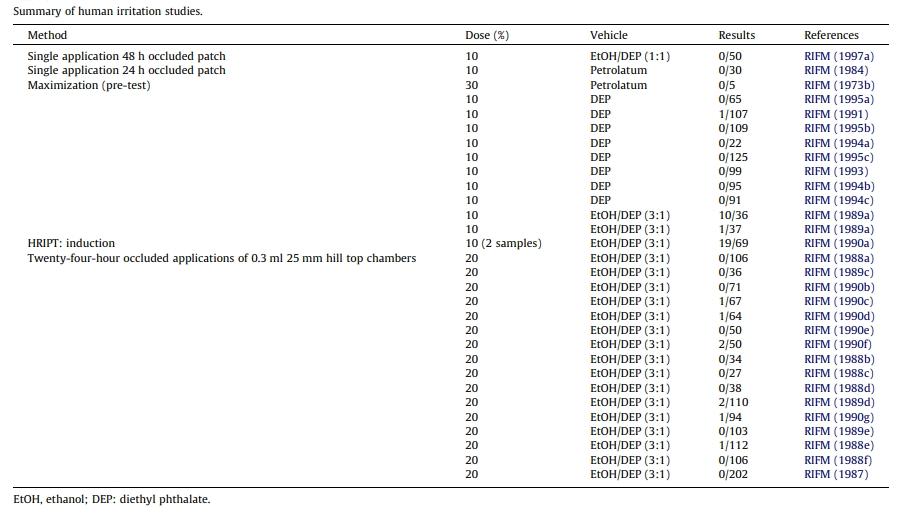
The Human Repeat Insult Patch Test (HRIPT) studies have identified the use of 10% or 20% Musk T in DEP or EtOH:DEP. As part of the HRIPT, irritation was assessed. During the induction phase, ethylene brassylate was applied to occlusive absorbent patches and left on the upper arms or backs of each volunteer for 24 or 48 hours. These induction applications were applied at the same site a total of 9 or 10 times over a period of 3 weeks. Mild-to-moderate irritation was reported during the induction phase, with occasional reports of mild irritation during the challenge phase. Results are summarized in the table below.
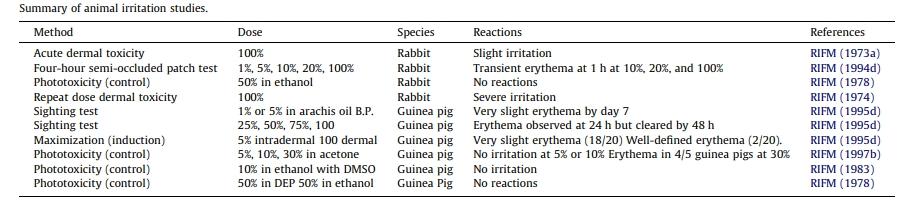
In acute dermal toxicity studies in rabbits, the skin irritation potential of Musk T was evaluated. Ten rabbits were injected with Musk T at 5.0 g/kg body weight. Observations included mild redness (5/10), moderate redness (3/10), mild edema (1/10), and moderate edema (1/10) (RIFM, 1973a).
There are diverse synthesis methods for Musk T. With continuous technological advancements, these ethylene brassylate synthesis methods are continually optimized, enhancing yield and quality while reducing production costs and environmental impacts. In the future, with the introduction of new technologies and further improvements in processes, ethylene brassylate synthesis will become more efficient and sustainable, meeting the growing market demand. By comprehensively applying these methods, the production of Musk T will usher in broader prospects for development.
[1] Shao, Y. Research and industrial practice of Musk T synthesis. Liaoning Chemical Industry, 2001, (06): 252-254.
[2] Jiangxi Huangyan Fragrance Co., Ltd. A method for utilizing polymers generated during the synthesis of Musk T. April 2, 2024.
[3]https://echa.europa.eu/view-article/-/journal_content/title/9109026-293
[4]https://pubmed.ncbi.nlm.nih.gov/12809710/
[5]McGinty D, Letizia C S, Api A M. Fragrance material review on ethylene brassylate[J]. Food and chemical toxicology, 2011, 49: S174-S182.
|
 |
 |
 EN
EN
 Agricultural News
 Food News
 Industrial News
 Cosmetic News
 Pharmaceutical News
 Science News


 13YRS
13YRS