-
We detected your language preference as English. Would you like to switch to the English version for a better experience?
Switch to English
Stay here


Sodium acetate trihydrate, also known as "sodium acetate trihydrate," is an important chemical raw material with extensive applications and significance. It is primarily used as a melting agent, coagulant, and anticaking agent, able to stabilize pH and regulate acidity and alkalinity. Sodium acetate trihydrate also has numerous functions and uses. In the chemical field, it is used to prepare and formulate buffer solutions and as a preservative and acid cleaner. Its role helps food maintain specific pH values and prevents the growth of harmful bacteria. In the pharmaceutical field, it is an important pharmaceutical excipient, widely used in oral care and detergent production. Additionally, in oral health, sodium acetate trihydrate effectively prevents tooth decay, cleanses the mouth, removes stains, and disinfects. It also finds wide applications in fireworks production, food additives, and more.
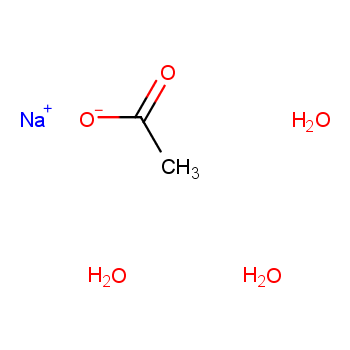
Sodium acetate trihydrate, often abbreviated as SAT, is a crystalline compound with the chemical formula CH3COONa·3H2O. It is formed by the combination of sodium acetate molecules and three water molecules, hence termed as "trihydrate."
Sodium acetate trihydrate consists of sodium ions (Na+), acetate ions (CH3COO-), and water molecules (H2O). Sodium ions act as cations, while acetate ions act as anions, forming a stable ionic compound.
Sodium acetate trihydrate finds widespread applications in various industries, including pharmaceuticals as a buffering agent, food additives, heat packs, and a key component in making hot ice demonstrations. Its unique properties make it a valuable substance for scientific experiments and practical applications.
Currently, the technology routes for the production of sodium acetate trihydrate (SAT) used domestically and internationally are classified into two categories based on the alkali raw materials used: one is using sodium hydroxide as the raw material, and the other is using sodium carbonate. According to the different types of acetic acid used, it is classified into pure acetic acid and recycled dilute acetic acid. The production process of sodium acetate trihydrate (SAT) involves several complex steps to ensure the production of high-quality crystals. Below, we will delve into the intricate procedures required for synthesizing SAT on an industrial scale:

Acetic Acid: Acetic acid is the key precursor for SAT production. Sodium Hydroxide (NaOH): Sodium hydroxide, also known as caustic soda, is another important raw material.
Acetic acid is carefully mixed with sodium hydroxide in a controlled environment to produce sodium acetate and water. The reaction is closely monitored to ensure proper stoichiometry and pH levels.
The sodium acetate solution obtained from the neutralization reaction is then subjected to crystallization. Crystallization can be induced through various methods such as cooling, evaporation, or seeding, depending on the specific manufacturing setup. Controlling parameters including temperature, pressure, and agitation are crucial for promoting the formation of high-quality SAT crystals.
After crystallization, the resulting sodium acetate crystals are separated from the mother liquor. Separation techniques may include filtration, centrifugation, or decantation to separate solid SAT crystals from the liquid phase. The separated crystals undergo washing and drying processes to remove impurities and excess moisture, ensuring the purity and stability of the product.
The purified sodium acetate trihydrate crystals are then packaged into appropriate containers such as bags or barrels and distributed to end-users. Proper labeling and documentation are necessary to comply with regulatory standards and ensure safe handling during transportation and storage.
Making sodium acetate trihydrate (SAT) at home is an interesting experiment that can be accomplished using readily available household items. Here's a detailed guide outlining the step-by-step process:
Pour measured white vinegar into the heat-resistant container. The exact amount will depend on the quantity of SAT needed.
Gradually add baking soda to the vinegar while stirring continuously. The reaction between vinegar and baking soda will produce sodium acetate solution, water, and carbon dioxide gas. Stir until no more bubbles form.
Place the container with the sodium acetate solution on the stove or hot plate. Heat the solution gently over low to medium heat to allow water to evaporate slowly. Stir the solution occasionally to prevent uneven evaporation.
Continue heating until close to the boiling temperature but avoid vigorous boiling. Once most of the water has evaporated, remove the container from heat and let it cool slightly. As the solution cools, sodium acetate trihydrate crystals will start to form. Nucleation or seed crystals formation may be observed.
Once the solution cools to room temperature, filter the mixture using filter paper or coffee filter to separate the crystals from the remaining liquid. Transfer the filtered crystals onto a clean surface and let them air dry completely. Avoid exposure to moisture during the drying process.
After drying, store the SAT crystals in a sealed container to prevent them from absorbing moisture from the surrounding environment. Label the container with the production date and proper operating instructions.
By following these simple steps, you can successfully prepare sodium acetate trihydrate at home.
This article will introduce the method of producing sodium acetate trihydrate using acetic acid from the oxidation residue of terephthalic acid, with the specific steps as follows:
The mother liquor containing cobalt and manganese recovered from the PTA oxidation residue recovery workshop is fed into the distillation kettle and distilled under stirring and reduced pressure to distill acetic acid. The stirring speed is 60 rpm to 80 rpm, the vacuum degree is -0.04 to -0.09 Mpa, and the kettle temperature is 60 to 85°C. The purpose of this step is that the dilute acetic acid used as raw material for the synthesis of SAT is recovered from the oxidation residue of PTA, which contains a large amount of benzoic acid. If sodium acetate trihydrate is directly synthesized, the product will contain benzoic acid sodium impurities, affecting the purity of the product. Therefore, the purification of dilute acetic acid becomes a prerequisite for the entire process of synthesizing sodium acetate. In this separation process, a very important key technology is to start from the purification of dilute acetic acid, that is, to separate the PTA oxidation residue into insoluble organic acids. After that, under high vacuum (-0.085Mpa or more), that is, under the condition that the kettle temperature does not exceed 65°C, to avoid the sublimation of benzoic acid. In addition, using the low solubility of benzoic acid in dilute acetic acid, the obtained dilute acetic acid is reduced to room temperature for further separation, thus obtaining high-purity dilute acetic acid.
The purified dilute acetic acid is fed into the reaction kettle and slowly neutralized with alkali under stirring and water cooling. The stirring speed is 60 rpm to 80 rpm, the reaction temperature is 60 to 70°C, and the endpoint pH is controlled to be 9.5 to 11.5. After the alkali is added, keep warm for 1 to 1.5 hours. The purpose of this step is that the reaction between acetic acid and alkali is an acid-base neutralization reaction, accompanied by a large amount of heat generation, resulting in temperature rise. The higher the temperature, the more intense the reaction. Controlling the reaction temperature too low is not conducive to the progress of the reaction, resulting in incomplete reaction within a certain period of time, a small amount of acetic acid is evaporated during the distillation process, and the COD value of the distillate is increased. In addition, sodium acetate is a strong base and weak acid, with high-temperature hydrolysis and ionization characteristics. Therefore, too high a reaction temperature will promote the hydrolysis and ionization of sodium acetate, resulting in an increase in the COD value of the distillate. Among the reaction temperatures of 60-70°C, the reaction temperature of 60-70°C is more suitable for the progress of the reaction, and the COD value of the distillate is also lower. From the perspective of product purity, the product synthesized at a reaction temperature of 60-70°C also has a higher purity. Considering the above analysis and the principle of minimum energy consumption, the reaction temperature is controlled between 60-70°C.
The sodium acetate reaction solution after neutralization is fed into the distillation kettle and heated to evaporate under stirring and reduced pressure. The stirring speed is 60 rpm to 80 rpm, the vacuum degree is -0.05 to -0.08 Mpa, the kettle temperature is 65 to 80°C, and when the acetic acid concentration reaches 80%, measure the pH value of the solution. When the pH value exceeds 9, acidify the sodium acetate reaction solution until the final pH value is 7.5 to 9.
Cool the evaporated and concentrated reaction solution to 70-80°C, then pour it into a filter for filtration. The filtrate enters the reaction kettle, and the filter cake is sodium benzoate. The purpose of this step is that the concentrated reaction solution after vacuum concentration contains trace amounts of sodium benzoate impurities, so in a single crystallization and impurity removal process, the principle of the difference in solubility between sodium acetate trihydrate and sodium benzoate at a certain temperature and their differences in crystallization is effectively utilized to separate them, that is, when the reaction solution is concentrated to a concentration of 80-85%, and the temperature is 70-80°C, the impurity benzoic acid gradually precipitates, while sodium acetate cannot precipitate due to its high solubility without the addition of seed crystals. In this case, hot filtration is performed. If the filtration temperature is too low, the supersaturation concentration of sodium acetate is too high, the solution state is very unstable, a slight vibration or friction will induce crystallization, the filtered sodium benzoate contains a large amount of sodium acetate, resulting in separation failure. Therefore, in the impurity removal process, the super-saturation concentration of the solution and the filtration temperature are the key conditions for the effective separation of sodium acetate and sodium benzoate.
Stir and cool the filtered reaction kettle to a temperature of 53-57°C, add 1% of the theoretical amount of sodium acetate to the filtrate as a crystallization inducer, and control the cooling time to 4-5 hours. After cooling to room temperature, pour it into a filter until dry. After drying, the mother liquor is returned to the distillation kettle for reuse, and the filter cake is wet sodium acetate trihydrate.
Put the wet sodium acetate trihydrate into a vacuum dryer for vacuum drying. The vacuum degree is -0.085 to -0.09 Mpa, and the temperature is 35 to 40°C. When drying to a constant, the product is obtained.
Sodium acetate trihydrate (SAT) possesses remarkable transformative abilities, capable of turning into hot ice, which can be used to create captivating demonstrations. Below, we'll explore the process of producing hot ice using SAT:
Begin by dissolving sodium acetate trihydrate crystals in distilled water to form a saturated solution. Ensure the solution is heated to slightly below its boiling point to maximize solubility.
Introduce a nucleating agent into the hot sodium acetate solution to trigger crystallization. This can be achieved by adding a small SAT crystal, a seed crystal, or carefully scratching the surface of the container.
As the solution cools, sodium acetate molecules begin to reassemble into a solid crystalline structure. This process releases latent heat, causing the solution to rapidly solidify into a mass of transparent crystalline substance.
The crystallization of sodium acetate trihydrate is an exothermic process, meaning it releases heat energy. When hot ice forms, it generates a noticeable temperature increase, hence its name.
Once formed, hot ice can be shaped into various forms and structures using tools or molds. Its malleability allows for creative experimentation and artistic expression.
Sodium acetate trihydrate is a chemical compound that readily dissolves in water but is also prone to deliquescence, requiring sealed and dry storage. Protective measures should be taken when storing and transferring sodium acetate trihydrate, such as using sealed containers or packaging materials to prevent exposure to air and subsequent deliquescence. When handling, appropriate protective gear such as gloves and safety goggles should be worn to avoid direct contact with the chemical substance.
Sodium acetate trihydrate is also a flammable and explosive substance, requiring strict adherence to relevant safety regulations during storage and transportation. For instance, it should not be stored or transported with flammable or explosive materials, and storage areas should be kept dry, well-ventilated, and away from ignition sources and flammable materials, with precautions taken against static electricity.
Sodium acetate trihydrate can be easily made at home using vinegar (acetic acid) and baking soda (sodium bicarbonate). Simply mix vinegar and baking soda to initiate a neutralization reaction, then evaporate the solution to allow crystals to form.
To make hot ice, first prepare a saturated solution of sodium acetate trihydrate in distilled water. Heat the solution close to its boiling point, then introduce a nucleating agent to initiate crystallization. As the solution cools, it solidifies into hot ice, releasing heat in the process.
While hot ice is primarily known for its visual appeal and educational value, it also has practical applications. It can be used as hand warmers, reusable heat packs, and even in certain chemical reactions where controlled heat release is needed.
Sodium acetate trihydrate and hot ice are generally safe to handle. However, caution should be exercised when working with hot liquids and sharp objects during preparation and handling. Ensure proper ventilation and use heat-resistant containers to prevent burns or injuries.
Sodium acetate trihydrate is a versatile chemical compound. From household laundry detergents to food additives, and from antibiotic adjuvants in medicine to biomaterials for repair, sodium acetate leaves its mark. Sodium acetate trihydrate opens doors to endless possibilities and creative exploration. From its simple compound origins to its transformative properties in creating hot ice, SAT offers a fascinating journey into the realms of chemistry and art.
Therefore, whether in experimental science or everyday life, sodium acetate trihydrate will continue to be an essential tool for exploring the unknown, harnessing its chemical properties and the magical abilities of its reactions. Let us explore this field with boldness and creativity, unleashing your potential to create more with sodium acetate trihydrate.
[1]CN200810229404.2
[2] Wang Qinzheng. Research on supercooling and cyclic stability of sodium acetate trihydrate [D]. Huazhong University of Science and Technology, 2021.DOI:10.27157/d.cnki.ghzku.2021.001874.
|
 |
 |
 |
 |
 |
 EN
EN
 Agricultural News
 Food News
 Industrial News
 Cosmetic News
 Pharmaceutical News
 Science News

 2YRS
2YRS

