-
We detected your language preference as English. Would you like to switch to the English version for a better experience?
Switch to English
Stay here


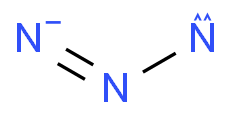
Azide ion (N3-) is a simple anion with a nitrogen atom at the center bonded to two other nitrogen atoms. The chemical formula for the azide ion is N3-. As a highly reactive compound, it is primarily involved in organic synthesis and is a key component in the production of various organic materials.

Polarity refers to the uneven distribution of electrical charge within a molecule or compound. It occurs when electrons are not shared equally between atoms, leading to regions of positive and negative charge. This uneven charge distribution is a result of differences in electronegativity between atoms.
To determine the polarity of the azide ion (N3-), we consider its molecular structure and the electronegativity of its constituent atoms. The azide ion has a Linear geometry, with each nitrogen atom bonded to another nitrogen atom through a Double Bond. Due to the high electronegativity of nitrogen (approximately 3.04 on the Pauling scale), the electron density is pulled towards the nitrogen atoms, creating partial positive charges on the nitrogen atoms connected by the double bonds and a partial negative charge on the nitrogen atom bearing the negative charge. The polarity of the azide ion is further confirmed by its dipole moment. Since the molecule has an uneven distribution of charge and a linear structure with a lone pair of electrons on one nitrogen atom, it possesses a net dipole moment, indicating that the molecule is indeed polar.


Azide ions play a role in medicinal chemistry, particularly in the synthesis of drugs and pharmaceuticals that require azide functionality.
| Azide Ion (N3-) Basic Information | |
| Molecular Formula | N3- |
| Molecular Shape | Linear geometry |
| Electronegativity | Nitrogen: ~3.04 |
| Polarity | Polar due to the uneven distribution of charge and high electronegativity of nitrogen atoms. |
| Reactivity | Highly reactive, participating in various chemical reactions in synthesis and industrial applications. |
| Compound | Polarity | Applications |
| Hydrazine (N2H4) | Polar due to the presence of two nitrogen-hydrogen bonds and a lone pair on each nitrogen atom. | Used in rocket propellants and as a reducing agent in organic synthesis. |
| Trimethylamine (CH3)3N | polar, as the nitrogen atom is surrounded by three identical alkyl groups. | Used as a buffer in biological systems and as a solvent in organic synthesis. |
|
 |
 |
 EN
EN
 Agricultural News
 Food News
 Industrial News
 Cosmetic News
 Pharmaceutical News
 Science News