
What is BBr3?
Boron tribromide, with a chemical formula of BBr3, is a compound known for its significance in organic synthesis and various chemical reactions. It appears as a colorless to pale-yellow fuming liquid with a pungent odor, and it reacts violently with water to release hydrogen bromide gas. This compound is highly reactive and serves as a versatile reagent in organic chemistry, particularly in processes involving bromination, cyclization, and rearrangement reactions.
What is polarity?
Polarity describes the uneven distribution of electrons in a molecule or compound. In the realm of chemistry, polarity refers to the presence of positive and negative poles within a molecule due to differences in electronegativity between atoms. This discrepancy in electron distribution leads to a partial positive charge on one end of the molecule and a partial negative charge on the other.
Electronegativity, a measure of an atom's affinity for electrons, plays a crucial role in determining the polarity of a chemical bond. When atoms with notably different electronegativities form a bond, the shared electron pair tends to be closer to the more electronegative atom, creating a dipole moment and thus polarity in the molecule.
Polar molecules exhibit distinctive behaviors in various chemical and physical contexts, influencing properties like solubility, boiling point, and intermolecular interactions.
Polarity of BBr3
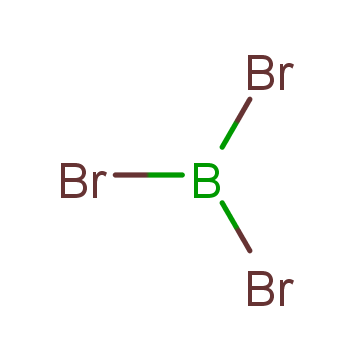
Boron tribromide, despite containing three highly electronegative bromine atoms and one boron atom, is a nonpolar molecule. Why is BBr3 nonpolar?
(1) Dipole Moment
Boron and bromine have notable differences in electronegativity, resulting in polar covalent bonds within the molecule. However, due to the trigonal planar molecular geometry of BBr3, the dipole moments of the three B-Br bonds cancel each other out, leading to a net dipole moment of zero. This symmetry ensures uniform electron density distribution throughout the molecule.
(2) Electronegativity
| Element Electronegativity |
| B |
2.04 |
| Br |
2.96 |
The difference in electronegativity (2.96 - 2.04 = 0.92) indicates a polar bond.
Despite the significant electronegativity difference between boron and bromine, the symmetric arrangement of the three bromine atoms around the boron atom nullifies any resultant dipole moment.

Thus, Boron tribromide, BBr3, is a nonpolar molecule.
Application of BBr3 Polarity
Boron tribromide serves as a crucial reagent in organic synthesis, particularly in the bromination of organic compounds and various rearrangement reactions. Its nonpolar nature facilitates its role as a catalyst or reactant in processes where selectivity and efficiency are paramount. Additionally, BBr3 finds applications in the production of pharmaceuticals, agrochemicals, and materials science due to its ability to induce specific chemical transformations.
Highlight of Boron tribromide
| Boron tribromide Cas 10294-33-4 |
| Molecular formula |
BBr3 |
| Molecular shape |
Trigonal Planar |
| Relative molecular mass |
250.52 g/mol |
| Solubility |
Reacts violently with water, soluble in organic solvents |
| Melting point |
−46.3 °C |
| Boiling point |
91.3 °C |



 EN
EN
 Agricultural News
 Food News
 Industrial News
 Cosmetic News
 Pharmaceutical News
 Science News

 1YR
1YR

