-
We detected your language preference as English. Would you like to switch to the English version for a better experience?
Switch to English
Stay here


Citric acid, as an important organic acid, is not only widely present in nature but also extensively used in food, medicine, chemical, and other fields. Its unique chemical properties give it diverse functions and application prospects. This article primarily explores whether citric acid is ionic or covalent, its physical properties, and its category in chemistry. It aims to inspire readers about the chemical properties of citric acid and help them better understand its characteristics and uses.
Citric acid was discovered by Karls Scheele in lemon juice in 1874. Its production involves the oldest and most extensively researched filamentous fungal fermentation, dating back to 1917 when Currie optimized conditions using surface cultivation methods. Most of its production today is through microbial processes. Submerged fermentation began to be used for citric acid production. Shu and Johnson identified many parameters crucial to the productivity of submerged citric acid fermentation processes.
Citric acid has GRAS (generally recognized as safe) properties and is widely used in food as a pH regulator and flavor enhancer, accounting for 70% of its applications, as well as other uses such as in pharmaceuticals and cosmetics, accounting for the remaining 30%, for acidification and chelation of metal ions. Key parameters for the production of citric acid by Aspergillus niger have been defined empirically, including high carbohydrate concentrations, low but finite manganese concentrations, maintaining high dissolved oxygen, constant agitation, and low pH. Understanding these physical and chemical conditions is essential for the adoption and maintenance of granular morphology, which is crucial for citric acid production. Knowledge of these factors has made it possible to develop highly efficient submerged fermentation for citric acid production.
Citric acid is a covalent molecule and a covalent acid. This is because when atoms share electrons to achieve stable outer shell configurations, covalent compounds are formed. In citric acid, atoms (carbon, hydrogen, and oxygen) are connected by covalent bonds, sharing electrons. It's important to note that citric acid can act as a weak acid, meaning it can provide protons (H+) in water within a limited range. However, the dissociation process does not involve complete electron transfer, and the molecule itself maintains covalent bonds.

Citric acid is a weak organic acid naturally present in citrus fruits. Here are some of its main physical properties:
Citric acid exists in two forms: anhydrous and monohydrate (each molecule of citric acid contains one molecule of water). The anhydrous form is more common, with slightly higher melting point and density than the monohydrate form.
In the field of chemistry, citric acid can be divided into two categories:
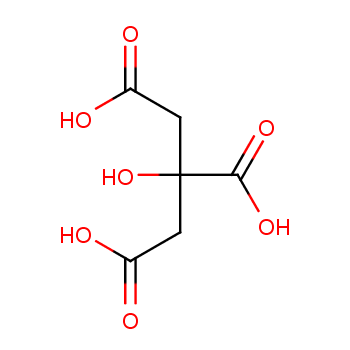
Citric acid belongs to a class of organic compounds called carboxylic acids. These organic acids contain a carboxyl group (COOH), which gives them acidity. Citric acid is a tricarboxylic acid because it has three carboxyl groups. It is propane-1,2,3-tricarboxylic acid, with a hydroxy substituent at position 2.
More generally, citric acid is also just an organic acid. Organic acids are organic compounds that can provide hydrogen ions (H+) in water, making them acidic. Citric acid is a weak organic acid, which means it only partially dissociates in water to release H+ ions.
Citric acid itself is not ionic. It is a weak organic acid naturally present in citrus fruits. Ions are atoms or molecules that gain or lose electrons, thus carrying a charge. While citric acid can provide hydrogen ions (H+) in solution, the remaining molecules (citrate ions) are ions, not the entire citric acid molecule itself. Citric acid is considered a triprotic acid because it can provide three H+ ions. Depending on the number of H+ ions lost, citric acid can form different citrate ions.
Yes, citric acid is a molecular compound. Here's a deeper look into its molecular nature:
When two or more atoms of different elements share electrons, molecular compounds are formed. In citric acid, there are carbon (C), hydrogen (H), and oxygen (O) atoms. These atoms share electrons to achieve stable outer shell configurations, following the octet rule.
The electron sharing in citric acid involves covalent bonds. Covalent bonds are formed when two atoms share one or more pairs of electrons. In the citric acid molecule, carbon atoms form covalent bonds with hydrogen and oxygen atoms.
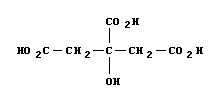
Citric acid's structure can be represented by the chemical formula HOC(COOH)(CH2COOH)2. This formula shows the arrangement of atoms and the bonds between them. The structure of citric acid is complex, with a central carbon atom attached to a hydroxyl group (OH), a carboxyl group (COOH), and two additional carboxyl groups linked by a methylene bridge (CH2).
No, citric acid itself is not a covalent bond. It is a molecule containing covalent bonds. Covalent bonds can be thought of as individual connections between two atoms. Citric acid is a larger structure, with many covalent bonds linking different atoms together.
By gaining a deeper understanding of citric acid's acidity, chelating ability, buffering capacity, and reducibility, we can better develop and utilize citric acid to create greater value for human society. In future research and applications, we can fully utilize the properties of citric acid to drive the development and innovation of related fields, making greater contributions to society and human health. Let's work together to continue exploring the chemical properties of citric acid, providing more insights and possibilities for scientific research and practice.
[1] https://en.wikipedia.org/wiki/Citric_acid
[2]https://www.researchgate.net/publication/379051516_Citric_acid_cross-linked_biopolymeric_nanofibers_containing_Zataria_multiflora_extract_an_environmentally_friendly_active_food_packaging_system
[3] https://www.sciencedirect.com/topics/agricultural-and-biological-sciences/citric-acid
 |
 |
 |
 |
 |
 |
 EN
EN
 Agricultural News
 Food News
 Industrial News
 Cosmetic News
 Pharmaceutical News
 Science News

 1YR
1YR

