
What is HClO?
Hypochlorous acid, with a chemical formula of HClO, is a weak acid that exists as a pale, yellowish solution. It is commonly found in nature as a component of bleach, and it plays a crucial role in the human immune system as a potent antimicrobial agent. Hypochlorous acid is formed when chlorine gas dissolves in water, and it is also produced by white blood cells, particularly neutrophils, as a part of the immune response to infection. This compound is highly reactive and exhibits strong oxidizing properties, making it effective in killing bacteria, viruses, and other pathogens. Polarity is one of the important nature of molecules. Understanding the polarity of HClO is crucial in comprehending its behavior in various chemical reactions. So do you know the polarity of HCLO? Is HClO polar or nonpolar?
What is Polarity?
Polarity describes the distribution of electrical charge within a molecule or compound. In chemistry, polarity refers to the separation of electric charge along a molecule's chemical bonds, resulting in regions with partial positive and negative charges. This phenomenon arises due to differences in electronegativity between the atoms involved in the chemical bonds.
Electronegativity, a property of atoms, indicates their ability to attract electrons. When atoms with different electronegativities form a chemical bond, the shared electrons are more attracted to the atom with higher electronegativity, leading to an uneven distribution of charge within the molecule. The greater the difference in electronegativity between atoms, the more polar the bond.
Molecules with polar bonds may exhibit unique physical and chemical properties, including solubility, melting point, and boiling point, due to the interactions between their polarized molecules. What about HCLO? Is HClO polar or nonpolar?
Polarity of HClO
Is HClO polar or nonpolar? Hypochlorous acid, despite containing highly electronegative chlorine, exhibits a nonpolar nature due to its molecular structure. Why is HClO nonpolar?
(1) Dipole Moment
Chlorine, being highly electronegative, attracts electrons more strongly, inducing a partial negative charge on the oxygen atom in hypochlorous acid. However, the molecule's overall structure is relatively symmetrical, with the oxygen atom at the center and the hydrogen and chlorine atoms on either side, resulting in the dipole moments canceling each other out. Consequently, hypochlorous acid lacks a significant net dipole moment.
(2) Electronegativity
| Element Electronegativity |
| Cl |
3.16 |
| O |
3.44 |
| H |
2.20 |
The difference in electronegativity (3.16 - 3.44 = 0.28) between chlorine and oxygen is not sufficient to confer significant polarity to the molecule.

Electron Cloud Model of HClO

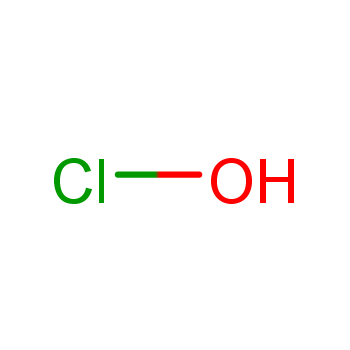
Molecule Structure of HClO
Therefore,
hypochlorous acid, HClO, is a nonpolar molecule.
Applications of HClO Polarity
Hypochlorous acid is utilized in various applications due to its potent antimicrobial properties.
Disinfection and Sanitization: It is widely used as a disinfectant in healthcare settings, food processing facilities, and water treatment plants due to its effectiveness against a broad spectrum of microorganisms, including bacteria, viruses, and fungi.
Wound Healing: Hypochlorous acid is used for wound irrigation and as a topical antiseptic to promote wound healing and prevent infections.
Surface Cleaning: It is employed in household and industrial cleaning products for its ability to eliminate pathogens from surfaces without leaving harmful residues.
Highlight of Hypochlorous Acid
| Hypochlorous Acid Cas 7790-92-3 |
| Molecular Formula |
HClO |
| Molecular Shape |
Bent |
| Relative Molecular Mass |
52.46 g/mol |
| Solubility |
Miscible with water |
| Boiling Point |
52.9 °C |
| Melting Point |
-59.4 °C |


 EN
EN
 Agricultural News
 Food News
 Industrial News
 Cosmetic News
 Pharmaceutical News
 Science News

 3YRS
3YRS


