-
We detected your language preference as English. Would you like to switch to the English version for a better experience?
Switch to English
Stay here


Silicon tetrafluoride (sif4) is an inorganic compound with the molecular formula SiF4. This compound is a colorless gas at room temperature and pressure, but it readily reacts with moisture to form silicon tetrafluoride hydrate (SiF4·nH2O), a white solid. Silicon tetrafluoride is of interest due to its unique properties and uses in various industries, particularly in semiconductor manufacturing and materials science.
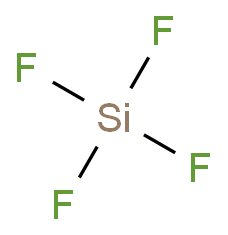
One of the most notable characteristics of silicon tetrafluoride is its nonpolarity. Silicon tetrafluoride is a nonpolar molecule due to its symmetrical tetrahedral structure, even though the silicon atom is less electronegative than the fluorine atoms. This results in polar Si-F bonds, but the symmetrical arrangement of these bonds causes the dipole moments to cancel out. The nonpolarity of SiF₄ makes it less likely to interact with polar solvents, though it still reacts with water, undergoing hydrolysis to produce silicic acid and hydrofluoric acid.
To understand the polarity of sif4, consider the following aspects:
Molecular Geometry: sif4 has a tetrahedral geometry, with four fluorine atoms symmetrically arranged around a central silicon atom. This symmetrical arrangement is crucial in determining its polarity.

Dipole Moment: The polarity of sif4 is confirmed by its dipole moment. The fluorine atoms, being more electronegative than silicon, pull the shared electrons closer to themselves, creating partial negative charges on the fluorine atoms and a partial positive charge on the silicon atom. The overall dipole moment indicates the molecule's polarity. While there is a significant difference in electronegativity between silicon (Si) and fluorine (F), resulting in polar Si-F bonds, the symmetry of the tetrahedral structure causes the dipole moments of these bonds to cancel out.

Electronegativity: Due to the equal and opposite dipoles in all directions, the molecule has no net dipole moment, making it nonpolar overall.

Silicon tetrafluoride finds applications in several fields, particularly in semiconductor manufacturing and materials science:
Materials Science: Silicon tetrafluoride is used as a precursor for the production of high-purity silicon, which is essential for semiconductor devices. It undergoes a series of reactions to convert into pure silicon.
Chemical Reagents: sif4 is used as a reagent in the synthesis of various compounds, including silicon compounds, fluorides, and fluorochemicals.
Plasma Etching: In semiconductor manufacturing, SiF4 is used in plasma etching processes to remove silicon dioxide layers, which is crucial for creating intricate circuit patterns on silicon wafers.
Photolithography: sif4 is employed in photolithography processes to develop patterns on semiconductor wafers using light-sensitive resists. In conclusion, silicon tetrafluoride (SiF4) is a polar molecule with unique properties and applications in various industries, particularly in semiconductor manufacturing and materials science. Its polarity enables it to participate in specific chemical reactions and processes that are essential for modern technology.
 |
|
 |
 |
|
 EN
EN
 Agricultural News
 Food News
 Industrial News
 Cosmetic News
 Pharmaceutical News
 Science News


