-
We detected your language preference as English. Would you like to switch to the English version for a better experience?
Switch to English
Stay here


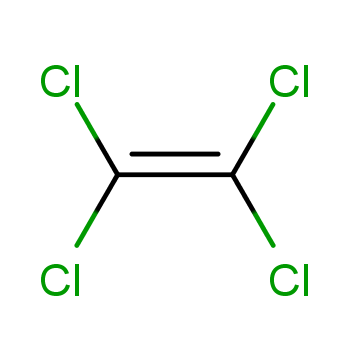
Tetrachloroethylene (C2Cl4), also known as perchloroethylene or PCE, is a chlorinated hydrocarbon that plays a significant role in various industrial and commercial applications. With a chemical formula consisting of two carbon atoms, four chlorine atoms, and no hydrogen atoms, Tetrachloroethylene exhibits a unique combination of properties that make it useful in numerous contexts. Its structure includes a carbon chain with four chlorine atoms attached, resulting in a highly stable molecule. However, the presence of chlorine atoms introduces several aspects that distinguish Tetrachloroethylene from other hydrocarbons.
Chlorine (Cl) is a highly reactive halogen element found in the periodic table. It is a greenish-yellow gas at room temperature and is one of the most reactive elements, capable of forming compounds with almost all elements except noble gases. Chlorine's reactivity comes from its high electronegativity, which is the ability of an atom to attract electrons towards itself. When chlorine combines with other elements, it forms compounds with differing degrees of polarity based on the electronegativity of the bonded elements.
Molecular Structure: Tetrachloroethylene has a planar molecular structure, where the four chlorine (Cl) atoms are symmetrically arranged around a carbon-carbon (C=C) double bond. The symmetrical arrangement of atoms is key to understanding its polarity.

Bond Polarity: The C-Cl bonds in tetrachloroethylene are polar due to the electronegativity difference between carbon and chlorine. Chlorine is more electronegative, which leads to a partial negative charge (δ⁻) on the chlorine atoms and a partial positive charge (δ⁺) on the carbon atoms.

Dipole Moment: Although the molecule has polar bonds, the symmetrical geometry results in the cancellation of individual dipole moments. The two C-Cl bonds on one side of the molecule are opposed by the two C-Cl bonds on the opposite side, leading to no net dipole moment.

In summary, tetrachloroethylene (C₂Cl₄) is considered a nonpolar molecule due to its symmetrical structure and the cancellation of dipole moments from the polar C-Cl bonds. This nonpolarity affects its solubility properties and its use as a solvent in various industrial applications, including dry cleaning and degreasing.
Despite its non-polar nature, Tetrachloroethylene finds widespread use in various industries due to its exceptional solvency properties. Some of its primary applications include:
Dry Cleaning: Tetrachloroethylene is commonly used in dry cleaning processes because it effectively removes oils and greases from fabrics without leaving residues.
Degreasing: It is used in industrial settings to remove oil, grease, and other contaminants from metal parts before painting or further processing.
Aerosol Propellants: Due to its high volatility, Tetrachloroethylene is sometimes used as a propellant in aerosol cans for various consumer products.
Solvent Extraction: It is used in solvent extraction processes for the purification of oils and fats in the food industry. In addition to these applications, Tetrachloroethylene has been found to have potential environmental and health concerns due to its persistence in the environment and potential for bioaccumulation in organisms. Its use is therefore subject to regulation in many countries to mitigate these risks.
Several compounds related to Tetrachloroethylene share similar structural and functional properties, making them valuable in their respective applications:
Carbon Tetrachloride (CCl4): A non-polar solvent used in industrial applications such as degreasing, fire extinguishing, and as a starting material for other organic compounds.
Trichloroethylene (C2HCl3): Polar molecule. Also, a chlorinated hydrocarbon, used primarily as a solvent in the metal cleaning and degreasing industries.
Dichloromethane (CH2Cl2): Polar molecule. Commonly used as a solvent in various industrial processes and in the manufacture of other chemicals. These related compounds, like Tetrachloroethylene, demonstrate the versatility and importance of chlorinated hydrocarbons in modern industrial practices.
After exploring the polarity chemistry of C₂Cl₄, have you gained a deeper understanding of whether it is "polar or nonpolar"? While C₂Cl₄ as a molecule is nonpolar, this does not necessarily mean that all of its bonds are nonpolar bonds. If you're interested in similar compounds or related supply chain resources, Guidechem offers a comprehensive list of global Tetrachloroethylene suppliers, where you can find the right procurement plan to meet your research and production needs.
 |
|
 |
 |
 |
|
 EN
EN
 Agricultural News
 Food News
 Industrial News
 Cosmetic News
 Pharmaceutical News
 Science News

 1YR
1YR

