-
We detected your language preference as English. Would you like to switch to the English version for a better experience?
Switch to English
Stay here


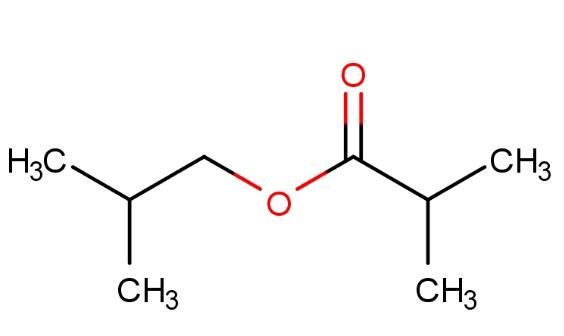
Isobutyl isobutyrate (C8H16O2), a compound with a molecular structure featuring a central ester group (C=O-O-C) and two identical isobutyl groups [(CH3)2CH-], exhibits diverse chemical properties. This unique structure confers distinctive characteristics and wide-ranging applications to isobutyl isobutyrate.
Isobutyl isobutyrate is primarily used in the formulation of fragrances and flavorings, serving as a key component in pineapple flavorings. What does isobutyl isobutyrate smell like? Isobutyl isobutyrate has a scent reminiscent of pineapple, grape skin, or ether. According to Chinese standard GB 2760-96, isobutyl isobutyrate is permitted for use as a food flavoring, added to a range of flavors such as fruit-type edible flavors, whisky flavors, and tobacco flavors. It also functions as a superior organic solvent, a drying agent in paint removers, and an additive in extraction distillation. Due to its minimal harm to humans and animals and its non-environmental pollution potential, it is considered a green product, with its applications expanding as environmental requirements increase.
Isobutyl isobutyrate is a flammable, colorless, transparent liquid. At atmospheric pressure, isobutyl isobutyrate boiling point is 148.6℃, melting point is -80.6℃, flash point is 37℃, isobutyl isobutyrate density (D204) is 0.874, and refractive index is 1.398. Isobutyl isobutyrate is insoluble in water but soluble in alcohols, ethers, and ketones. What is the vapor pressure of isobutyl isobutyrate? The vapor pressure of isobutyl isobutyrate is 1 mm Hg (39.9 ℃).
The defining feature of isobutyl isobutyrate's molecular structure is its composition of a central ester group (C=O-O-C) surrounded by two identical isobutyl groups [(CH3)2CH-]. What functional groups are in isobutyl isobutyrate? Isobutyl isobutyrate belongs to the carboxylic acid ester class of organic compounds. Carboxylic acid esters are derivatives of carboxylic acids, where the carbon of the carbonyl group is bonded to an alkyl or aryl portion via an oxygen atom (forming the ester group). This unique structure imparts unique properties:
- Ester functional group: The presence of the ester group allows isobutyl isobutyrate to participate in hydrolysis and esterification reactions, enhancing its chemical versatility.
- Branched hydrocarbon chain: The bonding of two isobutyl groups forms a branched molecular structure, influencing its solubility and physical properties such as boiling point.
Nuclear magnetic resonance spectroscopy (NMR), also known as magnetic resonance spectroscopy (MRS), is a technique that exploits the magnetic properties of certain atomic nuclei. This occurs when the nuclei are exposed to an external magnetic field and radiofrequency radiation in the range of approximately 4 to 900 MHz, depending on the isotopic properties of the nuclei and the strength of the external magnetic field. Each NMR-active nucleus resonates at a frequency determined by its chemical environment. Therefore, NMR spectroscopy provides information about the functional groups present in the sample and the connectivity between adjacent nuclei within the same molecule. Because NMR spectra are unique or highly characteristic for individual compounds and functional groups, NMR spectroscopy is one of the most important methods for identifying molecular structures, especially organic compounds.
- 13C NMR: In CDCl3

- 1H NMR: In CDCl3, 90 MHz
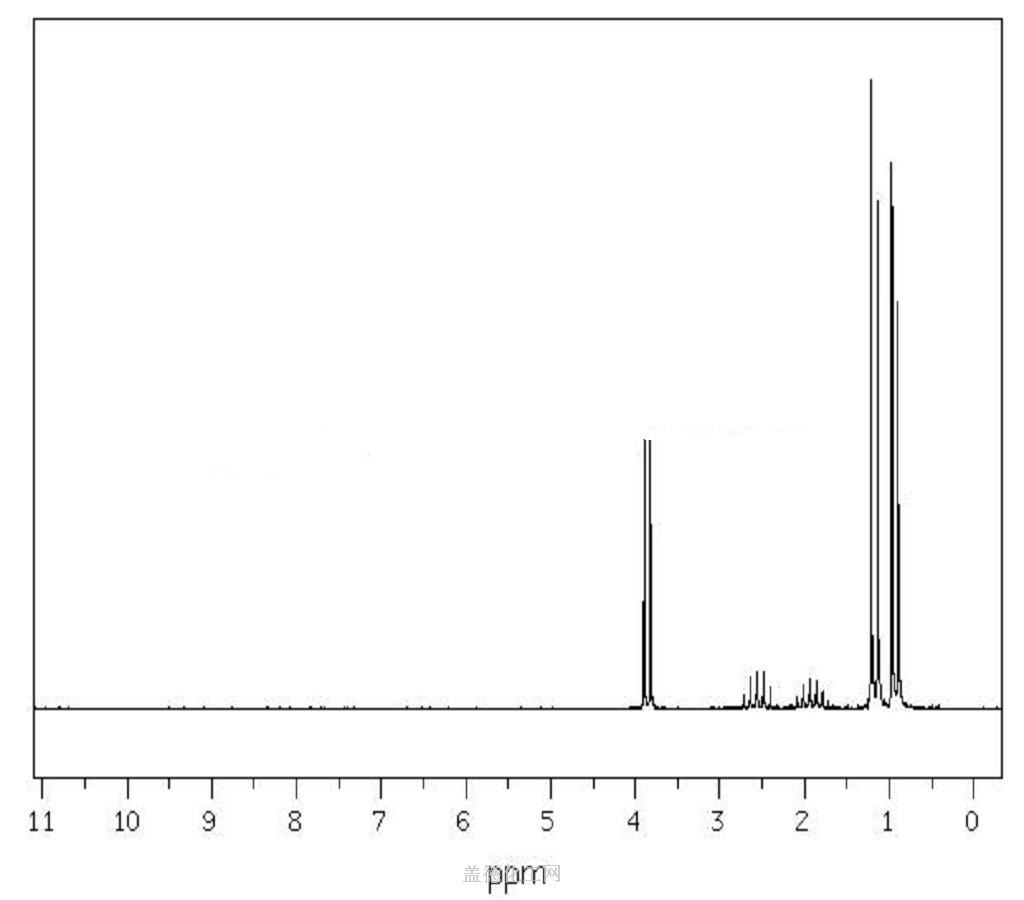
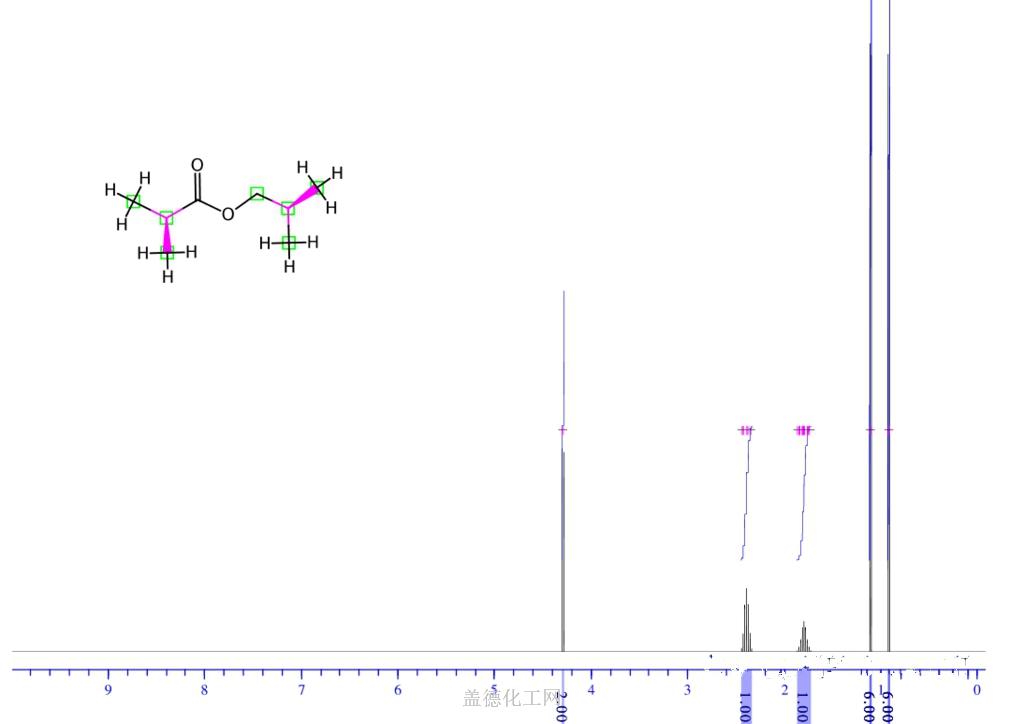
- Predicted 1H proton NMR
Qu Yaman and colleagues synthesized isobutyl isobutyrate in one step using isobutanol-aluminum as a catalyst, catalyzing two molecules of isobutyraldehyde via the Tishchenko reaction. They studied the synthesis conditions of isobutyl isobutyrate using a single-factor experimental method and determined the optimal synthesis conditions to be m (isobutanol-aluminum): m (isobutyraldehyde) = 1:10, reaction temperature 10°C, and reaction time 3.5 h. Under these conditions, the conversion rate of isobutyraldehyde exceeded 99%, and the yield of isobutyl isobutyrate exceeded 95%. The authors analyzed the product using FTIR, GC-MS, and 1H NMR spectroscopy, with the 1H NMR spectrum of the product shown in the figure below.
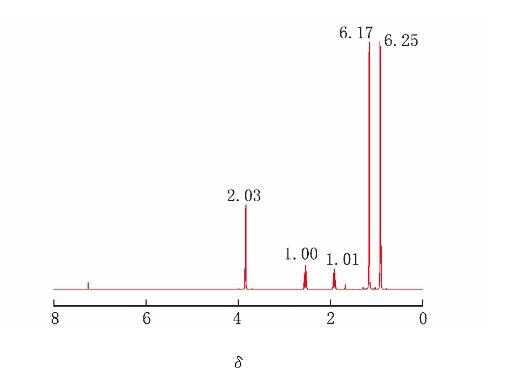
From the figure, it can be observed that the hydrogen atoms of the two isobutyl groups (-CH3) are split into double peaks at 0.87-0.94 and 1.18-1.23, multiple peaks appear at 1.86-1.96 and 2.49-2.58 for -CH, and double peaks are evident at 3.81-3.85 for -CH2, confirming isobutyl isobutyrate as the main product following the condensation reaction of isobutyraldehyde.
- Toxicological data and safety assessment: Isobutyl isobutyrate is a colorless liquid with a fruity odor, suitable for various applications. However, cautious handling is crucial due to potential health hazards. Toxicological studies indicate that contact with isobutyl isobutyrate can irritate the eyes, skin, and respiratory system. Inhalation of concentrated vapors may cause dizziness, headaches, and nausea. Although limited, existing data suggest no significant chronic health effects.
- Regulatory status and guidelines: Despite a lack of conclusive evidence of long-term risks, regulatory agencies such as OSHA (Occupational Safety and Health Administration) have established safety handling guidelines. These guidelines specify exposure limits and recommend control measures such as adequate ventilation and the use of personal protective equipment to minimize inhalation and skin contact.
Isobutyl isobutyrate is a widely used chemical substance with diverse applications. It is employed not only in the food and fragrance industries as a flavoring and fragrance component but also plays a role in cosmetics, cleaners, and coatings. Understanding isobutyl isobutyrate enhances our comprehension of its role and value across various fields. In the future, as scientific technology advances, the applications of isobutyl isobutyrate may continue to expand and innovate.
[1] https://en.wikipedia.org/wiki/Nuclear_magnetic_resonance_spectroscopy
[2] Qu Yaman, Lv Zhiguo, Guo Zhenmei. One-step synthesis of isobutyl isobutyrate from isobutyraldehyde via Tishchenko reaction. Chemical Technology, 2019, 27(02): 11-14+49. DOI:10.16664/j.cnki.issn1008-0511.2019.02.003.
[3] Li Yangmeng. Research on the preparation of isobutyl isobutyrate by isobutanol dehydrogenation method [D]. Zhejiang University of Technology, 2018.
[4] https://pubchem.ncbi.nlm.nih.gov/compound/Isobutyl-isobutyrate
[5] https://www.guidechem.com/encyclopedia/isobutyl-isobutyrate-dic1453.html#NMR-Spectrum
[6] https://hmdb.ca/metabolites/HMDB0040252
 |
|
 |
 |
|
 EN
EN
 Agricultural News
 Food News
 Industrial News
 Cosmetic News
 Pharmaceutical News
 Science News

 4YRS
4YRS

