-
We detected your language preference as English. Would you like to switch to the English version for a better experience?
Switch to English
Stay here


Isobutyl isobutyrate, also known as 2-methylpropyl 2-methylpropanoate, has a molecular weight of 144.2114. It is a colorless to light yellow liquid with a pineapple fragrance, soluble in alcohol and ether but insoluble in water. What is isobutyl isobutyrate used for? It is widely used in industries such as fragrance, food, pharmaceuticals, and chemicals. It is used to formulate edible flavorings like pineapple, strawberry, and grape, as well as flavorings for tobacco and liquor. As a major component of pineapple fragrance, it also serves as an excellent drying paint remover, organic solvent, and extraction distillation additive. Due to its non-toxic nature to humans and animals and its non-polluting effect on the environment, it is regarded as an environmentally friendly product. With increasing environmental protection requirements, its applications are expected to expand further. The structure of isobutyl isobutyrate is as follows:
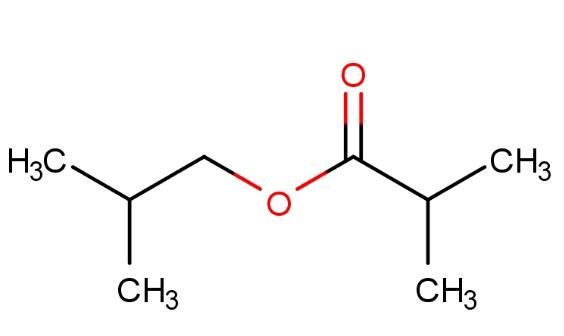
(1) Boiling point: 143.81 ℃ (EPI Suite)
(2) Flash point: 34 ℃ (Globally Harmonized System), 93 °F; closed cup (Flavor and Extract Manufacturers Association (FEMA))
(3) Log KOW: 2.68 (EPI Suite)
(4) Melting point: -55.3 ℃ (EPI Suite)
(5) Water solubility: 412.1 mg/L (EPI Suite)
(6) Specific gravity: 0.85 (FEMA)
(7) Vapor pressure: 3.09 mm Hg at 20 ℃ (EPI Suite v4.0), 3.0 mm Hg at 20 ℃ (FEMA), 4.28 mm Hg at 25 ℃ (EPI Suite)
Isobutyl isobutyrate belongs to a class of organic compounds known as carboxylic acid esters. Carboxylic acid esters are derivatives of carboxylic acids where the carbon atom of the carbonyl group is connected to an alkyl or aryl group through an oxygen atom (forming an ester group).
Exposure to isobutyl isobutyrate may cause the following acute (short-term) health effects:
(1) Vapors and/or mist may irritate the skin and eyes.
(2) Contact with very high concentrations may cause headaches and dizziness.
Long-term exposure to isobutyl isobutyrate may lead to the following chronic (long-term) health effects, potentially lasting for months or years:
Based on currently available information from the New Jersey Department of Health and RIFM's fragrance ingredient safety assessments, isobutyl isobutyrate has not been found to have carcinogenic toxicity.
Based on currently available information from the New Jersey Department of Health and RIFM's fragrance ingredient safety assessments, isobutyl isobutyrate has not been found to have reproductive toxicity.
LC50 (rat) = 5,000 ppm/6h. Isobutyl isobutyrate is considered virtually non-toxic when ingested and is classified as having only slight peritoneal toxicity. When injected into the peritoneal cavity, it killed rats at 6300 MG/KG and mice at 1600 MG/KG. Inhalation of 5000 PPM within 6 hours was lethal to two-thirds of the rats. The LD50 value for rabbit skin is higher than 10 CU CM/KG, but such amounts interfered with normal development of the test animals. No significant effects on body weight gain, food and water intake, hematological findings, serum and urine analyses, organ weights, or histopathology were observed when rats were dosed via gavage with 0, 10, 100, or 1000 mg/kg/day for 18 weeks. No adverse effects were noted at daily doses of at least 1000 mg/kg.
Is isobutyl isobutyrate flammable? Isobutyl isobutyrate is a flammable liquid with fire hazard potential. Use alcohol-resistant foam extinguishers in case of fire. Water may be ineffective in extinguishing fires and could spread the fire. Toxic gases may be produced during a fire.
(1) Keep away from heat, hot surfaces, sparks, open flames, and other ignition sources. No smoking.
(2) Ground and bond the container and receiving equipment. Use non-sparking tools. Take precautionary measures against static discharge. Flammable vapors may accumulate in containers. Use explosion-proof equipment. Wear personal protective equipment. Use only outdoors or in a well-ventilated area. Avoid inhaling dust, fumes, gas, mist, vapors, or spray. Avoid skin and eye contact.
(3) Wash contaminated clothing before reuse. Do not eat, drink, or smoke when using this product. Wash hands thoroughly after handling.
Isobutyl isobutyrate is a flammable liquid with fire hazards. The following safety guidelines and handling precautions should be followed:
Keep away from heat, sparks, and open flames.
Do not smoke near the material.
Use explosion-proof electrical equipment.
Ground and bond containers to prevent static discharge.
Use only in well-ventilated areas.
Local exhaust ventilation may be required.
Wear appropriate gloves, goggles, and clothing to prevent skin and eye contact.
Consider respiratory protection in poorly ventilated areas or during high exposure.
Wash hands thoroughly after handling materials.
Do not eat, drink, or smoke while using isobutyl isobutyrate.
Keep containers tightly closed, stored in a cool, dry, well-ventilated area.
Keep away from incompatible materials such as strong oxidizers.
Familiarize yourself with the safety data sheet (SDS) for isobutyl isobutyrate before handling it. The SDS contains more detailed information on specific hazards and proper safety procedures. Follow the first aid procedures outlined in the SDS in case of accidental contact. If you have any concerns about using isobutyl isobutyrate, consult a safety expert.
Overall, scientific research and regulatory approval are crucial for the safety of isobutyl isobutyrate. While there are some studies on its potential risks, under normal use, it is generally considered a safe chemical. However, it is important for individuals to always follow product instructions and handle chemicals with care to ensure safety. For any health or safety concerns, it is best to seek advice from professionals.
[1]https://www.synerzine.com/
[2]Yuan Xuhong. Green catalytic synthesis of isobutyl isobutyrate [J]. Chemical Engineer, 2017, 31(10):83-85. DOI:10.16247/j.cnki.23-1171/tq.20171083.
[3]https://www.sciencedirect.com/science/article/pii/S2590140018300017
[4]https://www.fishersci.com/
[5]https://pubchem.ncbi.nlm.nih.gov/compound/Isobutyl-isobutyrate
[6]https://www.nj.gov/health/eoh/rtkweb/documents/fs/1047.pdf
[7]https://www.sciencedirect.com/science/article/abs/pii/S0278691522006871
|
 |
 |
 |
|
 EN
EN
 Agricultural News
 Food News
 Industrial News
 Cosmetic News
 Pharmaceutical News
 Science News

 4YRS
4YRS

