Welcome to the world of molecular structures! Let's explore the Lewis structure of Aluminum chloride (AlCl3), a compound crucial in various chemical processes and industries. Understanding its Lewis structure helps in grasping its bonding pattern, molecular geometry, and other important properties.
What is the Lewis Structures?
Lewis structures are visual representations of electron arrangements in molecules. Proposed by Gilbert N. Lewis, they use dots to represent valence electrons and lines to represent bonds, aiding in understanding a molecule's shape and properties based on the octet rule. This rule suggests that atoms tend to achieve stability by having eight electrons in their outer shell.
What is Aluminum chloride?
Aluminum chloride (AlCl3) is a chemical compound consisting of one aluminum atom bonded to three chlorine atoms. It is commonly used as a catalyst in organic synthesis, particularly in Friedel-Crafts reactions, and as an electrolyte in the production of aluminum metal.
How to draw Lewis structures for Aluminum chloride (AlCl3)?
Let's illustrate the Lewis structure of AlCl3:
Step 1: Identify the Central Atom: Aluminum (Al) is the central atom in AlCl3.
Step 2: Calculate Total Valence Electrons: Aluminum contributes 3 valence electrons, and each chlorine contributes 7, giving a total of 3 + (3 x 7) = 24 valence electrons.
Step 3: Arrange Electrons Around Atoms: Connect each chlorine atom to the central aluminum atom with a single bond (line) and distribute remaining electrons as lone pairs around each chlorine atom.
Step 4: Fulfill the Octet Rule: Ensure each chlorine atom has 8 electrons (1 lone pair and 3 bonding pairs), and the aluminum atom has 8 electrons (no lone pairs and 3 bonding pairs).
Step 5: Check for Formal Charges: Aluminum has a formal charge of zero, while each chlorine atom also has a formal charge of zero.

Molecular geometry of Aluminum chloride
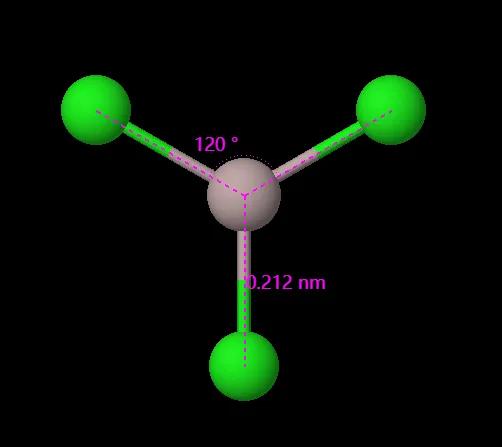
The Lewis structure indicates that Aluminum chloride (AlCl3) adopts a trigonal planar geometry. In this arrangement, the three chlorine atoms are symmetrically positioned around the central aluminum atom, forming three bond pairs. This geometry minimizes electron-electron repulsion, resulting in a stable configuration.
Hybridization in Aluminum chloride
In AlCl3, the aluminum atom undergoes sp2 hybridization. One s orbital and two p orbitals combine to form three sp2 hybrid orbitals. These orbitals then overlap with the p orbitals of chlorine atoms, forming three strong σ bonds. This hybridization ensures the stability and symmetry of the AlCl3 molecule.
Aluminum chloride (AlCl3) is a polar molecule. While the individual bonds between aluminum and chlorine are polar due to the electronegativity difference between aluminum (1.61) and chlorine (3.16), the molecule, overall, exhibits polarity due to its trigonal planar geometry, causing an imbalance in the distribution of charges.
What are approximate bond angles and Bond length in Aluminum chloride?
The bond angle in Aluminum chloride is approximately 120 degrees. This angle arises from the trigonal planar geometry of the molecule, where the three chlorine atoms are positioned at the vertices of an equilateral triangle, resulting in 120-degree bond angles between adjacent chlorine atoms. The bond length in Aluminum chloride is approximately 201pm.
Note: While VSEPR theory provides a good starting point for predicting molecular geometries and bond angles, real molecules can sometimes deviate from the ideal angles due to factors like lone pair repulsion, bond polarity, and molecular interactions.
Highlight of Aluminum chloride
| Aluminum chloride Cas 7446-70-0 |
| Molecular formula |
AlCl3 |
| Molecular shape |
Trigonal planar |
| Polarity |
polar |
| Hybridization |
sp2 hybridization |
| Bond Angle |
120 degrees |
| Bond length |
201 pm |


 EN
EN
 Agricultural News
 Food News
 Industrial News
 Cosmetic News
 Pharmaceutical News
 Science News

 1YR
1YR


