Welcome to the world of molecular structures! Today, we'll delve into the Lewis structure of chlorine dioxide (ClO2), a compound with fascinating properties and applications. Understanding the Lewis structure of ClO2 is crucial for comprehending its bonding and molecular characteristics.

What is the Lewis Structures?
Lewis structures, developed by Gilbert N. Lewis, are diagrams that represent the bonding between atoms in a molecule and the lone pairs of electrons that may exist in the molecule. They provide a visual depiction of how electrons are distributed among atoms in a compound, aiding in predicting molecular geometry, hybridization, and polarity.
What is Chlorine dioxide (ClO2)?
Chlorine dioxide (ClO2) is a chemical compound consisting of one chlorine atom and two oxygen atoms. It is a yellow to reddish gas at room temperature, with a pungent odor. ClO2 is widely used as a disinfectant, bleaching agent, and odor eliminator due to its strong oxidizing properties and effectiveness against various microorganisms.
How to draw Lewis structures for Chlorine dioxide (ClO2)?
Let's explore how to draw the Lewis structure of ClO2:
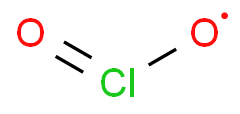
Step 1: Determine the Central Atom: In ClO2, chlorine (Cl) is the central atom since it's the least electronegative.
Step 2: Calculate Total Valence Electrons: Chlorine contributes 7 valence electrons, and each oxygen contributes 6, giving a total of 7 + (2 × 6) = 19 valence electrons.
Step 3: Connect Atoms with Single Bonds: Form a single bond between the central chlorine atom and each oxygen atom.
Step 4: Distribute Remaining Electrons: Place lone pairs on each oxygen atom until all valence electrons are used.
Step 5: Check for Octet Rule: Ensure that each atom (except for hydrogen) has a full outer shell by counting the number of electrons around it.

Molecular geometry of Chlorine dioxide (ClO2)
The Lewis structure suggests that ClO2 adopts a bent molecular geometry. The two oxygen atoms are positioned on one side of the central chlorine atom, creating a bent shape. This geometry results from the presence of two lone pairs on the central chlorine atom, causing repulsion and bending the molecule.
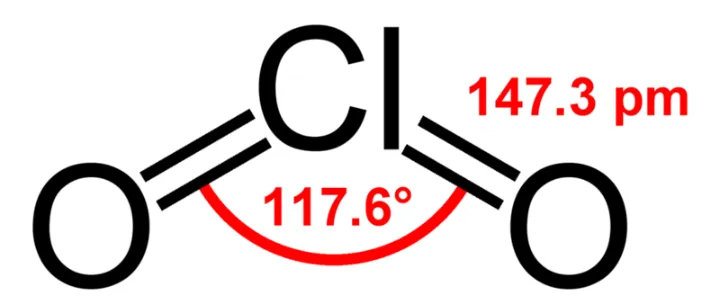
(Image Source: Wikipedia)
Hybridization in Chlorine dioxide (ClO2)
In ClO2, the central chlorine atom undergoes sp3 hybridization. One s orbital and three p orbitals of chlorine hybridize to form four sp3 hybrid orbitals. These orbitals then overlap with the p orbitals of oxygen atoms to form two strong σ bonds and two lone pairs, resulting in the bent molecular geometry.
Chlorine dioxide (ClO2) is a polar molecule. Although the individual Cl-O bonds are polar due to the electronegativity difference between chlorine and oxygen, the bent molecular geometry leads to an uneven distribution of charge, resulting in a net dipole moment.
What are approximate bond angles and Bond length in Chlorine dioxide (ClO2)?
The approximate bond angle in ClO2 is around 117 degrees. This angle deviates from the ideal 120-degree angle expected for a trigonal planar arrangement due to the presence of two lone pairs, causing greater repulsion. The bond length of Cl-O in chlorine dioxide is approximately 156 picometers (pm).
Note: Actual bond angles and lengths may vary slightly due to factors such as lone pair repulsion and bond polarity.
Highlight of Chlorine dioxide
| Chlorine dioxide Cas 10049-04-4 |
| Molecular formula |
ClO2 |
| Molecular shape |
Bent |
| Polarity |
polar |
| Hybridization |
sp3 hybridization |
| Bond Angle |
117.6 degrees |
| Bond length |
147.3 pm |



 EN
EN
 Agricultural News
 Food News
 Industrial News
 Cosmetic News
 Pharmaceutical News
 Science News

 5YRS
5YRS

