
Welcome to the fascinating realm of molecular structures! Today, let's delve into the Lewis structure of Chloromethane Solution (CH3Cl), a compound with intriguing characteristics and applications. Understanding its Lewis structure is crucial as it elucidates how atoms bond in Chloromethane Solution and provides insights into its molecular geometry, hybridization, and polarity.
What is the Lewis Structures?
Lewis structures, pioneered by Gilbert N. Lewis, depict the arrangement of electrons in molecules. By representing valence electrons as dots and bonds as lines, Lewis structures predict a molecule's shape and properties based on the octet rule. This fundamental principle asserts that atoms strive for stability by achieving eight electrons in their outer shell, a concept central to understanding chemical bonding.
What is Chloromethane Solution?
Chloromethane Solution (CH3Cl) is a colorless, volatile compound consisting of a central carbon atom bonded to three hydrogen atoms and one chlorine atom. It is commonly used as a solvent, in pesticide production, and as a precursor in the synthesis of silicon-containing chemicals.
How to draw Lewis structure of Chloromethane Solution?
Let's explore the process of drawing the Lewis structure of Chloromethane Solution (CH3Cl):
Step 1: Identify the Central Atom: Carbon (C) serves as the central atom in CH3Cl due to its lower electronegativity compared to hydrogen and chlorine.
Step 2: Calculate Total Valence Electrons: Carbon contributes 4 valence electrons, hydrogen contributes 1 each (total of 3), and chlorine contributes 7, totaling 4 + 3 + 7 = 14 valence electrons.
Step 3: Arrange Electrons Around Atoms: Connect each hydrogen atom to the central carbon atom with a single bond (line) and the chlorine atom with a single bond.
Step 4: Fulfill the Octet Rule: Ensure each hydrogen atom has 2 electrons (1 bonding pair), chlorine has 8 electrons (2 lone pairs and 1 bonding pair), and carbon has 8 electrons (2 lone pairs and 4 bonding pairs).
Step 5: Check for Formal Charges: Verify that all atoms have achieved stability without formal charges if possible.

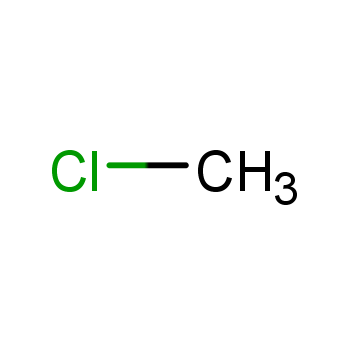
Lewis Structure of Chloromethane Solution
Molecular geometry of Chloromethane Solution
The Lewis structure suggests that Chloromethane Solution adopts a tetrahedral geometry. In this configuration, the three hydrogen atoms and one chlorine atom are symmetrically positioned around the central carbon atom, forming four bond pairs. This geometry minimizes electron repulsion, ensuring molecular stability.
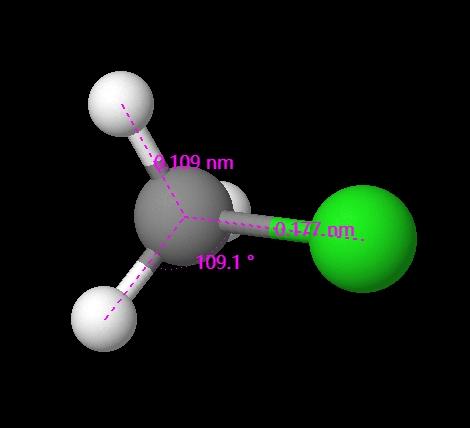
Molecular Structure of Chloromethane Solution
Hybridization in Chloromethane Solution
In Chloromethane Solution, the carbon atom undergoes sp3 hybridization. This hybridization involves the mixing of one s orbital and three p orbitals, resulting in four sp3 hybrid orbitals. These orbitals then overlap with the s orbital of hydrogen and the p orbital of chlorine atoms, forming four strong σ bonds and ensuring the stability of the molecule.
Is Chloromethane Solution polar or nonpolar?
Chloromethane Solution (CH3Cl) is a polar molecule. The polar covalent bond between carbon and chlorine, due to their electronegativity difference (carbon: 2.55, chlorine: 3.16), results in a slightly negative charge near the chlorine atom and a slightly positive charge near the hydrogen atoms. Despite this polarity, the tetrahedral arrangement of atoms leads to a symmetrical distribution of charges, balancing out the dipole moments, albeit to a minor extent.
What are approximate bond angles and Bond length in Chloromethane Solution?
The bond angles in Chloromethane Solution are approximately 109.5 degrees. This angle arises from the tetrahedral geometry, where the hydrogen and chlorine atoms are positioned at the vertices of a tetrahedron around the central carbon atom. The bond length between carbon and hydrogen is approximately 110.7 pm, and between carbon and chlorine is approximately 178.4 pm.
Note: While VSEPR theory provides a good approximation for molecular geometries and bond angles, actual molecules may exhibit deviations due to factors like lone pair repulsion and bond polarity.
Highlight of Chloromethane Solution
| Chloromethane Solution Cas 74-87-3 |
| Molecular formula |
CH3Cl |
| Molecular shape |
Tetrahedral |
| Polarity |
Polar |
| Hybridization |
sp3 hybridization |
| Bond Angles |
109.5 degrees |
| Bond Length (C-H / C-Cl) |
110.7 pm / 178.4 pm |



 EN
EN
 Agricultural News
 Food News
 Industrial News
 Cosmetic News
 Pharmaceutical News
 Science News

 5YRS
5YRS

