-
We detected your language preference as English. Would you like to switch to the English version for a better experience?
Switch to English
Stay here


Lewis structures, devised by Gilbert N. Lewis, visually represent electron arrangements in molecules. By depicting valence electrons as dots and bonds as lines, Lewis structures predict a molecule's shape and properties based on the octet rule. This rule states that atoms tend to achieve stability by having eight electrons in their outer shell. Lewis structures adhere to this rule, offering a clear picture of chemical bonding.
Nitric Oxide (NO) is a colorless gas with a crucial role in physiology as a signaling molecule. It is involved in vasodilation, neurotransmission, and immune response regulation. Industrially, it's used in the production of nitric acid and as a precursor for other nitrogen-containing compounds.
Step 5: Check for Formal Charges: Calculate formal charges to ensure stability.
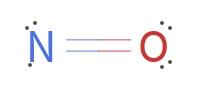
Lewis Structure of Nitric Oxide
The Lewis structure suggests that NO adopts a linear geometry. The nitrogen atom is centrally bonded to the oxygen atom with a double bond, resulting in a linear arrangement of atoms. This geometry reflects the sp hybridization of nitrogen, maximizing bonding efficiency.
In Nitric Oxide (NO), the nitrogen atom undergoes sp hybridization. One s orbital and one p orbital combine to form two sp hybrid orbitals. These orbitals overlap with the p orbital of oxygen, forming a strong σ bond between nitrogen and oxygen. This hybridization contributes to the stability and linear geometry of NO.
Nitric Oxide (NO) is a polar molecule. The electronegativity difference between nitrogen (3.04) and oxygen (3.44) results in polar covalent bonding. Despite its linear geometry, the asymmetrical distribution of electrons gives NO a net dipole moment, making it polar.
The bond angle in Nitric Oxide (NO) is 180 degrees, reflecting its linear geometry. The bond length between nitrogen and oxygen is approximately 115.5 pm, characteristic of a double bond.
| Nitric Oxide Cas 74-90-8 | |
| Molecular formula | NO |
| Molecular shape | Linear |
| Polarity | Polar |
| Hybridization | sp hybridization |
| Bond Angle | 180 degrees |
| Bond length | 115.5pm (N=O double bond) |
 |
 |
|
 EN
EN
 Agricultural News
 Food News
 Industrial News
 Cosmetic News
 Pharmaceutical News
 Science News
