-
We detected your language preference as English. Would you like to switch to the English version for a better experience?
Switch to English
Stay here


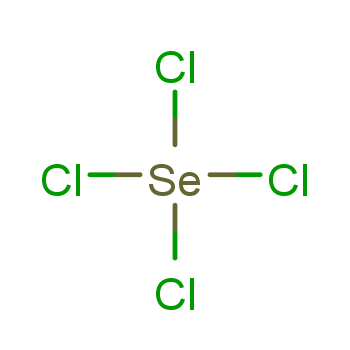
The Lewis structure of Selenium Tetrachloride (SeCl4) can be drawn by following the rules set by Gilbert N. Lewis. This structure helps in visualizing the arrangement of electrons in the molecule, which predicts its shape and properties. The rule that guides the structure is the octet rule, suggesting that atoms tend to achieve stability by having eight electrons in their outer shell. In SeCl4, selenium (Se) acts as the central atom, surrounded by four chlorine (Cl) atoms.
Selenium Tetrachloride (SeCl4) is a chemical compound characterized by one selenium (Se) atom bonded to four chlorine (Cl) atoms. It is a colorless gas under standard conditions, and its structure and properties are crucial in various industrial applications. Selenium Tetrachloride exists as a symmetrical molecule, with a tetrahedral arrangement of chlorine atoms around the central selenium atom.

Drawing the Lewis structure for Selenium Tetrachloride (SeCl4) involves several steps that adhere to the principles of chemical bonding and the octet rule:
Step 1: Identify the Central Atom: Selenium (Se) is the central atom since it is less electronegative than chlorine.
Step 2: Calculate Total Valence Electrons: Selenium contributes 6 valence electrons, and each chlorine atom contributes 7, giving a total of 6 + (4 x 7) = 34 valence electrons.
Step 3: Arrange Electrons Around Atoms: Connect each chlorine atom to the central selenium atom with a single bond (line) and distribute remaining electrons as lone pairs around each chlorine atom.
Step 4: Fulfill the Octet Rule: Ensure each chlorine atom has 8 electrons (2 lone pairs and 1 bonding pair), and the selenium atom has 4 electrons (no lone pairs and 4 bonding pairs).
Step 5: Check for Formal Charges: Formal charges are not necessary as all atoms have achieved the octet rule.
The Lewis structure of Selenium Tetrachloride (SeCl4) reveals an octahedral molecular geometry. This geometry is due to the central selenium atom being bonded to four chlorine atoms, with two lone pairs of electrons on the selenium atom, resulting in a total of six electron domains. The lone pairs occupy the equatorial positions, while the four chlorine atoms are positioned at the vertices of an octahedron, leading to bond angles of approximately 90 degrees between adjacent chlorine atoms.

The molecular orbital theory explains the distribution of electrons within Selenium Tetrachloride (SeCl4). In this compound, the bonding and antibonding interactions occur between the atomic orbitals of selenium and chlorine atoms. The six bonding interactions between the selenium and chlorine atoms result in the formation of six sigma bonds. The presence of two lone pairs on the selenium atom leads to the formation of two additional orbitals, contributing to the overall electronic structure of the molecule. This structure allows for the stabilization of the compound and the prediction of its physical and chemical properties.
The Lewis structure of Selenium Tetrachloride (SeCl4) indicates an octahedral molecular geometry. The central selenium atom is bonded to four chlorine atoms, with two lone pairs of electrons on the selenium atom. This arrangement results in an octahedral structure with bond angles of approximately 90 degrees between adjacent chlorine atoms, minimizing electron repulsion and achieving a stable configuration.
In Selenium Tetrachloride (SeCl4), the central selenium atom undergoes sp3d hybridization. This process involves the mixing of its 3s, 3p, and 3d atomic orbitals to create six equivalent sp3d hybrid orbitals. These hybrid orbitals are then used to form the six sigma bonds with the chlorine atoms, while the two unhybridized p-orbitals on the selenium atom accommodate the two lone pairs, contributing to the octahedral molecular geometry.
In Selenium Tetrachloride (SeCl4), the bond angle between adjacent chlorine atoms is approximately 90 degrees, resulting from the octahedral molecular geometry. The bond length between the selenium atom and any chlorine atom is around 0.217 nm, reflecting the strength of the Se-Cl bond and the compact arrangement of atoms in the molecule.
| Selenium Tetrachloride (SeCl4) Cas 10026-03-6 | |
| Molecular formula | SeCl4 |
| Molecular shape | Octahedral |
| Polarity | polar |
| Hybridization | sp3d hybridization |
| Bond Angle | 90 degrees |
| Bond length | 0.217 nm |
|
 |
 |
 |
|
|
 EN
EN
 Agricultural News
 Food News
 Industrial News
 Cosmetic News
 Pharmaceutical News
 Science News


