Guideview >  Articles >  Property  > What is the Lewis Structure of Silica gel?

What is the Lewis Structure of Silica gel?

Discover silica gel Lewis Structure, molecular geometry, and more. Explore the fascinating chemistry behind Silica gel (SiO2) and its diverse applications. Edison1 MIN READMay 13, 2024

Welcome to the fascinating world of molecular structures! Today, let's delve into the Lewis structure of Silica gel (SiO2), a compound with diverse applications and intriguing chemical properties. Understanding its Lewis structure sheds light on its bonding pattern, molecular geometry, hybridization, and polarity.


What is the Lewis Structure of Silica gel?


What is the Lewis Structures?

Lewis structures, conceptualized by Gilbert N. Lewis, provide a visual representation of electron distribution in molecules. By depicting valence electrons as dots and bonds as lines, Lewis structures offer insights into a molecule's shape and properties based on the octet rule. This rule dictates that atoms tend to attain stability by achieving eight electrons in their outermost shell. Lewis structures serve as a fundamental tool in understanding chemical bonding.

What is Silica gel?

Silica gel, chemically represented as SiO2, is a porous and granular form of silicon dioxide. It finds widespread use as a desiccant to control humidity, as a catalyst support in various chemical reactions, and in chromatography for separating mixtures. Silica gel exhibits excellent adsorption properties due to its high surface area and porosity.


Molecular geometry of Silica gel (SiO2)


How to draw Lewis structures for Silica gel (SiO2)?


Let's explore the Lewis structure of Silica gel (SiO2):

Step 1: Identify the Central Atom: Silicon (Si) serves as the central atom in SiO2.
Step 2: Calculate Total Valence Electrons: Silicon contributes 4 valence electrons, and each oxygen contributes 6, giving a total of 4 + (2 x 6) = 16 valence electrons.
Step 3: Arrange Electrons Around Atoms: Form double bonds between silicon and each oxygen atom, distributing remaining electrons as lone pairs around each oxygen atom.
Step 4: Fulfill the Octet Rule: Ensure each oxygen atom has 8 electrons (2 lone pairs and 2 bonding pairs), and the silicon atom has 8 electrons (0 lone pairs and 4 bonding pairs).

Step 5: Check for Formal Charges: Formal charges may not be necessary as all atoms have achieved the octet rule.


silica gel lewis structure

Silica gel lewis structure


Molecular geometry of Silica gel (SiO2)

The Lewis structure indicates that Silica gel (SiO2) adopts a bent geometry. In this arrangement, each oxygen atom is bonded to the central silicon atom by a double bond, resulting in a linear molecular shape. The linear geometry minimizes electron-electron repulsion, contributing to the stability of the molecule.
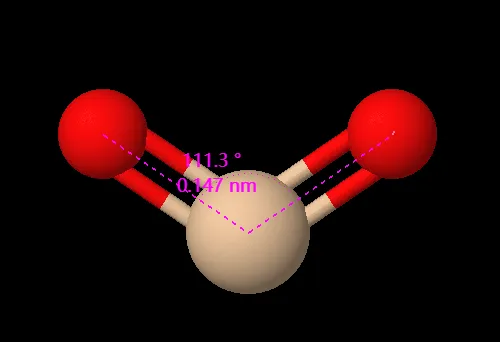

Molecular Structure of Silica gel


Hybridization in Silica gel (SiO2)

In Silica gel (SiO2), the silicon atom undergoes sp hybridization. One s orbital and one p orbital combine to form two sp hybrid orbitals. These orbitals then overlap with the p orbitals of oxygen atoms, forming two strong σ bonds. This hybridization ensures the stability and linear geometry of the SiO2 molecule.

Is Silica gel (SiO2) polar or nonpolar?

Silica gel (SiO2) is a nonpolar molecule. Although it contains polar covalent bonds between silicon and oxygen atoms due to the electronegativity difference between silicon (1.90) and oxygen (3.44), the linear arrangement of atoms cancels out any net dipole moment. Consequently, SiO2 does not exhibit overall molecular polarity.

What are approximate bond angles and Bond length in Silica gel (SiO2)?

The bond angle in Silica gel (SiO2) is 111.3 degrees, owing to its linear geometry. The bond length between silicon and oxygen atoms is approximately 161 pm. It's important to note that while theoretical calculations predict ideal bond angles, real molecules may deviate slightly due to factors such as lone pair repulsion and bond strain.


Highlight of Silica gel

Silica gel Cas 112926-00-8
Molecular formula SiO2
Molecular shape Bent
Polarity nonpolar
Hybridization sp hybridization
Bond Angle 111.3 degrees
Bond length 147 pm


Related News