Welcome to the world of molecular structures! Today, we'll explore the Lewis structure of Sodium chloride (NaCl), a fundamental compound with various applications. Understanding the Lewis structure of NaCl provides insights into its bonding, geometry, and other important characteristics.

What is the Lewis Structures?
Lewis structures, developed by Gilbert N. Lewis, are diagrams that represent the valence electrons of atoms within a molecule. By using dots to represent valence electrons and lines to represent bonds, Lewis structures provide a visual understanding of how atoms bond in a compound. They are based on the octet rule, which states that atoms tend to gain, lose, or share electrons to achieve a stable electron configuration with eight electrons in their outermost shell.
What is Sodium chloride?
Sodium chloride (NaCl), commonly known as table salt, is an ionic compound composed of sodium ions (Na+) and chloride ions (Cl−). It is a crystalline solid with a characteristic salty taste and is essential for various biological processes. NaCl is widely used in food seasoning, food preservation, and chemical industries.
How to draw Lewis structures for Sodium chloride (NaCl)?
Let's delve into drawing the Lewis structure of NaCl:
Step 1: Identify the Central Atom: In NaCl, sodium (Na) is the central atom as it is less electronegative than chlorine.
Step 2: Calculate Total Valence Electrons: Sodium contributes 1 valence electron, and chlorine contributes 7, giving a total of 1 + 7 = 8 valence electrons.
Step 3: Arrange Electrons Around Atoms: Sodium donates its valence electron to chlorine, forming a single bond (NaCl) with the chloride ion gaining the extra electron.
Step 4: Fulfill the Octet Rule: Sodium achieves a stable electron configuration with a full outer shell (2 electrons), while chlorine also achieves stability with a full outer shell (8 electrons).
Step 5: Check for Formal Charges: In NaCl, formal charges are not applicable as both sodium and chlorine have achieved stable electron configurations.

Molecular geometry of Sodium chloride (NaCl)
The molecular geometry of NaCl is simple. It forms a cubic crystal lattice structure, with sodium ions (Na+) surrounded by six chloride ions (Cl−) and vice versa. This arrangement maximizes the attraction between oppositely charged ions, resulting in the formation of a stable ionic lattice.
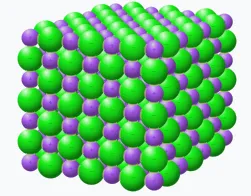
(Image Source: Wikipedia)
Hybridization in Sodium chloride
In NaCl, there is no hybridization involved as it is an ionic compound formed by the transfer of electrons from sodium to chlorine. Therefore, the concept of hybridization, which is relevant to covalent compounds, does not apply here.
Sodium chloride (NaCl) is a nonpolar molecule. Although it consists of ions with opposite charges (Na+ and Cl−), the overall molecule is nonpolar due to its symmetrical ionic crystal lattice structure. The positive and negative charges are evenly distributed throughout the crystal lattice, resulting in no net dipole moment.
What are approximate bond angles and Bond length in Sodium chloride?
As NaCl is an ionic compound, it does not have typical covalent bonds with defined bond angles or bond lengths. Instead, it forms a three-dimensional crystal lattice where each sodium ion is surrounded by six chloride ions and vice versa. The distance between sodium and chloride ions in the lattice is determined by the arrangement of ions and their charges.
Note: While the concept of bond angles and lengths is not applicable to ionic compounds like NaCl, the distance between ions in the crystal lattice can be measured and is influenced by factors such as ion size and charge.
Highlight of Sodium chloride
| Sodium chloride Cas 7647-14-5 |
| Molecular formula |
NaCl |
| Molecular shape |
- |
| Polarity |
nonpolar |
| Hybridization |
- |
| Bond Angle |
- |
| Bond length |
- |


 EN
EN
 Agricultural News
 Food News
 Industrial News
 Cosmetic News
 Pharmaceutical News
 Science News


 1YR
1YR

