-
We detected your language preference as English. Would you like to switch to the English version for a better experience?
Switch to English
Stay here


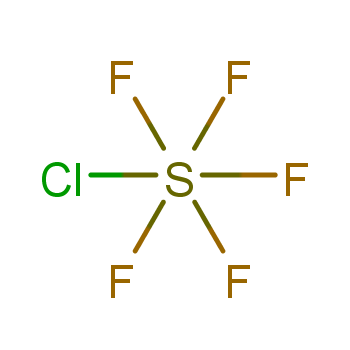
The Lewis structure for Sulfur Pentafluoride Chloride (SF5Cl) is a graphical representation of the electron distribution in the molecule. This structure is created using the rules devised by Gilbert N. Lewis, which involve depicting valence electrons as dots and bonds as lines. The octet rule is adhered to, suggesting that atoms aim to achieve stability by having eight electrons in their outer shell. The Lewis structure of SF5Cl offers insights into the molecule's shape and properties.
Sulfur Pentafluoride Chloride (SF5Cl) is a compound consisting of one sulfur atom bonded to five fluorine atoms and one chlorine atom. This compound is characterized by its strong Lewis acidity, which makes it useful in various chemical reactions. SF5Cl is a colorless gas under standard conditions and is known for its high reactivity.

Let's delve into the process of drawing the Lewis structure for SF5Cl:
1. Identify the Central Atom: Sulfur (S) is the central atom, as it is less electronegative than both fluorine (F) and chlorine (Cl).
2. Calculate Total Valence Electrons: Sulfur contributes 6 valence electrons, while each fluorine contributes 7, and chlorine contributes 7. This gives a total of 6 + (5 * 7) + 7 = 48 valence electrons.
3. Arrange Electrons Around Atoms: Connect each fluorine atom to the central sulfur atom with a single bond, and then distribute the remaining electrons as lone pairs around each fluorine atom.
4. Ensure Octet Rule: Make sure each fluorine atom has 8 electrons (2 lone pairs and 1 bonding pair), and sulfur has 12 electrons (2 lone pairs and 6 bonding pairs).
5. Check Formal Charges: Formal charges are not necessarily needed as all atoms have achieved the octet rule.
The molecular geometry of SF5Cl is determined by the spatial arrangement of atoms around the central sulfur atom. With 6 electron pairs (5 bonding pairs and 1 lone pair) and no lone pairs on the sulfur atom, the geometry is trigonal bipyramidal. The 90-degree angle between the F-S-F bonds is a characteristic feature of this geometry.
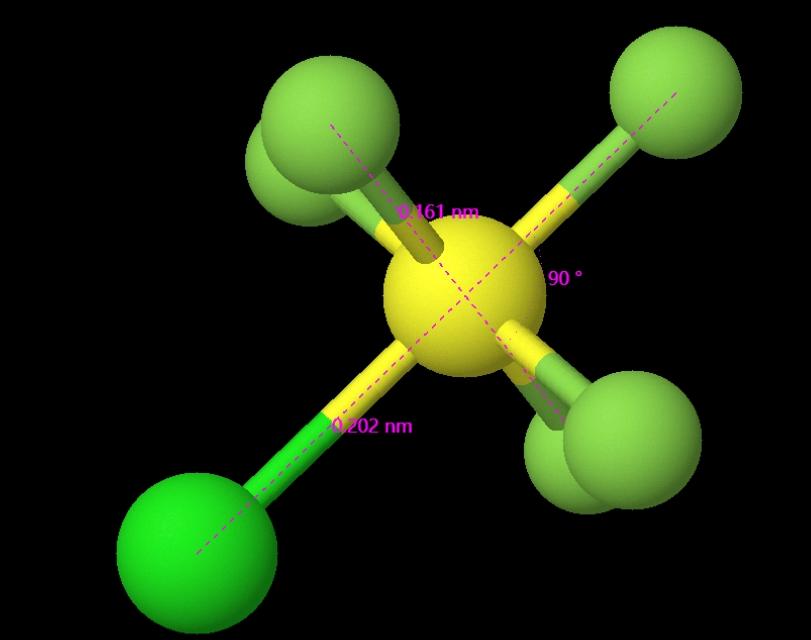
According to molecular orbital theory, SF5Cl features six sigma bonds formed between sulfur and the five fluorine atoms, with one chlorine atom bonded to sulfur. The presence of a lone pair on the sulfur atom implies the involvement of additional orbitals beyond the typical p-orbitals. However, advanced calculations reveal that the actual electronic structure involves four delocalized bonds across all seven atoms, rather than six distinct bonds involving d-orbitals.
The Lewis structure indicates that SF5Cl adopts a trigonal bipyramidal geometry. In this configuration, the sulfur atom is at the center, with the five fluorine atoms surrounding it in a trigonal bipyramidal arrangement, and one chlorine atom bonded to sulfur. This geometry minimizes electron-electron repulsion and results in a stable configuration.
The hybridization of the central sulfur atom in sulfur pentafluoride chloride (SF₅Cl) is primarily sp³d². This hybridization allows for an octahedral arrangement of the five fluorine atoms and one chlorine atom around the sulfur atom. The sp³d² hybridization accommodates the six regions of electron density, resulting in a distorted octahedral geometry. The presence of strong electronegative fluorine atoms influences the bond angles, while the chlorine atom's larger size leads to slight adjustments in bond lengths within the molecular structure.
The bond angles in SF5Cl are approximately 90 degrees. This arises from the trigonal bipyramidal geometry of the molecule, where the five fluorine atoms are positioned at the vertices of a trigonal bipyramid, leading to 90-degree bond angles between adjacent fluorine atoms. S-F has a bond length of 0.161 nm, and S-Cl has a bond length of 0.202 nm.
| Sulfur Pentafluoride Chloride (SF5Cl) | |
| Molecular formula | SF5Cl |
| Molecular shape | Trigonal bipyramidal |
| Polarity | polar |
| Hybridization | sp3d2 hybridization |
| Bond Angle | 90 degrees |
| Bond length | S-F:0.161 nm; S-Cl:0.202 nm |
SF5Cl is classified as a polar molecule due to the electronegativity difference between sulfur and chlorine, which creates a polar bond. Furthermore, its seesaw molecular geometry contributes to an asymmetrical charge distribution, resulting in an overall polar character for the molecule.
To calculate the total bond energy of SF5Cl, determine the bond energy for a single S-F bond, which is approximately 327 kJ/mol. Since there are six S-F bonds and one S-Cl bond, multiply the bond energy of one S-F bond by 6 and add the bond energy of the S-Cl bond to get the total bond energy. For SF5Cl, the total bond energy is approximately 1962 kJ/mol.
Bond order refers to the number of chemical bonds between atoms in a molecule. In the case of SF5Cl, each S-F bond is a single bond, resulting in a bond order of 1 for each S-F bond. If a molecule has resonance structures, bond order is averaged over the different structures, but SF5Cl does not exhibit resonance, maintaining a bond order of 1.
|
 |
 |
|
|
 EN
EN
 Agricultural News
 Food News
 Industrial News
 Cosmetic News
 Pharmaceutical News
 Science News

 4YRS
4YRS

