-
We detected your language preference as English. Would you like to switch to the English version for a better experience?
Switch to English
Stay here


Sulfur Pentafluoride Chloride (ClF5S), also known as Sulfur Pentafluorochloride, is a highly reactive and potent fluorinating agent used in various industrial processes. With the chemical formula ClF5S, this compound is primarily utilized in the synthesis of pharmaceuticals, organic compounds, and materials science. As a member of the sulfur halides family, ClF5S combines sulfur, fluorine, and chlorine elements in a unique structure that enables its application in diverse fields.
Polarity in chemistry refers to the uneven distribution of electrons within a molecule or compound, resulting in the formation of regions with partial positive and partial negative charges. This occurs when the electronegativity of the atoms involved differs significantly, causing electrons to be more attracted to one atom over another. Consequently, the molecule develops a dipole moment, indicating its polarity.
Understanding the polarity of Sulfur Pentafluoride Chloride involves examining its molecular structure, electronegativities of its constituent atoms, and the overall charge distribution. Let's break down these aspects:
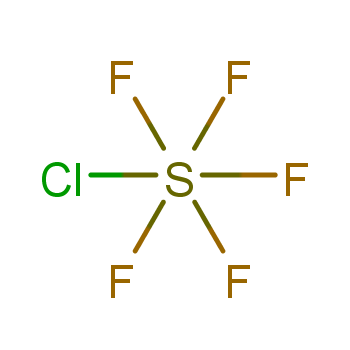
1. In Molecular Structure, Sulfur Pentafluoride Chloride consists of a central sulfur atom bonded to five fluorine atoms and one chlorine atom. The presence of these electronegative elements (fluorine and chlorine) around the sulfur atom creates an uneven electron distribution, contributing to the molecule's polarity.

2. Electronegativities The electronegativities of the atoms in ClF5S are as follows: - Sulfur (S): 2.58 - Fluorine (F): 3.98 - Chlorine (Cl): 3.16 Fluorine and chlorine have significantly higher electronegativities compared to sulfur, which means they pull the shared electrons more strongly towards themselves. This uneven electron distribution leads to a net positive charge at the sulfur atom and negative charges at the fluorine and chlorine atoms, thus confirming the polarity of ClF5S.

3. Dipole Moment The dipole moment of a molecule quantifies the separation of positive and negative charges. In the case of ClF5S, the strong electronegativity of the fluorine and chlorine atoms creates a pronounced dipole moment, emphasizing its polar nature.

Conclusion Based on the molecular structure, electronegativities, and dipole moments, it is evident that Sulfur Pentafluoride Chloride (ClF5S) is a polar molecule. This polarity is crucial for its reactivity and application in various industrial processes, particularly in the synthesis of pharmaceuticals and organic compounds.
Sulfur Pentafluoride Chloride (sf5cl) utilizes its polarity in several ways, including:
Chemical Synthesis ClF5S acts as a powerful fluorinating agent, capable of introducing fluorine into organic compounds, facilitating the synthesis of new and complex molecules.
Pharmaceutical Industry In the pharmaceutical industry, ClF5S is used for the preparation of various drugs and intermediates through its ability to modify organic structures.
Materials Science ClF5S finds applications in materials science, where its polarity aids in the modification and functionalization of polymers and other materials.
Research and Development Researchers often utilize sf5cl in laboratory settings for its unique reactivity, exploring its potential in novel chemical reactions and the development of new materials.
Environmental Applications In environmental science, sf5cl can be employed for the treatment of contaminated soils and groundwater, leveraging its reactivity to degrade pollutants.
 |
|
 |
|
|
 EN
EN
 Agricultural News
 Food News
 Industrial News
 Cosmetic News
 Pharmaceutical News
 Science News

 4YRS
4YRS

