-
We detected your language preference as English. Would you like to switch to the English version for a better experience?
Switch to English
Stay here


Methyl 4-methylbenzoate, also known as Methyl 4 methylbenzoate p toluate ester or 4-methylbenzoic acid methyl ester, Methyl 4 methylbenzoate formula is CH3C6H4CO2CH3. This white, waxy solid is soluble in common organic solvents. Although its direct applications are limited, it plays a crucial intermediate role in the synthesis of dimethyl terephthalate, an important industrial chemical.
Methyl 4-methylbenzoate has the molecular formula C9H10O2, with a benzoyl group (C6H5CO2) and a methyl group (CH3) attached at the para position on the benzene ring.
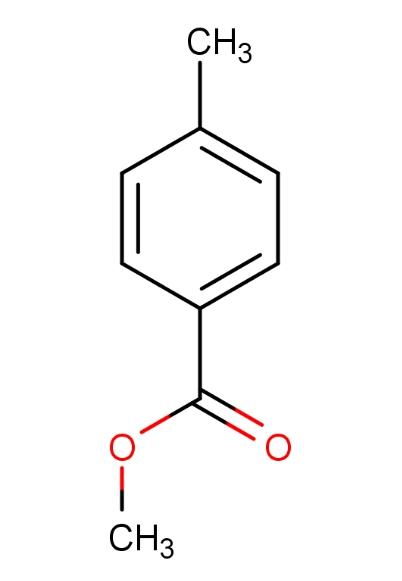
The structure of Methyl 4-methylbenzoate is similar to that of p-methylbenzoic acid methyl ester and ethylene di-4-methylbenzoate, with comparable bond parameters. The molecular unit is planar, with a dihedral angle of 0.95(6)° between the aromatic ring and the –COOMe group. The crystal structure shows intermolecular C—H...O interactions, forming infinite chains extending along the [001] direction.
13C NMR: in CDCl3

1H NMR: 90 MHz (CDCl3 format)
Appearance: Opaque, colorless to white, glossy crystalline solid
Odor: Strong, unpleasant smell
Density: 1.06
Boiling Point: 103-104°C at 15 mm Hg (lit.)
Melting Point: 32-35°C (lit.)
Flash Point: 90°C
Water Solubility: <0.1 g/100 mL at 22°C
Dielectric Constant: 4.3 (33°C)
LogP: 2.7 at 25°C
Refractive Index: 1.508
Vapor Density: 4.7 (vs air)
Vapor Pressure: 1 mm Hg (39°C)
Stability: Stable at room temperature in a sealed container under normal storage and handling conditions.
Storage Conditions: Keep away from heat sources, sparks, and open flames. Store in a sealed container in a cool, dry, well-ventilated area, away from incompatible materials.
Methyl 4-methylbenzoate is an important pharmaceutical intermediate. It is obtained through esterification of p-methylbenzoic acid with methanol in the presence of a catalyst. With increasing demand, developing a high-conversion manufacturing device is essential. Esterification is typically a reversible reaction; therefore, removing water from the product is necessary to drive the reaction toward ester formation.
Xu Songhao et al. reported a device for producing Methyl 4-methylbenzoate, which includes an esterification tower, distillation tower, reboiler, first condenser, second condenser, and a water separator. The esterification tower features a stirring device and connects to the water separator. The water separator is linked to the first condenser, and the outlet of the water separator connects to the distillation tower. The distillation tower connects to the reboiler, with the upper part of the distillation tower linked to the second condenser. The esterification tower contains a ring bubble tray with several bubble holes. This new structure ensures that the reaction proceeds toward ester formation, improving product yield.
According to OSHA hazard communication standards from 2012, Methyl 4-methylbenzoate is classified as a hazardous substance. It may cause skin corrosion or irritation, severe eye damage or irritation, and target organ toxicity (single exposure), primarily affecting the respiratory system. Appropriate personal protective equipment and face protection should be worn, ensure good ventilation, avoid direct contact with skin, eyes, or clothing, and prevent ingestion and inhalation. Avoid dust formation.
General Advice: Consult a doctor. Present the safety data sheet to the attending physician.
Inhalation: Move the patient to fresh air. If breathing stops, perform artificial respiration. Consult a doctor.
Skin Contact: Wash with soap and plenty of water. Consult a doctor.
Eye Contact: Rinse thoroughly with plenty of water for at least 15 minutes and consult a doctor.
Ingestion: Do not induce vomiting in an unconscious person. Rinse mouth with water. Consult a doctor.
Personal Precautions, Protective Equipment, and Emergency Procedures: Use personal protective equipment. Avoid dust formation. Avoid inhalation of vapors, mists, or gases. Ensure good ventilation. Evacuate personnel to a safe area. Avoid inhaling dust. Refer to Section 8 for personal protection.
Environmental Precautions: Prevent further leakage or spillage if safe to do so. Do not let the product enter drains. Avoid release into the environment.
Methods and Materials for Containment and Cleaning Up: Collect and dispose of. Sweep and shovel. Store in a suitable, closed container for disposal.
Safe Handling Precautions: Avoid contact with skin and eyes. Avoid dust and aerosol formation. Obtain special instructions before use. Provide appropriate ventilation in areas where dust is formed.
Safe Storage Conditions, Including Incompatibilities: Store in a cool place. Keep container tightly closed, and store in a dry, well-ventilated area.
[1]https://pubchem.ncbi.nlm.nih.gov/compound/Methyl 4-methylbenzoate
[2]https://www.osha.gov/
[3]https://www.guidechem.com/msds/99-75-2.html
[4]https://www.guidechem.com/encyclopedia/methyl-4-methylbenzoate
[5]Saeed A, Rafique H, Fl?rke U. Methyl 4-methylbenzoate[J]. Acta Crystallographica Section E: Structure Reports Online, 2008, 64(5): o821-o821.
[6]https://en.wikipedia.org/wiki/Methyl_p-toluate
 |
|
 EN
EN
 Agricultural News
 Food News
 Industrial News
 Cosmetic News
 Pharmaceutical News
 Science News


 3YRS
3YRS

