-
We detected your language preference as English. Would you like to switch to the English version for a better experience?
Switch to English
Stay here


Paraquat dichloride, also known as 1,1'-dimethyl-4,4'-bipyridinium dichloride, also referred to as Methyl Viologen and Gramoxone. Paraquat dichloride, CAS number 1910-42-5, is an organic compound. The common name for Methyl Viologen is "Paraquat," which is one of the most widely used herbicides in the United States. Paraquat, also known as Paraquat dichloride, is referred to as Baracide in Taiwan. Its chemical name, N, N'-dimethyl-4,4'-bipyridinium dichloride, and its chemical formula (C12H14N2)2+ exist in a divalent cation form. The product is available in two forms: dichloride and dimethyl sulfate salt, and it is classified as a bipyridine heterocyclic compound.
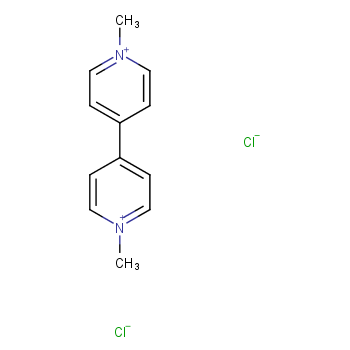
Paraquat dichloride, with the IUPAC name 1,1'-Dimethyl[4,4'-bipyridine]-1,1'-diium dichloride, has a molecular formula of C12H14Cl2N2 and a chemical formula of [(C6H7N)2]Cl2, with a structural formula of CH3Cl-N-C5H4-C5H4-N-CH3Cl. Its molecular weight is 257.2 Da. It is classified as a viologen, which belongs to a family of redox-active heterocycles with similar structures. The chemical structure of paraquat dichloride is as follows:
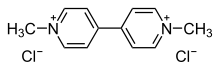
paraquat dichloride structure
Paraquat dichloride (C12H14Cl2N2, CAS: 1910-42-5) in its pure form appears as white needle-like crystals. It is highly soluble in water and methanol, but less soluble in acetone and ethanol, and insoluble in hydrocarbons. This substance often contains crystallization water and loses this water at 50°C. When added to a solution of sodium bisulfite and ammonia, the solution turns deep purple, which becomes pure blue upon dilution, and remains purple at higher concentrations. This color change can be used as a redox indicator (from blue to colorless). It is more stable in acidic media but unstable in alkaline conditions, and it has corrosive effects on metals. Its melting point ranges from 175-180°C.
Paraquat is a widely used herbicide in agriculture, but improper use can lead to severe health issues or even life-threatening conditions. It typically appears as an odorless yellow solid or gray-white powder. In the United States, paraquat is sold as a liquid with added blue dye to prevent confusion with beverages, and it emits a strong, pungent odor as a warning sign to prevent accidental ingestion and induce vomiting. To ensure safety, the U.S. Environmental Protection Agency lists paraquat as a restricted-use pesticide, permitting its application only by certified professional applicators.
The minimum lethal dose of paraquat for humans is approximately 35 milligrams per kilogram of body weight. According to the World Health Organization’s "Environmental Health Criteria: Paraquat and Diquat" (1984, p. 76), the estimated lethal dose for humans is about 14 milliliters of 40% paraquat solution. The lethal dose or concentration (LD, LC) is as follows:
While paraquat dichloride plays a crucial role in agriculture, its potential dangers should not be overlooked. This chemical can cause serious harm to both human health and the environment, so strict adherence to relevant laws, regulations, and safety guidelines is essential when using it.
[1]https://zh.wikipedia.org/wiki/%E7%99%BE%E8%8D%89%E6%9E%AF
[2]https://en.wikipedia.org/wiki/Paraquat
[3]https://baike.baidu.com/item/%E7%99%BE%E8%8D%89%E6%9E%AF
[4] Li Bing. Expression of cytokines in the kidneys of rats with acute paraquat poisoning and the effect of ulinastatin on them[D]. Hebei: Hebei Medical University, 2018. DOI:10.7666/d.D01513875.
[5] Kong Deqin. Study on the role and mechanism of PARP1/Sirt1 in regulating mitochondrial reactive oxygen species in paraquat-induced apoptosis of lung epithelial cells[D]. Air Force Medical University, 2019.
[6]https://pubchem.ncbi.nlm.nih.gov/compound/Paraquat
[7]https://www.epa.gov/ingredients-used-pesticide-products/paraquat-dichloride
 |
 |
 |
 |
|
|
 EN
EN
 Agricultural News
 Food News
 Industrial News
 Cosmetic News
 Pharmaceutical News
 Science News

 6YRS
6YRS


