-
We detected your language preference as English. Would you like to switch to the English version for a better experience?
Switch to English
Stay here


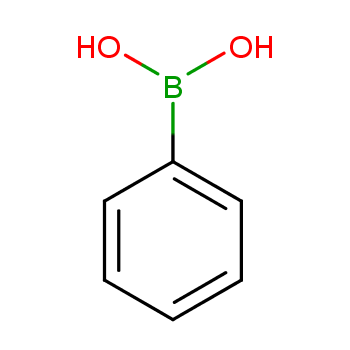
Phenylboronic acid (C6H5BO2) is a white powder with a melting point between 216-219°C, sparingly soluble in water and solvents like benzene, but readily soluble in ether and methanol. It serves as an important chemical intermediate, widely applied in pharmaceuticals, pesticides, materials, and other fields.
In catalytic reactions involving phenylboronic acid self-coupling and oxidation, gold and palladium nanoparticles, as well as gold/palladium nano-clusters, catalyze the formation of biphenyl in the presence of oxygen. Selective oxidation of phenylboronic acid yields phenol, showcasing its oxidative reactivity. Additionally, through non-covalent bonds such as hydrogen bonding and hydrophobic interactions or dynamic reversible covalent bonds, phenylboronic acid efficiently delivers proteins of different molecular weights and charges, demonstrating its value in protein intracellular delivery. Observation of biphenyl and phenol formation in Suzuki coupling experiments further highlights the multifunctionality and application prospects of phenylboronic acid. This article will delve into various reactions of phenylboronic acid in organic synthesis, showcasing its extensive application value.
The reaction mechanisms of phenylboronic acid primarily involve the Suzuki-Miyaura coupling reaction, borylation reaction, and Buchwald-Hartwig amination reaction.
The Suzuki-Miyaura coupling reaction is a common method for introducing boron atoms into organic compounds, constructing aromatic compounds via the reaction of boronates with organic compounds. This reaction is widely used in pharmaceuticals, catalysis, polymer, and advanced materials preparation due to its broad substrate tolerance, good stereo- and regioselectivity, low toxicity of organoboron reagents, and stability.
Borylation reactions introduce inorganic boron compounds into organic compounds, which can be achieved through reactions of boron with halogens, hydroxyl groups, or epoxides.
The Buchwald-Hartwig amination reaction introduces ammonia or amines into organic compounds, involving proton transfer and water elimination processes.
These reaction schemes require an understanding of the reaction mechanism of phenylboronic acid and the properties of key intermediates. Mastery of this knowledge allows chemists to better control the reaction process, obtain desired products, and provide powerful tools for research and application in the chemical field.
The Suzuki-Miyaura coupling reaction is a common carbon-carbon coupling reaction in organic chemistry, mainly used for synthesizing aromatic compounds such as benzene and its derivatives. This reaction involves a cross-coupling process between molecules, resulting in direct connections between carbon atoms and increasing the molecular weight and complexity of the reactants.
The mechanism of the Suzuki coupling reaction typically begins with the oxidative addition of organic halides or pseudo-halides to form a palladium(II) complex B from a zero-valent palladium(Pd(0)) complex A. Subsequently, the anion X- from the Pd(II) complex B undergoes ion exchange with the anion from the base, forming intermediate C. In the presence of the base, intermediate C undergoes transmetalation with the carbon-boron bond in the organic boron reagent, transferring the group from the boron reagent to the palladium metal. Finally, a new carbon-carbon bond is formed through reductive elimination, and the resulting Pd(0) complex A can initiate the next cycle. The reaction involves oxidative addition, ion exchange, transmetalation, and reductive elimination processes, thereby constructing carbon-carbon single bonds. The reaction mechanism is illustrated in the figure below:

Borylation reaction is an important reaction in organic chemistry, introducing boron atoms into organic molecules to enhance their stability and reactivity. It is also a crucial step in organic synthesis because the introduction of boron atoms can enhance the electronic structure and chemical properties of molecules.
Currently, borylation reactions are mainly classified into C-H borylation and C-C borylation. C-H borylation mainly involves the substitution of hydrogen on aromatic rings with boron, while C-C borylation involves the borylation between two carbon atoms. In C-C borylation, the most significant reaction is the introduction of trifluoromethyl boronic acid potassium into the benzene ring to stabilize its electronic structure.
Phenylboronic acid serves as a common fluorescent probe and an important boronating reagent. Through borylation reactions, hydroxyl groups in phenylboronic acid can be converted into phenylboronate, which can be used in the synthesis of fluorescent probes and cell labeling.
The Buchwald-Hartwig reaction, an important palladium-catalyzed cross-coupling reaction, efficiently combines phenylboronic acid with amines to generate aromatic amines. It plays a significant role in organic synthesis by introducing various organic functional groups into aromatic rings, constructing molecules with complex structures.
The mechanism of the Buchwald-Hartwig amination reaction mainly involves the cross-coupling reaction of phenylboronic acid with amines under the catalysis of a palladium catalyst. This process exhibits high selectivity as the substituent on the amine can be any organic group, making the reaction highly selective in synthesizing specific structural aromatic amines.
Phenylboronic acid, as a commonly used chemical reagent in laboratories, participates in many other important reactions such as cross-coupling reactions and boronate ester formation.
In cross-coupling reactions, phenylboronic acid serves as an acyl transfer agent, successfully forming new bonds between two molecules, thus constructing larger molecules. This coupling reaction is widely used in the chemical synthesis of drugs and materials.
In boronate ester formation reactions, phenylboronic acid acts as a catalyst for esterification reactions, forming new C-O bonds with organic lithium reagents as Grignard reagents, thus protecting diols or diamines effectively during the synthesis process.
The versatility of phenylboronic acid allows its widespread application in various synthetic transformations. From pharmaceuticals to materials, from chemical synthesis to biosynthesis, phenylboronic acid has made significant contributions and is widely used in chemical laboratories and industrial applications.
This article discusses the chemical reactions of phenylboronic acid, involving Suzuki-Miyaura coupling, borylation, and Buchwald-Hartwig amination reactions. Understanding and applying these reaction mechanisms are crucial for advancing material design and development, achieving progress in biotechnology research and applications, and driving chemical research forward. We encourage readers to further explore the potential of phenylboronic acid in related fields and contribute to more chemical synthesis and biotechnology research using methods like Buchwald-Hartwig amination.
[1] Cheng, J., Jin, J., Yang, X., et al. Innovative Experimental Design Exploring the Mechanism of Organic Chemical Reactions Based on Suzuki-Miyaura Coupling Reaction. Chemical Education (Chinese and English), 2023, 44(08): 82-88. DOI:10.13884/j.1003-3807hxjy.2022040034.
[2] Fu, X. Research Progress on Buchwald-Hartwig Coupling Reaction of Halogenated Aromatic Hydrocarbons and Amines. Journal of Bohai University (Natural Science Edition), 2022, 43(02): 103-118. DOI:10.13831/j.cnki.issn.1673-0569.2022.02.011.
[3] Guo, L. Synthesis Study of Pentafluorophenylboronic Acid Compounds [D]. Guizhou University, 2018.
[4] Li, H. Preparation of Adsorption Materials and Fluorescent Probes Based on Phenylboronic Acid [D]. Lanzhou University, 2018.
|
 |
 |
 EN
EN
 Agricultural News
 Food News
 Industrial News
 Cosmetic News
 Pharmaceutical News
 Science News


 6YRS
6YRS


