
What is BeCl2?
Beryllium chloride, with a chemical formula of BeCl2, is a compound that exists as a white crystalline solid at room temperature. It is highly soluble in water and has a melting point of 405°C. Beryllium chloride is commonly encountered as a dihydrate with the formula BeCl2·2H2O. This compound is highly toxic and poses serious health risks upon exposure, including respiratory and skin irritation, as well as potential carcinogenic effects.
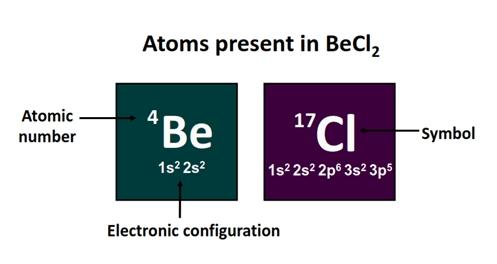
(Image Source: Is BeCl2 polar or nonpolar? - Polarity of BeCl2)
What is Polarity?
Polarity describes the distribution of electrons in a molecule or compound. In chemistry, the polarity of a molecule refers to the uneven distribution of positive and negative charges within the molecule, leading to the presence of positive and negative poles. This uneven distribution is primarily influenced by differences in electronegativity between atoms.
Electronegativity is a measure of an atom's ability to attract electrons. The polarity of a bond is determined by the difference in electronegativity between the atoms involved. When atoms with significantly different electronegativities form a bond, the shared electron pair tends to be closer to the more electronegative atom, resulting in a polar bond.
Polar molecules exhibit unique behaviors in chemical reactions and physical properties, such as solubility, melting point, and boiling point. These properties play crucial roles in various chemical and biological processes.
Polarity of BeCl2
Beryllium chloride presents an interesting case regarding polarity. Despite the electronegativity difference between beryllium and chlorine atoms, BeCl2 is a polar molecule. Why is BeCl2 polar?
(1) Dipole Moment
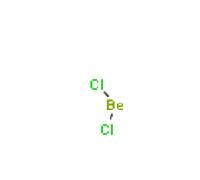
Chlorine is significantly more electronegative than beryllium, resulting in polar covalent bonds between beryllium and chlorine atoms. The geometry of BeCl2 is linear, with two chlorine atoms arranged symmetrically around the beryllium atom. Despite the polar bonds, the symmetrical arrangement of the two chlorine atoms results in the
cancellation of dipole moments, yielding a net dipole moment of zero.
(2) Electronegativity
Beryllium has a relatively low electronegativity compared to chlorine. Although the bonds between beryllium and chlorine are polar due to the electronegativity difference, the linear molecular geometry of BeCl2 results in symmetrical distribution of electron density, leading to
negligible overall polarity.

Therefore, despite the polar bonds,
beryllium chloride (BeCl2) is a nonpolar molecule.
Application of BeCl2 Polarity
Beryllium chloride, despite being nonpolar, finds applications in various fields. It is primarily used in the production of beryllium metal and other beryllium compounds. Additionally, beryllium chloride serves as a catalyst in organic synthesis, particularly in Friedel-Crafts reactions and other organic transformations.
Highlight of Beryllium Chloride
| Beryllium Chloride (BeCl2) Cas 7787-47-5 |
| Molecular formula |
BeCl2 |
| Molecular shape |
Linear |
| Relative molecular mass |
79.92 g/mol |
| Solubility |
Highly soluble in water |
| Melting point |
405°C |
| Boiling point |
520 °C |




 EN
EN
 Agricultural News
 Food News
 Industrial News
 Cosmetic News
 Pharmaceutical News
 Science News

 5YRS
5YRS

