-
We detected your language preference as English. Would you like to switch to the English version for a better experience?
Switch to English
Stay here


Tetrazoles possess significant chemical structural features and find extensive applications across various fields. Their unique structure and properties have made them a focal point of many research and applications in fields such as medicine and materials science. The synthesis of tetrazoles is diverse, offering the possibility of synthesizing tetrazole derivatives with different structures and properties through various synthetic routes, thereby providing more possibilities for research and applications in various fields. This article will introduce the synthesis methods of tetrazoles, discussing different synthesis approaches and their significance in tetrazole compound research, aiming to better understand and apply this class of compounds to promote the development and innovation in related fields.
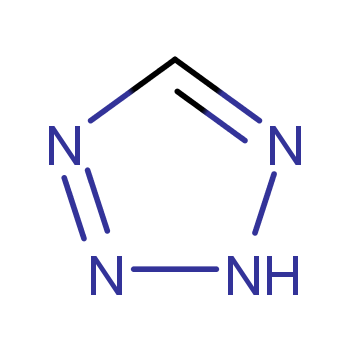
Tetrazole is a class of artificially synthesized organic heterocyclic compounds consisting of a five-membered ring with four nitrogen atoms and one carbon atom. The name "tetrazole" also refers to the parent compound with the chemical formula CH2N4, which has three isomers. The structure of the parent compound with the chemical formula CH2N4 is shown in the figure below:

Tetrazoles are a major class of heterocycles containing one carbon atom and four nitrogen atoms. They do not exist naturally. Interestingly, they have the most nitrogen atoms in a stable heterocyclic ring because tetrazole is highly explosive even at low temperatures. In 1885, the Swedish chemist J. A. Bladin first reported the synthesis of tetrazole derivatives at Uppsala University. He observed that the reaction of dicyanobenzylhydrazine with nitrous acid formed a compound, which he later named "tetrazole" for this new ring structure. Depending on the number of substituents, tetrazoles can be classified into non-substituted, mono-substituted, di-substituted, and tri-substituted. 5-substituted tetrazoles with 6π electrons may exist in the I or II tautomeric forms (as shown in the figure). In solution, the 1H tautomer is the predominant form, but in the gas phase, the 2H tautomer is more stable.

Tetrazole derivatives are a major category of heterocycles, important for medicinal chemistry and drug design not only because of their carboxylic bioisosteric acid and amide moiety but also due to their metabolic stability and favorable physicochemical properties. More than 20 FDA-approved drugs contain 1H- or 2H-tetrazole substituents.
Tetrazoles are typically formed by the reaction of organic nitriles with sodium azide (NaN3) in the presence of a catalyst. Here is a breakdown of this process:
The most common pathway for synthesizing tetrazoles is the cycloaddition reaction between azides and synthons such as nitriles, isocyanates, and imino-functionalized groups. Among these methods, converting amides to tetrazoles is one of the essential methods because amides are commercially available and can be readily prepared. Most of the earlier reported amidations have some drawbacks such as separation of amides from acyl chlorides, removal of acyl chlorides prior to azidation, and use of expensive reagents such as silicon tetrachloride and azidosilanes. In the report by R. Sribalan et al., the focus was on improving the method without the need for intermediate separation and using cheaper reagents for the in situ synthesis of tetrazoles from amides. Based on this, a mechanism for tetrazole formation was proposed, as shown in the figure below:

Initially, in the presence of POCl3, the amide can be converted to a nitrile intermediate similar to the Bischler-Napieralski reaction, under the elimination of hydrogen chloride. The nucleophilic addition of azide ion to the nitrile gives intermediate 2, which subsequently undergoes intramolecular cyclization to generate tetrazole 3. According to the proposed mechanism, we understand that the selectivity depends on the azide-tetrazole equilibrium. With an increase in the stoichiometric amount of sodium azide, the equilibrium shifts towards the formation of tetrazole 3. Meanwhile, reducing the amount of sodium azide may not favor the generation of tetrazole. The general procedure for synthesizing tetrazoles is as follows:
Add benzylamine (1.01 mmol), phosphorus oxychloride (10.15 mmol), and sodium azide (4.06 mmol) separately into a round-bottom flask with two necks. One neck of the flask is connected to a reflux condenser with a protective tube, and the other neck is connected to a nitrogen inlet. Stir the reaction mixture at 80°C under a nitrogen atmosphere for 9 hours. Then cool it and quench carefully with ice water, neutralize with saturated sodium bicarbonate solution. Extract the product with ethyl acetate (75 mL), wash with water (2 × 75 mL) and brine (75 mL). Separate the organic layer, dry over anhydrous Na2SO4 and concentrate under reduced pressure.
Add benzylamine (1.01 mmol), phosphorus oxychloride (10.15 mmol), and sodium azide (4.04 mmol) into a 10 mL two-necked RB flask. Then connect one neck of the flask to a reflux condenser with a protective tube, and the other neck to a nitrogen inlet. Purge the reaction mixture with nitrogen for 10 minutes. Then remove the nitrogen inlet and close the flask abruptly with a stopper. Fix the reaction apparatus in a microwave synthesizer (preferably avoiding microwave irradiation of the sealed tube). Microwave irradiate the reaction mixture at 120 W and 80°C for 6 minutes. Then allow the reaction mixture to reach room temperature. Quench the reaction mixture with crushed ice and neutralize with sodium bicarbonate solution. Extract the product with ethyl acetate (75 mL), wash with water (2 × 75 mL) and brine (75 mL). Separate the organic layer, dry over anhydrous Na2SO4 and concentrate under reduced pressure.
There isn't a specific reaction for synthesizing tetrazoles as there are many methods for making five-membered heterocycles. However, some common methods include:
A solution of nitrile (10 mmol), NaN3 (12 mmol, 0.78g), and Py·HCl (10 mmol, 1.15g) in 20 mL DMF is added to a 50 mL round-bottom flask. The reaction mixture is heated at 110°C for 8 hours with vigorous stirring. Conversion is monitored by high-performance liquid chromatography and thin-layer chromatography. The reaction mixture is cooled to room temperature, dissolved in 4 mL of 5 M NaOH solution, and stirred for 30 minutes. Concentrate the solution under reduced pressure by removing DMF and Py; dissolve the residue in 10 mL of water. Adjust the pH to 1 with HCl (3M, 10 mL) to form a precipitate. Then filter the precipitate, wash with 2 × 10 mL of 3M HCl, dry at 80°C overnight, yielding pure tetrazole as a white solid (1.23g). Yield 84% (melting point 216-218°C).
Through the discussion of tetrazole synthesis in this article, we not only understand the significance and importance of tetrazole compounds but also delve into their wide-ranging applications across various fields. The diversity in tetrazole synthesis methods provides researchers with more choices and possibilities. The unique structure and properties of tetrazole compounds bring new opportunities and challenges to various industries, promoting the development and innovation in related fields. Given the potential and importance of tetrazole compounds, we urge researchers to continue exploring the chemical properties and application areas of tetrazoles, embracing their potential, advancing scientific technology, and making greater contributions to the development of human society. Let's work together to expand the application areas of tetrazoles and create a better future.
[1] Sribalan R, Lavanya A, Kirubavathi M, et al. Selective synthesis of ureas and tetrazoles from amides controlled by experimental conditions using conventional and microwave irradiation[J]. Journal of Saudi Chemical Society, 2018, 22(2): 198-207.
[2] Zhou Y, Yao C, Ni R, et al. Amine Salt–Catalyzed Synthesis of 5-Substituted 1 H-Tetrazoles from Nitriles[J]. Synthetic Communications®, 2010, 40(17): 2624-2632.
[3] https://en.wikipedia.org/wiki/Tetrazole
[4] https://pubchem.ncbi.nlm.nih.gov/compound/67519
[5] https://www.ncbi.nlm.nih.gov/pmc/articles/PMC6376451
 |
|
 |
 EN
EN
 Agricultural News
 Food News
 Industrial News
 Cosmetic News
 Pharmaceutical News
 Science News


 15YRS
15YRS

