-
We detected your language preference as English. Would you like to switch to the English version for a better experience?
Switch to English
Stay here


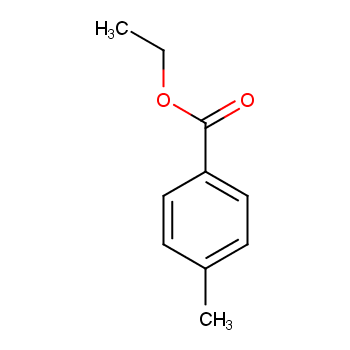
4-Methylbenzoic acid ethyl ester, also known as ethyl 4-methylbenzoate, is an important compound with wide applications in the chemical industry. This article aims to explore the properties and synthesis methods of ethyl 4-methylbenzoate. By delving into this compound, we gain a better understanding of its significance and applications in the chemical industry.
Ethyl 4-methylbenzoate, also referred to as para-toluylic acid ethyl ester, is an organic ester with the molecular formula C10H12O2. It is a colorless transparent liquid commonly used as an intermediate in organic synthesis and as a plasticizer and various additives. Industrial synthesis of ethyl 4-methylbenzoate often involves the esterification reaction between para-methylbenzoic acid and ethanol, with sulfuric acid serving as a dehydrating agent and providing acidic conditions to catalyze the reaction.
Ethyl 4-methylbenzoate consists of an ethyl (C2H5) group connected to the para-toluylic acid ester group (CH3C6H4CO2). The ester group itself originates from benzoic acid (C6H5COOH), with a methyl group (CH3) substituted at the para position (p). It exhibits several key chemical properties:
Ethyl 4-Methylbenzoate State: Liquid at room temperature
Ethyl 4-Methylbenzoate Color: Colorless
Ethyl 4-Methylbenzoate Molecular Formula: C10H12O2
Ethyl 4-Methylbenzoate Molecular Weight: 164.20 g/mol
Ethyl 4-Methylbenzoate Melting Point: 131°C
Ethyl 4-Methylbenzoate Boiling Point: 235°C (at atmospheric pressure); 144-145°C (at 5 mmHg pressure)
Ethyl 4-Methylbenzoate Density: 1.025 g/mL at 25°C
Ethyl 4-Methylbenzoate Refractive Index: n20/D 1.508
Ethyl 4-Methylbenzoate Solubility: Insoluble in water or slightly soluble in water, soluble in ethanol, acetone, and chloroform, among other organic solvents.
In industrial production, the esterification reaction of methyl benzoate with ethanol is commonly employed. In this process, sulfuric acid serves as a dehydrating agent and provides acidic conditions to catalyze the reaction. Esterification reactions exhibit reversible characteristics, so increasing the amount of sulfuric acid can facilitate the progress of the esterification reaction. However, excessive sulfuric acid usage may lead to partial etherification of alcohols, resulting in more side reactions and potentially increasing the burden of waste disposal. Ma Yonggang et al. introduced a distillation-dehydration esterification process, where the esterification liquid undergoes alkali washing, water washing, and then distillation to obtain ethyl 4-methylbenzoate, with a yield of 92% to 95%.
The specific process involves adding methyl benzoate and 95% ethanol, along with a small amount of sulfuric acid, in a predetermined ratio into a reaction flask. Reflux reaction is carried out with steam entering the middle of the distillation column. During the distillation process, the reflux ratio is controlled at R=3 to 4 to remove water from ethanol. Approximately 93% to 94% of ethanol is obtained at the top of the column and returned to the reaction vessel as reflux, while the bottom of the column yields water with ethanol content below 3%, which is then discharged. After the reaction is complete, it is cooled to room temperature, obtaining the esterification reaction solution in the reactor, followed by conventional operations such as alkali washing, water washing, extraction, and finally distillation to obtain the product. The experimental setup is as shown in the diagram below:

Biodegradability: Ethyl 4-methylbenzoate is considered to be readily biodegradable, meaning microorganisms can relatively quickly break it down in the environment, minimizing its persistence.
Ecotoxicity: Data on the specific ecotoxicity of ethyl 4-methylbenzoate are limited. However, its structure suggests moderate toxicity to aquatic organisms such as fish and water fleas. Further research is needed for a more definitive assessment.
Information on the specific toxicity of ethyl 4-methylbenzoate is limited. However, as it belongs to esters, it is considered to cause irritation to the eyes, skin, and respiratory system.
Caution is advised in handling ethyl 4-methylbenzoate, following general safety protocols in the laboratory, including wearing personal protective equipment such as gloves and eye protection.
Due to limited data on environmental and health impacts, it is important to refer to the latest Safety Data Sheet (SDS) for ethyl 4-methylbenzoate from reputable suppliers. The SDS will provide specific information on potential hazards, handling procedures, and disposal recommendations. Maintaining caution and following safety procedures are crucial when dealing with any unknown or potentially hazardous chemicals.
[1] Ma, Yonggang, et al. "Improvement of the esterification synthesis process of para-methylbenzoic acid ethyl ester." Shandong Chemical Industry, 2004, (02): 12-13. DOI: 10.19319/j.cnki.issn.1008-021x.2004.02.005.
[2]https://pubchem.ncbi.nlm.nih.gov/compound/66743
[3]https://webbook.nist.gov/cgi/cbook.cgi?ID=C94086&Units=SI&Mask=80
 |
|
 EN
EN
 Agricultural News
 Food News
 Industrial News
 Cosmetic News
 Pharmaceutical News
 Science News

 6YRS
6YRS

