-
We detected your language preference as English. Would you like to switch to the English version for a better experience?
Switch to English
Stay here


Bismuth Triiodide (BiI3) is an ionic compound composed of bismuth (Bi) and iodine (I). It is characterized by its cubic crystal structure and exhibits properties such as high optical and thermal stability. Bismuth Triiodide is often used in applications requiring a reflective surface or in the production of various optical materials.

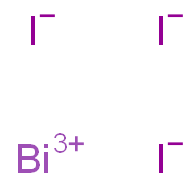
Drawing the Lewis structure of Bismuth Triiodide involves understanding the valence electrons of each atom and the rules governing their arrangement. Here’s a step-by-step guide:
The crystal structure of Bismuth Triiodide features a cubic arrangement with bismuth ions (Bi3+) at the corners and iodine ions (I-) occupying the faces and inside the unit cell. This structure results from the electrostatic attraction between the positively charged bismuth ions and negatively charged iodine ions, leading to a highly ordered lattice.
The molecular orbital theory helps explain the bonding and electronic structure of Bismuth Triiodide. In this compound, the bismuth and iodine atoms form ionic bonds through the transfer of electrons. The valence electrons of bismuth and iodine participate in the formation of bonding and antibonding molecular orbitals, contributing to the overall stability of the compound.
In Bismuth Triiodide, the bismuth ion (Bi3+) experiences crystal field splitting due to the surrounding iodide ions (I-). The iodide ions arrange themselves in an octahedral fashion around the bismuth ion, leading to the separation of the d-orbitals into higher-energy and lower-energy levels. This splitting influences the electronic transitions within the bismuth ion, affecting the compound's optical and spectroscopic properties.
Bismuth Triiodide involves sp3d2 hybridization for the central bismuth atom. The s, p, and d orbitals combine to form six hybrid orbitals, which participate in the formation of ionic bonds with the surrounding iodine atoms. This hybridization facilitates the transfer of electrons from bismuth to iodine, creating the ionic compound BiI3.

In bismuth triiodide (BiI₃), the approximate bond angles between the bismuth and iodine atoms are around 109.5°. This trigonal pyramidal geometry arises from the arrangement of the three iodine atoms around the central bismuth atom, with one lone pair of electrons situated at the apex of the pyramid. The bond length in BiI₃ is approximately 0.287 nm for the Bi–I bond, indicating the strong bonding interactions between bismuth and iodine.
Here are the key properties of Bismuth Triiodide (BiI3):
| Bismuth Triiodide (BiI3) | |
| Molecular formula | BiI3 |
| Crystal structure | The geometry of a triangular pyramid |
| Bond angles | 109.5 degrees |
| Bond length | 0.287 nm |
| Hybridization | sp3d2 |
A Lewis structure can be indicative of an ionic compound if it shows the transfer of electrons from one atom to another, resulting in the formation of positive and negative ions. For example, in Bismuth Triiodide (BiI3), the bismuth atom loses electrons to the iodine atoms, forming Bi3+ and I- ions, respectively. This electron transfer creates a strong electrostatic attraction between the ions, characteristic of ionic compounds.
Lattice energy is the energy released when one mole of a gaseous ionic compound dissociates into its constituent ions. To calculate lattice energy, you can use the Born-Haber cycle, which involves several steps including the ionization energy of bismuth, electron affinity of iodine, enthalpy of formation of bismuth, enthalpy of formation of iodine, and enthalpy of reaction for the formation of BiI3. The specific values would require consulting thermodynamic data tables.
The coordination number of an atom in a complex indicates the number of ligands or donor atoms that are bonded to it. In Bismuth Triiodide (BiI3), the bismuth atom is coordinated to three iodine atoms, making the coordination number three. This reflects the octahedral arrangement of iodine ions around the bismuth ion, facilitating the formation of stable ionic bonds.
In Bismuth Triiodide (BiI3), there are no lone pairs on the bismuth atom. Each iodine atom contributes three lone pairs, but these are involved in forming bonds with the bismuth atom, resulting in a complete octet for each iodine atom and a nearly full octet for the bismuth atom. The absence of lone pairs contributes to the stability of the ionic structure.
|
 |
 |
|
 |
 EN
EN
 Agricultural News
 Food News
 Industrial News
 Cosmetic News
 Pharmaceutical News
 Science News

 1YR
1YR

