-
We detected your language preference as English. Would you like to switch to the English version for a better experience?
Switch to English
Stay here


The Lewis structure, formulated by Gilbert N. Lewis, provides a visual depiction of electron arrangements within molecules. By illustrating valence electrons as dots and bonds as lines, these structures predict a molecule's shape and properties, adhering to the octet rule. The octet rule posits that atoms strive for stability by acquiring eight electrons in their outer shell.
Cobalt Sulfide (CoS) is an inorganic compound consisting of cobalt and sulfur atoms. It typically appears as a black or blue solid, depending on the preparation method, and is often utilized in various applications such as catalysis, magnetic materials, and pigments.

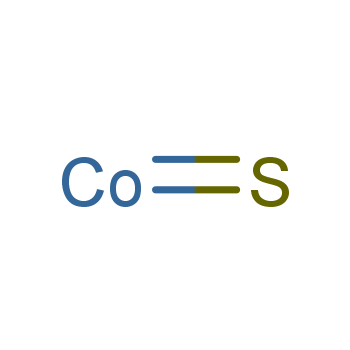
Let's explore the process of drawing the Lewis structure for Cobalt Sulfide (CoS):
The molecular geometry of Cobalt Sulfide (CoS) is determined by the spatial arrangement of atoms around the central cobalt atom. The sulfur atom is bonded to the cobalt atom through a single bond, and with no lone pairs on the sulfur atom, the geometry resembles a linear structure.

The molecular orbital theory addresses electron repulsion and the need for compounds to adopt stable configurations. In CoS, one sigma bond is formed between cobalt and sulfur, with sulfur having one lone pair. Although cobalt has only four valence orbitals, the Lewis structure suggests a single bond, implying the use of d-orbitals in this complex. However, advanced calculations reveal the actual electronic structure consists of four delocalized bonds across all atoms, rather than a single bond involving d-orbitals.
The Lewis structure indicates that Cobalt Sulfide (CoS) adopts a linear geometry. In this arrangement, the cobalt atom is at the center bonded to the sulfur atom, with no lone pairs present on either atom. This linear geometry results from the minimal electron repulsion between the atoms.
The orbitals involved and the bonds produced during the interaction of cobalt and sulfur molecules will be examined to determine the hybridization of Cobalt Sulfide (CoS). The involved orbitals are 3s, 3py, 3pz, 3dx2–y2, and 3dz2. In its ground state, cobalt has the 3s23p4 configuration. During the excited state, one electron from each of the 3s and 3px orbitals is promoted to the unoccupied 3dz2 and 3dx2-y2 orbitals. All six half-filled orbitals (one 3s, three 3p, and two 3d) hybridize now, resulting in the production of six sp3d hybrid orbitals.
The bond angle in Cobalt Sulfide (CoS) is approximately 180 degrees, arising from the linear geometry of the molecule, where the cobalt atom is bonded to the sulfur atom with no lone pairs. The bond length in CoS is approximately 0.186 nm.
| Cobalt Sulfide (CoS) Cas 1317-42-6 | |
| Molecular Formula | CoS |
| Molecular Shape | Linear |
| Polarity | Nonpolar |
| Hybridization | sp3d Hybridization |
| Bond Angle | 180 degrees |
| Bond Length | 0.186 nm |
To determine if a Lewis structure is polar, examine the molecular geometry and bond polarity. In the case of Cobalt Sulfide (CoS), the linear geometry and lack of lone pairs result in a nonpolar molecule due to the cancellation of dipole moments.
To calculate the total bond energy of Cobalt Sulfide (CoS), first, look up the bond energy for a single cobalt-sulfur (Co-S) bond, which is approximately 327 kJ/mol. CoS has one Co-S bond, so the total bond energy is 327 kJ/mol for one mole of CoS molecules.
Bond order is the number of chemical bonds between a pair of atoms. In the Lewis structure of Cobalt Sulfide (CoS), there is one Co-S bond, so the bond order for the Co-S bond is 1.
Electron groups in a Lewis structure encompass both bonding pairs (shared electrons) and lone pairs (non-bonded electrons) around an atom. In Cobalt Sulfide (CoS), the electron groups include one Co-S bond and no lone pairs on either atom.
In a Lewis dot structure, the dots represent valence electrons. Each dot corresponds to one valence electron of an atom. In Cobalt Sulfide (CoS), cobalt is represented by two dots (two valence electrons) and sulfur is represented by six dots (six valence electrons).
|
 |
 |
|
|
 EN
EN
 Agricultural News
 Food News
 Industrial News
 Cosmetic News
 Pharmaceutical News
 Science News

 6YRS
6YRS

