
I. Executive Summary
Decanoic acid (capric acid, CAS 334-48-5) is a saturated C10 medium-chain fatty acid that functions as one of the oleochemical industry's most versatile platforms. Commercially it is recovered by hydrolysis and fractionation of lauric oils, chiefly coconut and palm kernel oil, and sold either as a narrow-cut C10 acid or as the caprylic/capric blend that feeds medium-chain triglyceride production. Its 2026 relevance rests on four demand pillars: surfactants and personal-care esters, MCT nutrition, pharmaceutical excipients and oil-based depot prodrugs, and bio-based industrial esters.
Because the molecule is agriculturally derived, its cost base is tied to lauric-oil crop cycles, crushing margins and the price spread between coconut oil and palm kernel oil, rather than to petrochemical benchmarks. Supply security therefore depends on feedstock diversification, on fractionation capacity capable of resolving the C8/C10 split, and on documented sustainability of the originating oil. Buyers increasingly treat proof of origin as a specification parameter on the same footing as assay and colour.
The commercial framework is defined by grade segmentation and by regulatory framing. Technical oleochemical grade serves surfactants and lubricants, food-grade material must satisfy food-additive and flavouring rules with tight contaminant control, and pharmaceutical grade must meet USP, Ph.Eur. and FCC expectations under cGMP-aligned quality systems. Decanoic acid itself carries no approved therapeutic indication, and the anti-doping relevance that attaches to decanoate ester prodrugs of hormonal actives must be handled through segregation and documentation controls in contract manufacturing.
II. Product Deep Dive: Molecular Mechanisms and Production Evolution
2.1 Physicochemical Properties and Mechanisms
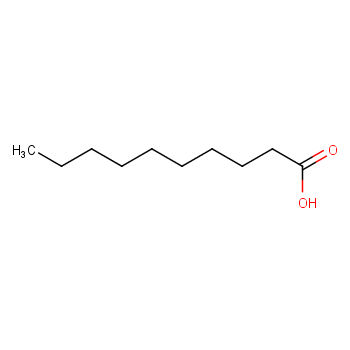
Decanoic acid (CH3(CH2)8COOH, molecular weight 172.26) is a ten-carbon straight-chain carboxylic acid that melts near 31–32 °C and boils around 268–270 °C at atmospheric pressure, which places it at the practical boundary between liquid and solid handling. Its acid dissociation constant near pKa 4.9 means that at neutral pH the molecule is predominantly ionised, while the C10 chain confers a logP of roughly 4 and very low water solubility in the protonated form. This amphiphilic balance governs everything that follows: the acid behaves as a hydrophobic building block in ester synthesis and as an anionic surfactant once neutralised.
- Medium-Chain Metabolic Behaviour: Unlike long-chain fatty acids, C10 is absorbed largely into the portal circulation and enters mitochondria with limited dependence on the carnitine shuttle, so it is oxidised rapidly and contributes efficiently to ketogenesis. Decanoic acid has additionally been characterised in preclinical research as a non-competitive antagonist at AMPA-type glutamate receptors, a finding explored in ketogenic-diet literature; this is investigational chemistry only and carries no approved therapeutic indication.
- Amphiphilic and Membrane-Active Character: The carboxylate is an effective anionic surfactant above its pKa, and the C10 chain length sits at the transition between hydrotropic and micelle-forming behaviour, letting formulators tune foam, wetting, emulsification and solubilisation. The same amphiphilicity underpins pH-dependent disruption of microbial membranes, which is exploited in food-contact sanitation, feed hygiene and crop-protection research.
2.2 Synthesis and Manufacturing Technologies
Industrial decanoic acid is obtained by liberating fatty acids from lauric-oil triglycerides and then separating the C10 fraction from its C8, C12 and C14 neighbours. The chemistry is mature, and competitive advantage now comes from energy integration, fractionation precision, contaminant control and the ability to certify the originating oil rather than from the hydrolysis step itself.
- Fat Splitting of Lauric Oils: Continuous high-pressure countercurrent steam hydrolysis at roughly 250 °C and 50 bar converts coconut or palm kernel triglycerides to fatty acids and sweet water with conversions near 98–99%, followed by glycerol recovery and effluent treatment. Enzymatic lipase splitting operates at near-ambient conditions with markedly lower energy demand and better colour, and is increasingly attractive where Scope 1 emissions and product quality both matter, at the cost of longer residence times.
- Fractionation and Finishing: Multi-column high-vacuum fractional distillation resolves the C8, C10 and C12 cuts, with the caprylic/capric split being the critical separation controlling final specification; hydrogenation removes traces of unsaturates where iodine value must be minimised. Bleaching earth and activated carbon polishing, deodorisation and careful temperature control protect colour and oxidative stability, while release testing covers GC-FID chain-length distribution, iodine value, acid value, peroxide value, moisture and heavy metals.
2.3 Core Application Matrix
- Oleochemicals, Surfactants and Personal Care: Decanoic acid is esterified, ethoxylated, amidated and converted to betaines, alkanolamides, sorbitan esters and monoglycerides, serving as emollient, emulsifier, foam booster and solubiliser. Caprylic/capric triglyceride produced from the C8–C10 cut is a standard light, stable emollient and carrier in cosmetic and topical formulations.
- Pharmaceutical Excipients and Depot Esters: Medium-chain triglycerides meeting USP/NF and Ph.Eur. monograph requirements are used as solubilising vehicles in soft gelatin capsules, injectable and topical formulations, and as lipid components of self-emulsifying drug-delivery systems. Decanoic acid is also the acyl moiety in decanoate ester prodrugs formulated in oil for sustained-release depot injection, which places strict demands on acid purity, peroxide value and documentation.
- Food, Feed and Industrial Uses: The acid and its esters contribute coconut, dairy and fruity flavour notes under recognised flavouring assessments, while medium-chain fatty acid blends are studied in animal nutrition for gut-health and hygiene applications. Industrial outlets include fatty-acid salt herbicides, lubricant and plasticiser esters, corrosion inhibitors and metal-working fluid additives where bio-based content is valued.
III. Global Market Supply-Demand Landscape and Export Trends
3.1 Demand Drivers and Market Shifts
Demand is being reshaped by four structural trends. MCT and ketogenic nutrition continue to expand, pulling C8–C10 volume into food, beverage and clinical-nutrition channels. Personal-care formulators are substituting light, bio-based emollients for mineral-oil and silicone systems. Pharmaceutical interest in lipid-based delivery and long-acting injectables is raising specification expectations. And bio-based lubricant and solvent policy is opening industrial outlets that reward renewable carbon content.
3.2 Capacity Distribution and Export Flows
Capacity sits close to the feedstock. South-East Asian producing countries dominate lauric-oil crushing, splitting and fractionation, while China and India operate large refining and derivative complexes serving both domestic and export markets. Europe and North America retain specialty oleochemical capacity focused on derivatives, pharmaceutical-grade finishing and certified sustainable streams. Trade therefore flows as bulk acid and MCT from producing regions to consuming regions, with high-specification and certified material moving under long-term contracts supported by audit and traceability documentation.
3.3 Market Bifurcation and Pricing Dynamics
The market divides sharply by grade and by provenance. Technical oleochemical grade tracks lauric-oil benchmarks closely and behaves as a commodity, whereas food, cosmetic and pharmaceutical grades carry premiums reflecting additional distillation, contaminant control, certification and documentation. Pricing follows coconut and palm kernel oil quotes, freight, currency and weather-linked crop outcomes, and is further influenced by export-policy changes in producing countries. Certified segregated sustainable material and compendial-grade excipients command the widest spreads over technical grade.
IV. In-depth Analysis of Global Compliance and Regulatory Barriers
Decanoic acid sits at the intersection of chemical, food, cosmetic and pharmaceutical regulation, so compliance is best managed as a matrix of end-use dossiers rather than as a single registration. A supplier serving all four channels must maintain REACH and TSCA currency, food-grade contaminant and provenance evidence, cosmetic-grade documentation, and pharmaceutical-grade compendial testing with appropriate GMP discipline.
4.1 European Market: REACH, CLP, and Sector-Specific Directives
- REACH Registration and CLP Classification: Decanoic acid is registered under REACH, and EU suppliers and importers must keep tonnage band, dossier and safety data sheet alignment current, including any jointly submitted data and exposure considerations. Under CLP and GHS the substance typically carries the skin and eye irritation classifications characteristic of medium-chain fatty acids, with corresponding labelling, packaging and downstream communication obligations.
- Food, Cosmetic and Deforestation Rules: Food and flavouring use is governed by the EU flavouring framework and by food-contact materials legislation where the acid or its esters contact food, while cosmetic use falls under the Cosmetics Regulation with ingredient and purity expectations. Where palm-derived feedstock is used, the EU Deforestation Regulation requires geolocation-to-plot due diligence and legality assurance, which coconut-derived streams are not subject to in the same way.
4.2 North American Market: TSCA, EPA, and FDA Regulations
- TSCA Listing and EPA Programmes: Decanoic acid is an active TSCA inventory substance, and importers must certify inventory status accordingly. On the EPA side, fatty acids and their salts benefit from long-standing tolerance exemptions and minimum-risk pesticide treatment when used as herbicidal or antimicrobial actives, which supports their positioning in bio-based crop protection and sanitation products.
- FDA and Compendial Expectations: Food uses rely on FDA food-additive and flavouring listings with Food Chemicals Codex identity and purity criteria, while pharmaceutical excipient use requires conformity to USP/NF and Ph.Eur. monographs, appropriate DMF support and, for drug-substance or registered-intermediate manufacture, ICH Q7 and ICH Q11-aligned process description and control. Buyers should confirm allergen and prior-cargo declarations where coconut-derived material enters food or cosmetic channels.
4.3 The Critical Hurdle: Quality Control and Safety Limits
Compliance Warning: The decisive quality issue in decanoic acid is contaminant control in a thermally processed natural product. Refining can generate 3-MCPD and glycidyl esters, so food and pharmaceutical grades require validated mitigation and documented results against applicable contaminant limits, together with heavy metals, unsaponifiable matter, iodine value, peroxide value and colour stability testing. Because decanoic acid is also the acyl component of decanoate ester prodrugs, contract manufacturers must maintain strict segregation and documentation where hormonal or other doping-controlled actives are handled under WADA-prohibited categories, and must never present material destined for such synthesis as suitable for consumer or food use. Decanoic acid itself has no approved therapeutic indication and must not be promoted with health, dosing or efficacy claims.
V. Green Trade Barriers and ESG in Manufacturing
Renewable-carbon credentials are the strongest ESG asset for decanoic acid, and land-use risk is its greatest vulnerability. Customers value the bio-based content and the biodegradability of fatty-acid derivatives, but they also scrutinise deforestation, peat conversion, biodiversity and labour practices in the originating landscapes.
5.1 Carbon Footprint and Circular Economy
Cradle-to-gate emissions are dominated by Scope 3 agricultural inputs: fertiliser-derived nitrous oxide, land-use change and methane from palm oil mill effluent, whereas Scope 1 steam for splitting and distillation and Scope 2 electricity for vacuum and cooling are comparatively modest. Credible reduction programmes combine biogas capture at mills, energy-efficient distillation with heat recovery, renewable steam and power, and the use of residues as boiler fuel. Circular-economy value comes from glycerol valorisation, recovery of distillation residues and the biodegradable end-of-life profile of fatty-acid derivatives.
5.2 Sustainable Sourcing and Traceability
Traceability must reach the mill and, under deforestation rules, the production plot, supported by recognised certification schemes operating segregated or mass-balance models and by ISO 9001 quality and ISO 14001 environmental management systems. Buyers should require product-level carbon footprints covering Scope 1, Scope 2 and Scope 3 emissions, geolocation evidence for palm-derived volumes and auditable smallholder inclusion data, since sustainability questionnaires now test documentation depth rather than intention.
VI. Supply Chain Resilience and Export Logistics
Because decanoic acid melts just above ambient temperature, logistics design must choose deliberately between molten and solid handling, and then control oxidation, colour and contamination in whichever mode is selected. Material that is overheated or held in contact with iron or copper discolours and develops odour, which is the most common cause of rejection at destination.
6.1 Packaging Standards and Moisture/Contamination Control
- Molten Handling and Materials Compatibility: Bulk material moves in heated, insulated ISO tanks or tankers held typically between 45 and 60 °C, with 316L stainless steel or appropriately lined construction and documented temperature records throughout transit. Solid product is supplied as flakes or pastilles in polyethylene-lined bags or fibre drums, which removes heating risk but introduces dust and caking considerations.
- Oxidation, Moisture and Food-Grade Integrity: Nitrogen blanketing, limited headspace and avoidance of prolonged hot holding protect colour and peroxide value, while moisture control prevents corrosion and haze. Food, cosmetic and pharmaceutical customers additionally require food-grade cleaning certificates, prior-cargo declarations, allergen segregation statements and, where applicable, preserved Kosher or Halal integrity across the logistics chain.
6.2 Dangerous Goods Identification and Transit Protocols
Decanoic acid is generally not classified as a dangerous good for transport when shipped as solid flakes or as molten liquid at normal handling temperatures, because it falls below the elevated-temperature substance thresholds of the modal regulations and presents no acute transport hazard. Operational risk is nevertheless real: hot-liquid transfers require burn-protection procedures, spill containment and thermal monitoring, and food-grade shipments must comply with sanitary transportation requirements for human and animal food. Carriers and terminals should be selected for heated-storage capability and for documented tank-cleaning regimes.
VII. Enterprise Global Expansion Strategy Guide
Winning positions in decanoic acid are built on specification depth, certified provenance and derivative integration. Producers that only sell split fatty acid compete on oil-linked margins, while those that qualify into food, cosmetic and pharmaceutical channels build defensible positions through documentation.
- Build a Certification-Ready Grade Ladder: Define technical, food, cosmetic and pharmaceutical grades with explicit limits on chain-length distribution, contaminants, colour, peroxide value and heavy metals, then attach the documentation set each channel requires: FCC and food-additive evidence, cosmetic-grade declarations, and USP/Ph.Eur. conformity with DMF or CEP support where monographs apply.
- Secure Feedstock and Hedge the Oil Link: Diversify across coconut and palm kernel streams, contract both segregated and mass-balance certified volumes, hedge coconut and palm kernel oil exposure, and consider toll splitting arrangements in consuming regions to shorten the logistics chain and reduce working-capital exposure to freight.
- Move into Derivatives and Contract Services: Integrate forward into MCT, esters and monoglycerides, and offer custom ester and prodrug synthesis under cGMP-aligned systems with containment, validated analytical methods and strict RUO-versus-clinical campaign separation, which converts a commodity acid into a service business with higher and more stable margins.
VIII. Conclusion
Decanoic acid combines an unusually broad application footprint with a simple, mature production route, which is why it remains central to oleochemical portfolios. Its commercial future is being determined less by hydrolysis technology than by the ability to resolve narrow cuts, control refining contaminants, and prove the provenance of the originating oil to the satisfaction of food, cosmetic, pharmaceutical and ESG auditors.
Through 2026 and beyond, the participants that prosper will be those treating documentation as product: compendial and FCC conformity, REACH and TSCA currency, ICH-aligned GMP where pharmaceutical use is claimed, deforestation due diligence, and Scope 1, 2 and 3 emissions transparency. Those capabilities convert a commodity fatty acid into a qualified, defensible supply position.
IX. Industry Resource Connection and Supplier Ecosystem
Powered by Guidechem
This white paper is exclusively compiled by the Guidechem Intelligence Team based on global customs data, regulatory databases, and industry research. Guidechem is a leading global B2B chemical platform, dedicated to connecting global buyers with verified, high-quality manufacturers.
Relying on Guidechem's extensive global database, we have mapped the core participants in the current global Decanoic acid supply chain:
- North America Supplier Ecosystem: Specialty oleochemical refiners and ingredient distributors supplying food-grade, cosmetic-grade and compendial-grade material with FCC and USP/NF documentation, TSCA-compliant import status and mature allergen and prior-cargo controls.
- Europe Supplier Ecosystem: REACH-registered fractionators and derivative specialists emphasising certified sustainable feedstock, deforestation due diligence, CLP and GHS compliance, and Ph.Eur. conformity with DMF or CEP support for excipient customers.
- Asia-Pacific and China Supplier Ecosystem: Lauric-oil-proximate crushing, splitting and fractionation complexes providing the bulk of globally traded technical and food-grade acid, plus large refining and MCT capacity increasingly certified to ISO 9001 and ISO 14001 standards.
Disclaimer: The content of this white paper is compiled based on public market data and regulatory information available as of 2026. Global chemical regulations are subject to dynamic adjustments. In actual export operations, enterprises must consult professional regulatory advisors or relevant competent authorities to obtain the latest compliance guidance.



 EN
EN
 Agricultural News
 Food News
 Industrial News
 Cosmetic News
 Pharmaceutical News
 Science News

 13YRS
13YRS

