
I. Executive Summary
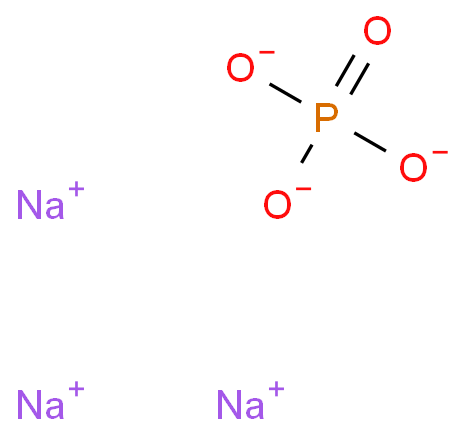
Trisodium phosphate (TSP, CAS 7601-54-9, Na3PO4) is the anhydrous form of the most alkaline commercial orthophosphate. It is a workhorse of food processing, industrial cleaning and water treatment. In 2026 it sits where four forces meet: steady food demand for phosphate emulsifying salts, shrinking detergent phosphate use under eutrophication rules, growing water-treatment volumes, and rock supply concentrated in few provinces.
The material is sold as technical, food and compendial grades. Buyers should note that the anhydrous salt differs from the dodecahydrate, which has a separate CAS identity and a lower alkali content per kilogram. Its value rests on alkalinity, calcium control and protein interaction: it softens water, saponifies fats, peptises soils and, in food, acts as an emulsifying salt. Demand spans processed cheese, cereal manufacture, clean-in-place systems, boiler water treatment and metal preparation.
Compliance is multi-headed. EU operators must satisfy REACH and CLP, the food-additive regime under Regulation (EC) 1333/2008 with purity criteria in Regulation (EU) 231/2012, and detergent phosphorus limits under Regulation (EC) 648/2004. US buyers navigate TSCA, FDA food-use provisions and the FCC monograph, NSF/ANSI 60 for potable dosing, and state nutrient rules. Phosphorus discharge permitting is a live constraint everywhere.
II. Product Deep Dive: Molecular Mechanisms and Production Evolution
2.1 Physicochemical Properties and Mechanisms
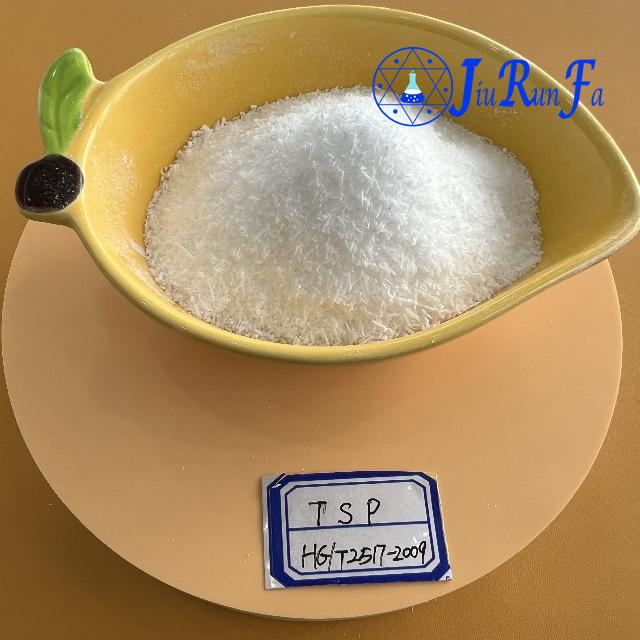
Anhydrous trisodium phosphate has a formula mass of 163.94 and is a white, free-flowing, hygroscopic solid that dissolves readily in water. Orthophosphate is the conjugate base of a weak acid whose third dissociation lies near pH 12, so solutions reach roughly pH 11.5 to 12.5 at working strength. That alkalinity drives both its cleaning power and its handling hazards. The salt cakes under humid storage and attacks amphoteric metals such as aluminium and zinc.
- Alkalinity, hydrolysis and sequestration behaviour: Phosphate buffers near its third pKa, generating hydroxyl ion that saponifies fats and peptises protein soils. Calcium and magnesium precipitate as sparingly soluble phosphates, giving true softening rather than simple chelation. Dosing must therefore be controlled to limit sludge, and concentrates must be handled with appropriate PPE.
- Emulsifying-salt and process-aid function: In processed cheese, TSP sequesters calcium from casein micelles, converting calcium caseinate into soluble sodium caseinate and producing a smooth, stable melt. The pH rise also increases water binding in muscle proteins, which explains its use in marinated meats and seafood. Intake is assessed as total phosphorus, so formulators must respect the group acceptable daily intake set by EFSA and JECFA.
2.2 Synthesis and Manufacturing Technologies
Industrial TSP is made by neutralising phosphoric acid with sodium hydroxide or carbonate to a sodium-to-phosphorus ratio near three, then crystallising, granulating or calcining. The decisive variable is the acid. Wet-process acid from phosphate rock needs extensive purification before food or compendial use, while thermal acid made from elemental phosphorus is intrinsically pure. Grade, cost and environmental footprint are therefore set upstream of the neutralisation step.
- Wet-process purification and neutralisation: Phosphate rock, essentially fluorapatite, is digested with sulfuric acid to give phosphoric acid and phosphogypsum. The acid is purified by defluorination, desulfation and removal of cadmium, arsenic, lead and uranium through precipitation, solvent extraction or ion exchange. Food-grade production therefore depends on controlling fluoride and heavy metals that originate in the rock.
- Thermal acid, granulation and grade control: Elemental phosphorus from an electric arc furnace is oxidised and hydrated to thermal phosphoric acid, supporting the purest food, pharmaceutical and electronic grades at much higher electricity intensity. Granulation produces dust-free technical grades with controlled particle size, density and flow. Release specifications cover assay, sodium-to-phosphorus ratio, loss on ignition, fluoride, heavy metals and particle size.
2.3 Core Application Matrix
- Food and beverage processing: Food-grade TSP, labelled E339(iii) in the EU, serves as an emulsifying salt in processed cheese and as a pH-control agent in cereal and dairy manufacture. It is also used within prescribed limits for moisture retention in meat and seafood. Use levels are constrained by good manufacturing practice, by category-specific legal limits and by total dietary phosphorus. Buyers should confirm plant certification and lot compliance with Regulation (EU) 231/2012 or FCC criteria.
- Industrial cleaning and water treatment: Technical TSP is a standard builder in heavy-duty alkaline cleaners, degreasers and clean-in-place formulations, supplying alkalinity, soil peptisation and hardness control. In boiler and cooling water it supports pH control, softening and passivation, and it is dosed in potable systems under NSF/ANSI 60 certification. Consumer laundry use has contracted under phosphorus limits, shifting volume to institutional channels.
- Metal preparation, ceramics and specialty uses: TSP is used in alkaline metal cleaning and pre-treatment baths, although aluminium and zinc need inhibited formulations. It also serves as a ceramic deflocculant, a dispersant in pigment and drilling fluids, a sugar-refining aid and a laboratory buffer. In these duties the buyer is purchasing alkalinity and dispersing power, so technical grades usually suffice.
III. Global Market Supply-Demand Landscape and Export Trends
3.1 Demand Drivers and Market Shifts
Demand rests on food processing, where urbanisation and convenience formats sustain phosphate consumption, and on industrial cleaning and water treatment. Offsetting this is the structural decline of consumer detergent phosphates under eutrophication rules and substitution by zeolites, citrates and polycarboxylates. The demand mix is therefore moving from commodity builder toward food and specialty grades. Published estimates vary by scope and should be treated as directional.
3.2 Capacity Distribution and Export Flows
Phosphate rock reserves are highly concentrated, with Morocco holding the largest reserve base, China among the leading producers, and significant output in the United States, Russia, Jordan and Saudi Arabia. Europe mines little rock and depends on imports, which is why phosphate rock is listed as a critical raw material for the EU. China has periodically applied export licensing and quota measures to phosphate fertilisers and elemental phosphorus, transmitting volatility into acid and salt markets.
3.3 Market Bifurcation and Pricing Dynamics
Pricing follows rock, sulfur and sulfuric acid, ammonia, energy and freight, with the fertiliser cycle competing for the same acid pool and amplifying swings. Technical grades trade close to variable cost, while food and compendial grades carry premiums for purification, certification and audit. Regional price divergence persists because import-parity economics differ from integrated production costs. Contracts use index-linked formulae, and buyers should hedge by qualifying alternative salts.
IV. In-depth Analysis of Global Compliance and Regulatory Barriers
TSP is regulated at once as an industrial chemical, a food additive and a nutrient of environmental concern. One import programme must satisfy inventory and hazard communication, food purity rules, and discharge permitting that increasingly targets phosphorus at watershed level. Detergent legislation adds formulation limits that differ between the EU and individual US states. The subsections below set out the barriers to market access in 2026.
4.1 European Market: REACH, CLP, and Sector-Specific Directives
- REACH registration and CLP/GHS classification: Trisodium phosphate is an existing EU substance (EC 231-509-8) whose registration and tonnage band must be confirmed with ECHA before import. Dossiers commonly notify Skin Irrit. 2 (H315) and Eye Irrit. 2 (H319), sometimes with STOT SE 3 (H335) for dust, and the entry must be verified for the grade supplied. Importers need an Annex II SDS with GHS07 labelling and should monitor restriction and SVHC screening.
- Food-additive, detergent and fertiliser rules: As E339, TSP is authorised under Regulation (EC) 1333/2008 subject to category-specific limits and must meet the purity criteria of Regulation (EU) 231/2012 for fluoride, arsenic, cadmium, lead and mercury. EFSA and JECFA assess phosphate intake as total phosphorus against a group acceptable daily intake, so finished-food formulation must be documented. Consumer detergent phosphorus is restricted under Regulation (EC) 648/2004, and fertiliser uses fall under Regulation (EU) 2019/1009 with cadmium limits.
4.2 North American Market: TSCA, EPA, and FDA Regulations
- TSCA status and EPA nutrient regulation: TSP is listed on the TSCA Inventory, and importers must hold the Section 13 certification while checking Chemical Data Reporting thresholds under section 8(a). The operative environmental constraint is nutrient discharge, managed through National Pollutant Discharge Elimination System permits, state criteria and total maximum daily load allocations. Several states also limit phosphorus in household laundry and dishwasher detergents.
- FDA food-use provisions and water certification: Food use is governed by the sodium phosphate provisions of 21 CFR 182.1778 together with the FCC monograph, and phosphate levels in meat and poultry must stay within applicable formulation rules. Food-grade production is expected under FSMA preventive controls or a GFSI-recognised scheme. NSF/ANSI 60 certification is effectively mandatory for potable-water dosing, and buyers should request listing evidence.
4.3 The Critical Hurdle: Quality Control and Safety Limits
Compliance Warning: Confirm which hydrate is supplied: the anhydrous salt and the dodecahydrate differ substantially in alkali equivalent, and substituting one for the other silently changes dosing and cost. Specifications must fix assay, sodium-to-phosphorus ratio, loss on ignition, insoluble matter, solution pH, particle size and bulk density. Food-grade material must be certified against Regulation (EU) 231/2012 or FCC limits for fluoride, arsenic, cadmium, lead and mercury, with lot certificates and retained samples. Alkaline dust is a respiratory and eye irritant, and aluminium, zinc and amphoteric metals must be protected from contact. Effluent pH and phosphate concentration must be permitted and controlled before discharge.
V. Green Trade Barriers and ESG in Manufacturing
The ESG profile of TSP is dominated by eutrophication, mining impact and electricity intensity rather than toxicity. Customers now ask suppliers to document phosphorus stewardship alongside carbon performance, while regulators tighten discharge limits and cadmium thresholds. Route choice drives the footprint: the wet-process chain is modest in energy but generates phosphogypsum. The thermal route is electricity-intensive and largely free of that waste.
5.1 Carbon Footprint and Circular Economy
A defensible claim requires a cradle-to-gate footprint under ISO 14067 or the GHG Protocol Product Standard with ISO 14040/14044 boundaries. Scope 1 covers drying and calcination, Scope 2 dominates where electric arc furnaces supply thermal acid, and Scope 3 covers rock, sulfur, freight, packaging and waste. Circularity is central, with attention shifting from constrained phosphogypsum use to struvite, sludge ash and manure-derived phosphorus.
5.2 Sustainable Sourcing and Traceability
Traceability starts at the mine, because rock origin determines cadmium and radionuclide content and therefore food-grade and fertiliser acceptability. Responsible-sourcing expectations cover land rehabilitation, water management, tailings and community impacts, evidenced through ISO 14001 and ISO 45001 certification and third-party audit. Product stewardship includes SDS quality, safe-use guidance and customer effluent advice. Buyers should require origin documentation, batch genealogy and audit rights.
VI. Supply Chain Resilience and Export Logistics
TSP is a heavy, low-unit-value bulk solid, so freight and handling economics shape sourcing more than for most specialties. The main quality risks in transit are moisture uptake and caking, contamination in shared equipment and dust during transfer. Because it is also a corrosive solid, packaging and modal rules are stricter than its commodity status suggests. Resilient programmes combine regional sourcing, controlled storage and contingency capacity.
6.1 Packaging Standards and Moisture/Contamination Control
- Moisture barrier and caking prevention: Material should be supplied in lined bags, lined FIBCs or bulk hopper vehicles and lined containers, with any anti-caking treatment declared. Warehouses must keep product dry and off the floor, separated from acids and ammonium salts, with stock rotation and periodic retesting. Low-dust granular grades reduce housekeeping and exposure burden.
- Labelling, segregation and food-grade assurance: Packaging must carry GHS07 labelling consistent with the notified classification, plus batch coding, net mass and storage instructions. Food-grade material requires segregation from technical production, dedicated or validated-cleaned equipment and tamper-evident seals. Buyers should confirm allergen and cross-contamination controls, since food-grade phosphates are often made in plants running industrial streams.
6.2 Dangerous Goods Identification and Transit Protocols
Trisodium phosphate is consigned as a corrosive solid, generally under UN 3262 (corrosive solid, basic, inorganic, n.o.s.), Class 8, with the packing group set by classification testing. Shipments need UN-certified packaging and segregation from acids and ammonium salts. It is not normally a marine pollutant, and bulk movement in lined containers is common for large contracts. Air freight is restricted by Class 8 rules and rarely economic. Consignments should move under allocated Incoterms with moisture-protective loading and a pre-agreed protocol for caking and contamination disputes.
VII. Enterprise Global Expansion Strategy Guide
Expansion depends on three decisions: which grade to commercialise, how to manage raw-material and trade-policy exposure, and how to demonstrate environmental stewardship. Companies that treat TSP as a simple alkali lose tenders on documentation rather than price. The moves below capture most of the available value for producers, converters, distributors and industrial end users.
- Decide grade and secure food-grade conformity: Establish whether the application needs technical, food or compendial material, then require certification against Regulation (EU) 231/2012 or FCC criteria with lot-specific fluoride and heavy-metal data. Confirm permitted use levels in each destination category and calculate total dietary phosphorus for food uses. Audit purification capability, food-safety certification and segregation before contracting.
- Manage raw-material and trade-policy exposure: Qualify supply across more than one phosphate province and monitor export licensing, inspection requirements and fertiliser-season tightness. Use index-linked contracts with review clauses and hold safety stock sized to the fertiliser cycle. Qualify alternative salts such as tetrasodium pyrophosphate, sodium tripolyphosphate and dipotassium phosphate so formulations absorb shocks without delay.
- Build environmental and ESG licence to operate: Document phosphorus stewardship: optimised dosing, effluent treatment to permitted limits and evaluation of recovered-phosphorus sources. Publish a cradle-to-gate footprint, secure renewable power where furnace or calcination loads dominate, and maintain ISO 14001 and ISO 45001 certification. Stewardship data is increasingly decisive when customers evaluate phosphate-free alternatives.
VIII. Conclusion
Trisodium phosphate remains indispensable wherever high alkalinity, calcium control and protein interaction are needed, yet it is no longer an unconstrained commodity. Its demand mix is migrating from detergent building toward food and specialty technical uses. Its cost base is tied to a concentrated, politically exposed rock chain. The practical constraint for buyers is qualified capacity and documentation rather than nameplate tonnes.
Through the remainder of the decade, tighter nutrient regulation, cadmium limits and critical-raw-material policy will keep pressure on sourcing and discharge practice. Recovered-phosphorus technologies should mature into credible secondary supply. Buyers should expect carbon and stewardship data to be priced into tenders. Organisations investing now in multi-province qualification, grade discipline and environmental documentation will absorb volatility.
IX. Industry Resource Connection and Supplier Ecosystem
Powered by Guidechem
This white paper is exclusively compiled by the Guidechem Intelligence Team based on global customs data, regulatory databases, and industry research. Guidechem is a leading global B2B chemical platform, dedicated to connecting global buyers with verified, high-quality manufacturers.
Relying on Guidechem's extensive global database, we have mapped the core participants in the current global Trisodium phosphate supply chain:
- North America: This tier is the most vertically integrated, combining domestic rock mining, acid production and conversion with strong food-grade and water-treatment certification. Participants differentiate through NSF/ANSI 60 listings, FCC compliance, FSMA-aligned plants and dependable bulk logistics. State detergent rules shape formulation demand rather than supply.
- Europe: The European tier is conversion- and compliance-led, importing rock and acid while specialising in E339 conformity and Regulation (EU) 231/2012 documentation. REACH and CLP competence, ISO 14001 sites and recovered-phosphorus pilots are concentrated here. Procurement is shaped by critical-raw-material exposure, cadmium limits and discharge permitting.
- Asia-Pacific / China: This tier supplies the largest share of global rock and acid capacity and dominates cost-competitive technical grades, with export volumes sensitive to licensing and fertiliser-season policy. Quality spans industrial material through certified food-grade product, so buyer-side audit and lot certification are essential.
Disclaimer: The content of this white paper is compiled based on public market data and regulatory information available as of 2026. Global chemical regulations are subject to dynamic adjustments. In actual export operations, enterprises must consult professional regulatory advisors or relevant competent authorities to obtain the latest compliance guidance.





 EN
EN
 Agricultural News
 Food News
 Industrial News
 Cosmetic News
 Pharmaceutical News
 Science News

 2YRS
2YRS

