-
We detected your language preference as English. Would you like to switch to the English version for a better experience?
Switch to English
Stay here


Formulators of shampoos, body washes, facial cleansers, and baby care products face a persistent dilemma: anionic surfactants deliver rich foam and strong cleansing but too often strip the skin barrier and trigger irritation complaints. At the same time, consumers and eco-certification schemes such as COSMOS and NATRUE increasingly demand plant-derived, readily biodegradable ingredients. Alkyl polyglucosides (APGs) resolve this tension elegantly. Manufactured by reacting glucose from starch with fatty alcohols from coconut and palm kernel oils, these nonionic surfactants combine dermatological mildness, hard-water tolerance, and excellent toxicological and environmental profiles — all without ethoxylation, and therefore free of 1,4-dioxane concerns. This guide covers APG chemistry, the commercial INCI grades, formulation strategy, and the global regulatory landscape.
| Attribute | Function | Target Applications | Key Specifications | Compliance Status |
|---|---|---|---|---|
| Family overview | Nonionic surfactant, primary or co-surfactant; foaming, cleansing, wetting, and (long-chain grades) o/w emulsifying | Shampoos, body and facial cleansers, baby wash, sensitive-skin and eco-certified products, hand dishwash, household and agrochemical cleaners | C8–C18 alkyl chains; active matter 50–70% (usually 50% aqueous); HLB ≈ 11–16; degree of polymerization 1.2–1.8 | CIR assessed as safe as used; no restrictions under EU 1223/2009; REACH registered; COSMOS/ECOCERT-approved feedstock |
| Representative grades | Decyl, caprylyl/capryl, lauryl, and coco glucoside — each tuned to a cleansing, solubilizing, or emulsifying role | Syndet and transparent cleansers, wipe solutions, micro-emulsion cleaners, cream and lotion emulsions | INCI: Decyl Glucoside, Caprylyl/Capryl Glucoside, Lauryl Glucoside, Coco Glucoside; pH (10% sol.) 11.5–12.5 typically adjusted to 5–7 in formulation | INCI names harmonized under PCPC/INCI nomenclature; listed in China IECIC; cleared for natural personal care schemes |
Alkyl polyglucosides are manufactured by Fischer glycosylation: a renewable fatty alcohol (typically C8–C14 fractions derived from coconut or palm kernel oil) is reacted with a glucose source — starch hydrolysate or monomeric glucose — under acid catalysis at elevated temperature. Water is continuously removed to drive the equilibrium, and excess fatty alcohol is subsequently stripped off under vacuum. The result is an equilibrium mixture of alkyl monoglucosides, diglucosides, and higher oligoglucosides, characterized by an average degree of polymerization (DP) typically between 1.2 and 1.8. No ethylene oxide, no sulfonation, and no persistent intermediates are involved, which is precisely why APGs contain no 1,4-dioxane residues and biodegrade rapidly.
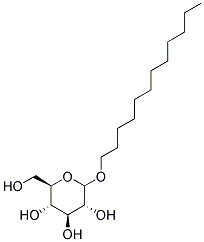
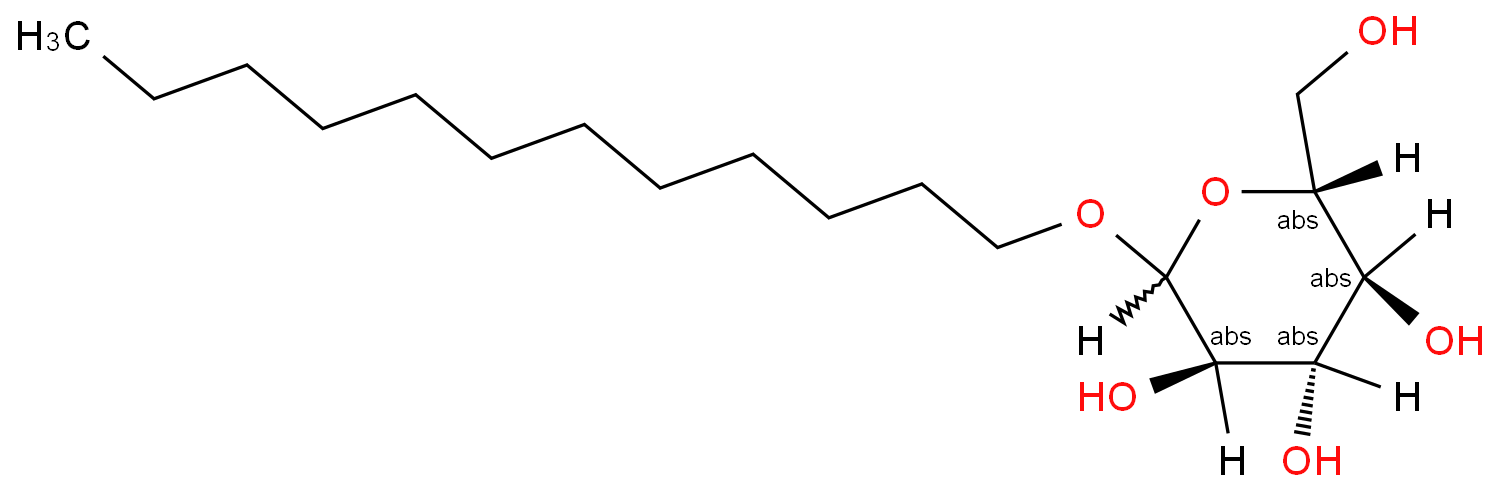
Fischer glycosylation of starch-derived glucose with a fatty alcohol (R = C8–C18 alkyl) yields the glycosidic surfactant.
Structurally, every APG molecule pairs a hydrophilic sugar head (multiple hydroxyl-bearing glucose units linked by glycosidic bonds) with a lipophilic fatty alcohol tail. This architecture explains the family's signature performance profile:
APGs are best classified by fatty-alcohol chain length, which sets the hydrophilic–lipophilic balance (HLB) and therefore the functional role in a formulation. All commercial grades are supplied as roughly 50% active aqueous solutions (some as 60–70% pastes or solids for long-chain types).
With the shortest hydrophobes, these grades carry the highest effective HLB (roughly 13–16). They are outstanding hydrotropes and solubilizers: they clarify micro-emulsion cleansers, boost the solubility of fragrance and other nonionic surfactants, and keep finished products clear and low-viscosity. Decyl glucoside (CAS 68515-73-1) is the workhorse for gentle facial cleansers and wipes; caprylyl/capryl glucoside excels in all-purpose and hard-surface sprays. Limitations: modest foam stability on its own and negligible emulsifying capacity.
Lauryl glucoside (CAS 110615-47-9) is the classic primary cleanser of the family. Its C12/C14 tail matches the optimal chain length for micelle formation, delivering dense, creamy foam and strong detergency while remaining dramatically milder than C12 sulfates. It is the first choice for sulfate-free shampoos, baby washes, and sensitive-skin body cleansers, usually at 8–20% active. Limitation: like all APGs, it does not build viscosity with electrolyte, so secondary thickeners are required.
Coco glucoside (CAS 141464-42-8) is produced from unfractionated coconut alcohol (C8–C18 blend), placing its performance between the decyl and lauryl grades. It balances cleansing, mildness, and foam, and its broad chain distribution makes it a forgiving co-surfactant in naturally positioned formulations where a single APG must do several jobs.
Cetyl and stearyl glucosides are lipophilic, wax-like APGs with low HLB used not as cleansers but as primary o/w emulsifiers for creams and lotions. They form liquid-crystal lamellar networks that give skin-feel, water resistance, and self-emulsifying behavior with polyglyceryl esters or fatty alcohols. Limitation: no foaming role; used at 1–3% in emulsion systems.
Across all classes, APGs share two further distinctions worth noting: they are sugar-based nonionic surfactants produced entirely from renewable feedstock, and their performance can be fine-tuned by the degree of polymerization — lower DP favors low viscosity and high detergency, while higher DP increases water solubility and mildness.
The table below compares the leading APG grades with the anionic and amphoteric surfactants they most often replace or complement in personal care and household cleansing systems.
| Surfactant (INCI) | CAS No. | Ionic Type | Water Solubility | Mildness / Sensory | pH Stability | Typical Applications |
|---|---|---|---|---|---|---|
| Decyl Glucoside | 68515-73-1 | Nonionic | Very high; hydrotropic | Very mild; low-foam clarifier | Excellent (pH 2–12) | Facial cleansers, wipes, sulfate-free blends, hard-surface cleaners |
| Lauryl Glucoside | 110615-47-9 | Nonionic | High | Very mild; dense creamy foam | Excellent | Primary cleanser in shampoo, baby wash, body wash |
| Coco Glucoside | 141464-42-8 | Nonionic | High | Very mild; balanced foam | Excellent | Co-surfactant for natural cleansers, hand wash, dishwash |
| Sodium Laureth Sulfate (SLES) | 68585-34-2 | Anionic | High | Moderate; potential irritation | Good (avoid < pH 5) | Mainstream shampoo and body wash; salt-thickened |
| Ammonium Lauryl Sulfate | 2235-54-3 | Anionic | High | Moderate; higher irritation potential than SLES | Good | High-foam economy shampoos |
| Cocamidopropyl Betaine | 61789-40-0 | Amphoteric | High | Mild; foam booster; rare sensitization reports | Excellent | Secondary surfactant across all cleanser formats |
| Caprylyl/Capryl Glucoside | 68515-81-1 | Nonionic | Very high; hydrotropic | Very mild | Excellent | Solubilizer, eco-cleaners, agricultural adjuvants, gentle cleansers |
APGs are easy to process — cold-water soluble, low-odor, and compatible with anionic, amphoteric, and nonionic co-surfactants — but they behave differently from sulfates in two critical areas: viscosity and pH. Commercial APG solutions are supplied at pH 11.5–12.5 for stability, and must be neutralized to the finished-product pH (typically 5.0–7.0) with citric or lactic acid during manufacture.
| Jurisdiction / Authority | Regulatory Status for Alkyl Polyglucosides |
|---|---|
| United States — CIR / FDA | The Cosmetic Ingredient Review (CIR) Expert Panel has assessed the alkyl glucosides as safe as used in cosmetics in the present practices of use and concentration. Not a "color additive" nor a drug active; no FDA restriction for rinse-off or leave-on use. Under MoCRA, products must list ingredients by INCI, including all APG grades. |
| European Union — Regulation (EC) 1223/2009 | Alkyl glucosides are not listed in Annex II (prohibited) or Annex III (restricted) and may be used without concentration limits. INCI labeling (e.g., Decyl Glucoside, Lauryl Glucoside, Coco Glucoside) is mandatory under Article 19. The SCCS has raised no safety concerns for the family. Glucosides must be REACH-registered as industrial chemicals. |
| Natural / Organic Certifications | COSMOS-standard and NATRUE accept APGs manufactured from vegetable fatty alcohols and starch-derived glucose; petrochemical ethoxylation routes are excluded, which APGs inherently avoid. ECOCERT-certified APG grades are commercially available for organic-formulation claims. |
| Biodegradability & Ecolabels | APGs meet OECD 301 ready-biodegradability criteria and are accepted surfactants in EU Ecolabel and US EPA Safer Choice detergent formulations, supporting "readily biodegradable" environmental claims. |
| China — NMPA / IECIC | Decyl glucoside, lauryl glucoside, coco glucoside, and caprylyl/capryl glucoside are listed in the Inventory of Existing Cosmetic Ingredients in China (IECIC) and may be used in cosmetics registered or notified under CSAR. |
| Japan — MHLW | APGs are permitted cosmetic ingredients under the Japanese Standards for Cosmetics with no quantitative restrictions; full ingredient labeling by INCI-Japanese nomenclature applies. |
APGs are 100% derived from renewable feedstock — glucose from corn or potato starch and fatty alcohols from coconut or palm kernel oil. The glycosidic bond linking them is the same ether-type bond found in natural carbohydrates, and no petrochemical epoxides are used. However, the acid-catalyzed synthesis is a chemical process, so APGs are best described as "naturally derived" rather than unprocessed naturals — a distinction accepted by COSMOS and NATRUE, which certify appropriately sourced APG grades.
Salt thickening relies on charge screening of anionic micelles, and nonionic APGs have no ionic head to screen. Effective alternatives include PEG-150 distearate (1–2%), PEG-120 methyl glucose dioleate, xanthan gum (0.3–1%), or blending with 10–20% cocamidopropyl betaine, which restores a partial salt response. A small amount of an anionic co-surfactant such as sodium laureth sulfate or sodium lauroyl sarcosinate also reintroduces a workable salt curve in hybrid systems.
No. 1,4-dioxane is a by-product of ethoxylation (ethylene oxide chemistry), and nitrosamines form when secondary amines are nitrosated. APG production involves neither ethylene oxide nor amine intermediates, so both contaminant classes are structurally excluded — a significant advantage for clean-beauty positioning and for manufacturers reformulating away from ethoxylated or ethanolamine-based surfactants.
Decyl glucoside is the most common choice because its high water solubility and low irritation potential suit gentle, transparent gel cleansers; lauryl glucoside adds foam density when richer lather is desired, and coco glucoside offers a balanced middle ground. Blending two grades — for example, decyl glucoside with a smaller proportion of lauryl glucoside plus cocamidopropyl betaine — typically delivers the best sensory profile while keeping the formula sulfate-free. More background on surfactant selection is available in the Guidechem encyclopedia.
 |
 |
 |
 |
 EN
EN
 Agricultural News
 Food News
 Industrial News
 Cosmetic News
 Pharmaceutical News
 Science News

 13YRS
13YRS

