-
We detected your language preference as English. Would you like to switch to the English version for a better experience?
Switch to English
Stay here


Aluminum oxide, also known as alumina, is one of the world's most abundant and widely used oxides. It exists in various forms, including crystalline solids and amorphous powders, and typically appears as a white or off-white solid of high hardness and considerable chemical resistance.
For industrial buyers, the key questions are not simply whether alumina is hard and refractory, but which crystal phase and morphology are supplied, how the Bayer process route and calcination conditions determine surface area and porosity, and which grade fits an abrasive, catalyst, refractory, filler or medical application. This guide consolidates those considerations into a practical B2B technical framework.
| Function | Suitable Users | Core Technical Indicators | Compliance Framework |
|---|---|---|---|
| Abrasive | Manufacturers of sandpaper, grinding wheels, cutting tools and polishing compounds | Hardness second only to diamond in the corundum form; high durability for material removal and surface finishing | Dust exposure limits apply during handling, grinding and finishing operations |
| Ceramic and refractory material | Producers of ceramic tiles, spark plugs, kiln linings, ball bearings and semiconductor components | High melting point around 2,072 degrees C, electrical insulation and chemical corrosion resistance | Product standards and workplace exposure rules apply according to the finished article |
| Catalyst support | Chemical process developers who need a high-surface-area support for heterogeneous catalysts | Gamma alumina offers a high density of surface active sites and porosity for reactant adsorption | Catalyst and process regulations apply by industry, and carrier purity affects performance |
| Filler, insulator and flame retardant | Formulators of paints, coatings, plastics, rubber, adhesives, sealants, construction materials and electronics | High electrical resistivity, thermal conductivity and heat-absorbing behaviour that delays flame spread | Fire-safety and electrical standards apply, with grade selection driven by the end application |
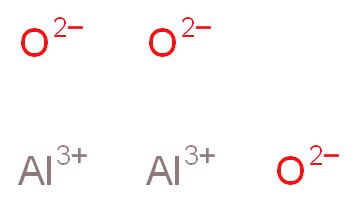
Aluminum oxide, with the chemical formula Al2O3, is a compound of aluminium and oxygen atoms. Its most common crystalline forms are alpha-Al2O3, which has a hexagonal close-packed structure, and gamma-Al2O3, which has a cubic structure. The arrangement of atoms in the crystal lattice is what determines the physical and chemical properties that make each phase suitable for different applications.
The distinction between phases is the single most important specification for an industrial buyer. The alpha phase is the thermodynamically stable, dense and extremely hard form used in abrasives, wear parts and structural ceramics, while the gamma phase is a metastable, high-surface-area form used where porosity and reactivity matter more than hardness. Two materials both described as "alumina" can therefore behave completely differently in service.
A defining chemical characteristic is that aluminum oxide is amphoteric, meaning it reacts with both acids and bases. This amphoteric nature explains part of its usefulness as a catalyst support and its behaviour in the Bayer process, and it also governs how the material should be handled in chemical environments, since neither strongly acidic nor strongly alkaline media can be assumed to be inert toward it.
Explore the aluminum oxide technical encyclopedia for additional chemical and application information.
| Parameter | Specification / Description |
|---|---|
| Chemical name | Aluminum oxide (aluminium oxide) |
| Common names | Alumina, corundum |
| Formula | Al2O3 |
| Molecular weight | 101.96 g/mol |
| CAS number | 1344-28-1 |
| EC number | 215-691-6 |
| Appearance | White solid, odorless |
Aluminum oxide delivers its performance through structure at two scales: the crystal lattice that sets hardness and stability, and the surface area and porosity that set adsorption and catalytic behaviour. Understanding both explains why one oxide serves such different industries.
The hexagonal close-packed arrangement of alpha alumina produces a dense, hard solid with a melting point of about 2,072 degrees C and a boiling point near 2,977 degrees C. This combination of hardness and thermal stability makes the alpha phase the basis of abrasives, wear-resistant ceramics and refractories, where the material must resist both mechanical abrasion and high-temperature exposure.
Gamma alumina's cubic structure gives it a high density of surface active sites and extensive porosity. These features allow reactants to adsorb and interact with the catalytic species, enhancing reaction rates, which is why gamma alumina is widely used as a catalyst support. Because performance depends on accessible surface rather than bulk hardness, the calcination history of a gamma alumina is central to its value.
Aluminum oxide has high electrical resistivity and acts as an insulator that prevents the flow of electric current between conductive components, which is why it is used as a substrate in circuit boards for high-power and high-temperature applications. Its ability to absorb heat and release it slowly also makes it useful as a flame-retardant barrier in polymers, textiles and other materials.
Aluminum oxide occurs naturally and is one of the most abundant minerals on Earth. The most common natural forms are corundum, the most well-known and abundant crystalline form of aluminum oxide with a hardness second only to diamond, and bauxite, a mixture of aluminum oxide minerals including gibbsite, boehmite and diaspore together with impurities such as iron oxides, silica and clays. Bauxite is the primary source of aluminium ore and the main raw material for extracting aluminium metal.
Industrial aluminum oxide is extracted from bauxite ore by the Bayer process. Bauxite is mined primarily in tropical or subtropical regions and is crushed and processed to remove impurities such as silica and clay. The purified bauxite is mixed with hot concentrated sodium hydroxide solution in high-pressure autoclaves, dissolving the aluminum oxide content to form soluble sodium aluminate while the impurities remain behind as a residue.
The hot solution is then cooled and allowed to settle, causing the impurities to separate out as red mud at the bottom of the vessel. The clear liquid containing dissolved sodium aluminate is separated by filtration, and carbon dioxide is bubbled through it to precipitate aluminum hydroxide. In chemical terms, sodium aluminate is neutralised to form aluminum hydroxide and sodium carbonate. The aluminum hydroxide is then heated in rotary kilns or fluidized bed calciners to drive off water and convert it to aluminum oxide.
The calcination step is where the product specification is effectively set. Temperature and residence time determine which crystal phase predominates and how much surface area survives, so a catalyst-grade gamma alumina and an abrasive-grade alpha alumina can emerge from closely related routes. Buyers should confirm phase, surface area and particle size distribution rather than accepting a generic alumina designation.
Aluminum oxide belongs to the family of refractory metal oxides and is the parent material of a group of derived products. Within a specification, the key comparison is not only between phases but between the unmodified oxide and the derivative materials that extend its functionality.
Activated alumina is a porous material derived from aluminum oxide with a high surface area. It is commonly used as a desiccant to remove moisture from gases and liquids and to adsorb impurities from liquids in water treatment processes, where its high porosity and amphoteric surface provide the necessary capacity.
Aluminum hydroxide, also known as alum hydrate, is derived from aluminum oxide and is widely used as a flame retardant and smoke suppressant in plastics, rubber and textiles. When heated it releases water vapour, which cools the material and reduces the spread of flames, making it a functional rather than merely inert additive.
Aluminum oxide nanoparticles exhibit unique properties because of their small size and are used in catalysis, electronics, coatings and as reinforcement in polymers, ceramics and composites. Yttrium aluminium garnet, or YAG, a synthetic crystal derived from aluminum oxide and yttrium oxide, is used as a laser material across medical, industrial and scientific applications.
| Parameter | Alpha-Aluminum Oxide | Gamma-Aluminum Oxide | Activated Alumina |
|---|---|---|---|
| Crystal structure | Hexagonal close-packed | Cubic | Porous, largely amorphous or transition phase |
| Hardness | Very high; second only to diamond in corundum form | Lower than alpha phase | Not selected for hardness |
| Surface area | Low; dense and sintered | High; many surface active sites | High; engineered for adsorption |
| Primary use | Abrasives, wear parts, structural and refractory ceramics | Catalyst support in chemical processes | Desiccant and impurity adsorption in water and gas treatment |
| Thermal behaviour | Stable to very high temperature | Can transform toward alpha at high temperature | Regenerated by controlled heating |
| Key limitation | Low surface area and limited porosity | Lower mechanical strength and phase stability | Capacity limited by pore volume and regeneration cycles |
| Property | Typical Value / Description |
|---|---|
| Chemical formula | Al2O3 |
| Molecular weight | 101.96 g/mol |
| Appearance and odor | White solid; odorless |
| Melting point | About 2,072 degrees C |
| Boiling point | About 2,977 degrees C |
| Density | 3.987 g/cm3 |
| Solubility | Insoluble in water and solvents; amphoteric, reacting with both acids and bases |
| Electrical behaviour | High electrical resistivity; used as an insulator and substrate |
| Function | Typical Applications | Key Technical Objective |
|---|---|---|
| Abrasive | Sandpaper, grinding wheels, polishing compounds, cutting tools and ball bearings | Remove and finish material with high hardness and wear resistance |
| Ceramics and refractories | Ceramic tiles, spark plugs, kiln linings and semiconductor components | Withstand high temperature and chemical corrosion while insulating |
| Catalyst support | Heterogeneous catalysts across chemical processes | Maximise accessible surface area and active-site density |
| Filler and extender | Paints and coatings, plastics, rubber, adhesives, sealants and construction materials | Improve durability, thermal conductivity and dimensional stability |
| Electrical insulation | Circuit-board substrates for high-power and high-temperature applications | Provide insulation and mechanical support for electronics |
| Flame retardant | Polymers, textiles, construction, automotive and electronics applications | Absorb heat and form a barrier that delays flame spread |
| Glass and medical use | Cookware and laboratory glassware, high-intensity discharge lamps, dental implants and prosthetics, orthopedic implants | Improve strength, thermal shock resistance, biocompatibility and appearance |
In paints and coatings, alumina improves viscosity, raises resistance to wear and abrasion, enhances durability and helps prevent pigments from settling for a more consistent appearance. In plastics it increases thermal conductivity, electrical insulation and mechanical strength and can reduce shrinkage during curing or cooling. In rubber it acts as a reinforcing filler that improves strength, flexibility and wear resistance in products such as tyres, hoses and gaskets, and in adhesives and sealants it improves bonding strength and environmental resistance.
Alumina ceramics are also used in dental implants and prosthetics and in orthopedic implants. Dental ceramics based on alumina are valued for biocompatibility, integration with surrounding bone and a natural appearance, while prosthetic crowns and bridges closely mimic the appearance and translucency of natural teeth. In orthopedic applications such as hip and knee joint replacements, the high mechanical strength and biocompatibility of alumina suit implants that must withstand the stresses of weight-bearing joints.
Define whether the application needs hardness, porosity or insulation, and specify the phase accordingly. Alpha alumina suits abrasives, wear parts and structural ceramics, while gamma alumina suits catalyst supports and adsorption where surface area is critical. Do not treat the phases as interchangeable, since their properties differ substantially.
Particle size distribution and morphology govern packing, dispersion and finish quality. In coatings and plastics, an unsuitable distribution can cause settling or surface defects, and in catalysts the accessible surface depends on the pore structure rather than the bulk chemistry. Specify the distribution and morphology explicitly against the process.
Because aluminum oxide reacts with both acids and bases, evaluate the pH and chemical environment of the process or end-use. A strongly acidic or alkaline medium can attack the surface, altering performance and, in a catalyst, changing activity. This is especially relevant where the material is exposed to process streams over long periods.
Aluminum oxide dust can irritate the skin, eyes and respiratory tract, so handling should include suitable engineering controls and personal protective equipment. Observe the applicable workplace exposure limits and keep operations that generate fine dust under the required controls.
The table below is an illustrative technical comparison drawn from published material rather than a universal commercial recipe. Actual grade selection and loading must be developed against the target duty and process of each project.
| End Use | Preferred Form | Technical Rationale |
|---|---|---|
| Abrasives and grinding | Fused alpha alumina grit | High hardness and durability for material removal |
| Catalyst support | Gamma alumina, high surface area | Porosity and active sites drive reaction rate |
| Paint and coating filler | Fine, controlled particle size | Improves durability and prevents pigment settling |
| Water and gas treatment | Activated alumina, porous | High surface area for desiccation and impurity adsorption |
| Electrical substrate | Dense alpha ceramic | High resistivity with thermal and mechanical support |
A second illustrative example is glass manufacture, where alumina is added to enhance mechanical strength, thermal shock resistance and durability and to help prevent cracking under rapid temperature change. Alumina-modified glass is well suited to cookware, laboratory glassware and specialized products such as high-intensity discharge lamps, where resilience under extreme conditions is essential.
Regulatory treatment of aluminum oxide depends on the form in which it is placed on the market and on its use, since the same chemistry may be an industrial abrasive, a cosmetic or food-contact material, or a nanomaterial subject to additional provisions. The compliance path should be established from the intended use rather than the chemical name.
| Market / Framework | Technical Relevance | Compliance Action |
|---|---|---|
| US OSHA | The legal airborne permissible exposure limit is 5 mg/m3 as respirable dust and 15 mg/m3 as total dust, averaged over an 8-hour work shift. | Implement dust controls and monitoring where the material is handled or machined. |
| ACGIH | The threshold limit value is 1 mg/m3 as the respirable fraction for aluminum, averaged over an 8-hour work shift. | Apply the more protective internal limit where the process generates fine respirable dust. |
| EU REACH | Obligations depend on the substance, the operator, the tonnage and any applicable exemptions, and nanomaterials may be subject to additional information requirements. | Verify the registration and supply-chain requirements for the specific form placed on the market. |
| Nanomaterial provisions | Aluminum oxide nanoparticles may fall under additional disclosure, labelling or assessment requirements because of their small size and higher reactivity. | Confirm the nanomaterial status and any notification obligations for the intended market. |
| Sector standards | Abrasive, refractory, electrical, medical and fire-safety applications each carry their own product standards and conformity requirements. | Verify the applicable standard for the finished article and maintain conformity documentation. |
The acute health effects of aluminum oxide include skin, eye and respiratory irritation. Direct contact can irritate the skin and eyes, leading to redness, itching or discomfort, and inhaling aluminum oxide particles can irritate the respiratory system including the nose, throat and lungs, potentially causing coughing, wheezing and shortness of breath. These effects are managed through standard industrial hygiene controls rather than by a change in material selection.
Chronic health effects are less clearly established and require additional study. Although aluminum oxide has been tested, its potential to cause cancer is not definitively classified, which suggests that there is no clear evidence but that more research is needed for a conclusive determination. Available information likewise does not provide conclusive evidence about effects on reproduction, so its impact on reproductive health has not been thoroughly studied.
Because the hazard profile is dominated by dust exposure, the practical control strategy is engineering-based. Enclosure, ventilation, wet methods and suitable respiratory protection should be applied where fine dust is generated, and exposure monitoring should confirm that airborne concentrations remain below the applicable limits, which differ between jurisdictions and between the respirable and total dust fractions.
| Application Context | Preferred Grade | Formulation Note |
|---|---|---|
| Abrasives | Fused alpha alumina | Confirm grit size against the required surface finish. |
| Catalyst support | Gamma alumina | Verify surface area and pore structure after calcination. |
| Coatings and plastics | Fine filler grade | Test dispersion, settling and shrinkage behaviour. |
| Drying and purification | Activated alumina | Size the bed for capacity and regeneration cycles. |
| Medical and dental ceramics | High-purity dense alpha | Confirm biocompatibility and mechanical specification. |
These grade references are illustrative and should not be interpreted as universal specifications. Product developers should confirm the phase, purity, particle size and exposure requirements applicable to the intended application and market.
Alpha alumina has a hexagonal close-packed structure and is the hard, dense form used in abrasives and ceramics. Gamma alumina has a cubic structure with high porosity and surface area, which is why it is preferred as a catalyst support where a high density of surface active sites is essential. The two phases are not interchangeable for a given duty.
It is extracted from bauxite by the Bayer process. Bauxite is digested with hot concentrated sodium hydroxide in high-pressure autoclaves to form soluble sodium aluminate, the insoluble impurities settle out as red mud, and carbon dioxide is bubbled through the filtered solution to precipitate aluminum hydroxide, which is then calcined to aluminum oxide.
Aluminum oxide reacts with both acids and bases, which is the definition of amphoteric behaviour. Although it is insoluble in water and solvents, this dual reactivity affects its stability in acidic or alkaline media and underpins its behaviour in the Bayer process. It should not be assumed chemically inert in either strongly acidic or strongly alkaline environments.
OSHA sets the legal airborne permissible exposure limit at 5 mg/m3 as respirable dust and 15 mg/m3 as total dust averaged over an 8-hour shift, while ACGIH sets a threshold limit value of 1 mg/m3 as the respirable fraction for aluminum over an 8-hour shift. Requirements change by jurisdiction, so the applicable limits should be verified.
| Identifier | Value | Resource |
|---|---|---|
| CAS number | 1344-28-1 | Chemical dictionary |
| EC number | 215-691-6 | Technical encyclopedia |
| Product lookup | aluminum oxide | Supply search |
| Supplier / trade search | activated alumina | Supplier search |
1. PubChem. Compound information for aluminum oxide, including structure and physical properties.
2. US Occupational Safety and Health Administration. Permissible exposure limits for aluminum oxide dust.
3. American Conference of Governmental Industrial Hygienists. Threshold limit values for aluminum and respirable dust fractions.
4. ChemSpider. Structural and identification data for aluminum oxide.
5. Aluminum industry manufacturers. Technical profiles on aluminum oxide production and applications.
6. Standard industrial references on the Bayer process and bauxite refining.
 |
 |
 |
 |
 |
 EN
EN
 Agricultural News
 Food News
 Industrial News
 Cosmetic News
 Pharmaceutical News
 Science News

 1YR
1YR

