-
We detected your language preference as English. Would you like to switch to the English version for a better experience?
Switch to English
Stay here


This article explores the characteristics, uses, and importance of ethynodiol diacetate in the field of contraception, aiming to provide readers with a deeper understanding of the mechanism of action and clinical application value of this drug. As research on ethynodiol diacetate continues to deepen, its role in contraception and other related fields is expected to be more widely recognized and applied. Through this article, readers will gain a better understanding of the importance and potential contributions of ethynodiol diacetate, providing more information and references for its clinical application.
Ethynodiol diacetate, also known as Etynodiol diacetate, marketed under brands like Ovulen, is a progestin medication used in contraceptive pills. It is typically taken by mouth in combination with an estrogen.
Ethynodiol diacetate acts as a progestin or synthetic progestogen, hence an agonist of the progesterone receptor, which is the biological target of progestogens like progesterone. It exhibits weak androgenic and estrogenic activity but lacks significant other hormonal activity. The drug is a prodrug of norethisterone, with ethynodiol serving as an intermediate.
The related compound Ethynodiol was discovered in 1954, and Ethynodiol diacetate was introduced for medical use in 1965. A combination of Ethynodiol and Ovulen was approved for medical use in the United States in 1966. Ethinylestradiol and Ethynodiol (Demulen) were approved for medical use in the United States in 1970. In 2021, the combination with Ethinylestradiol ranked 276th most commonly prescribed in the United States, with over 800,000 prescriptions.
Ethynodiol diacetate is a synthetic progestin used in combination with estrogen as an oral contraceptive. Though ethynodiol or ethynodiol diacetate are sometimes used synonymously, typically the latter is meant rather than ethynodiol (which is a separate drug that was never marketed).
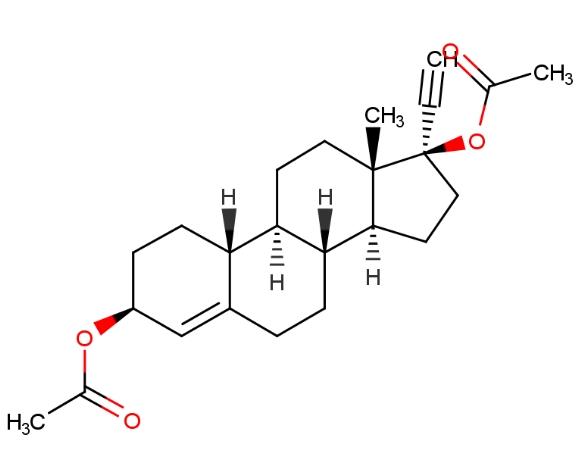
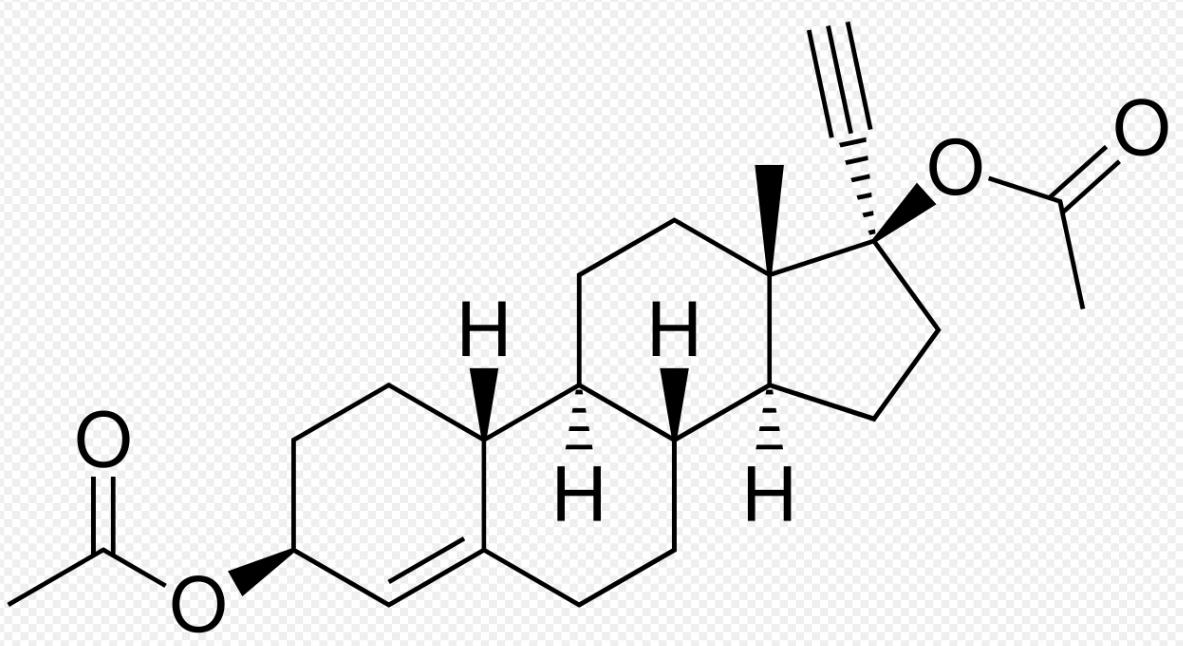
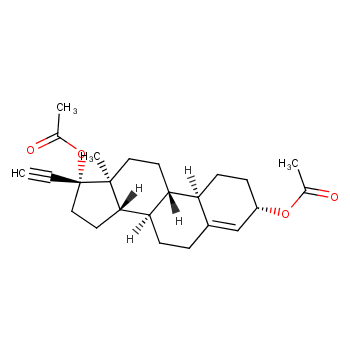
Ethynodiol diacetate, with the English name ethynodiol diacetate, CAS number 297-76-7, molecular formula C24H32O4, density 1.14 g/cm3, melting point 128 - 131°C, flash point 221.8°C, refractive index 1.544. Ethynodiol diacetate is a steroid molecule with a specific structure that allows it to interact with progesterone receptors in the body. Key features include the presence of a 17α-ethynyl group and two acetate esters. These structural elements influence its binding characteristics with target receptors. The structure of ethynodiol diacetate is shown in the figure below.
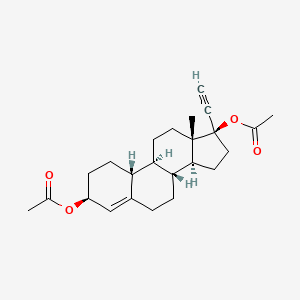
In terms of affinity for progesterone and androgen receptors, ethynodiol diacetate is virtually inactive and acts as a rapid conversion precursor drug for norethisterone, with ethynodiol appearing as an intermediate. Upon oral administration and first-pass metabolism in the liver, ethynodiol diacetate is rapidly converted by esterases to norethisterone, followed by C3 hydroxylation to produce norethindrone. Apart from its progestogenic activity, ethynodiol diacetate also exhibits weak androgenic activity, and unlike most progestogens but similar to norethisterone and levonorgestrel, it also has some estrogenic activity.
Ethynodiol diacetate is used as a female contraceptive. Ethynodiol diacetate is a synthetic form of the naturally occurring female sex hormone progesterone or a progestin. During a normal menstrual cycle in women, an egg matures and is released from the ovaries (ovulation). The ovaries then produce progesterone, which prevents more eggs from being released and prepares the lining of the uterus for a possible pregnancy. If a pregnancy occurs, progesterone levels in the body remain high, maintaining the uterine lining. If pregnancy doesn't occur, progesterone levels in the body decrease, leading to menstruation. Ethynodiol diacetate works by tricking the body into thinking that ovulation has already occurred by maintaining high levels of synthesized progesterone. This prevents the ovaries from releasing eggs.
Ethynodiol diacetate is used in combination with estrogen (such as ethinylestradiol or mestranol) as a component of oral contraceptives for women to prevent pregnancy. Ethinyl estradiol and ethynodiol diacetate are combined to prevent pregnancy. It is a contraceptive medication containing two hormones, ethinyl estradiol and ethynodiol diacetate, which when taken correctly can prevent pregnancy. It works by preventing the complete development of an egg each month. The egg can no longer accept sperm, so fertilization (pregnancy) is prevented. However, no method of contraception is 100% effective at preventing pregnancy, and other methods, such as sterilization or not having sex, are more effective than birth control pills. Discuss your contraceptive plan with your doctor. This medication does not prevent HIV infection or other sexually transmitted diseases. It is not effective as emergency contraception, such as after unprotected sexual contact. This medication is available only with your doctor's prescription.
Ethynodiol diacetate is a progestin, a synthetic hormone similar to the female sex hormone progesterone. It is typically combined with ethinyl estradiol (an estrogen) in contraceptive pills. Common side effects of Demulen (ethinyl estradiol and ethynodiol diacetate) include nausea, vomiting, headache, stomach cramps/bloating, dizziness, vaginal discomfort/irritation, increased vaginal fluid or discharge, breast tenderness/enlargement, mood changes, or weight gain. Acne may improve or worsen. Spotting or missed/irregular periods may occur between periods, especially during the first few months of use.
Demulen may interact with acetaminophen, ascorbic acid (vitamin C), atazanavir, St. John's wort, antibiotics, antiepileptic drugs, barbiturates, HIV or AIDS medications. Tell your doctor about all medicines and supplements you use.
Demulen must not be used during pregnancy. Tell your doctor if you are pregnant or think you might be pregnant. If you have just given birth or had an abortion after the first 3 months, talk with your doctor about when to start using birth control pills containing estrogen (such as this medication) safely. This medication passes into breast milk. It may reduce milk production and may have undesirable effects on a nursing infant. Consult your doctor before breastfeeding.
A phase IV trial assessed the efficacy and safety of monophasic oral contraceptive (OC) formulation (1 mg ethynodiol diacetate plus 35 mcg ethinyl estradiol (EDA 1 mg plus EE 35 mcg) (Demulen 1/35). A total of 7,759 patients were treated by 983 community obstetricians and gynecologists with 1 mg EDA and 35 mcg EE for durations ranging from 1 to 8 months. Clinical evaluation forms for 6,382 patients were subjected to safety analysis (including breakthrough bleeding, ovarian cyst formation, and skin discoloration); efficacy evaluation was conducted for 5,412 patients (pregnancy prevention), with a total of 21,440 cycles recorded.
From August 1988 to June 1989, 983 physicians participated in this phase IV trial, following 7759 women using monophasic oral contraceptives (OC), Demulen 1/35 (1 mg ethynodiol diacetate and 35 mcg ethinyl estradiol), to evaluate efficacy and safety. The total number of cycles in the study was 21,440. Additionally, the mean age of women was 1787 years. Only 6382 patients were available for safety assessment. Adverse reactions to OC occurred in 4.4% of patients, but only 1.7% discontinued use. Major side effects included nausea (67 cases), headache (45 cases), amenorrhea (42 cases), mood changes (30 cases), breast tenderness (19 cases), dysmenorrhea (12 cases), as well as weight gain, abdominal/pelvic pain, and bloating in 11 cases. Of the reported 280 adverse reactions, only 87 (31%) were considered severe. The major severe adverse reactions were depression (10 cases) and hypertension (6 cases). Only 5412 patients were available to determine efficacy. During the study period, 121 pregnancies were initially reported by physicians. Researchers learned that out of 84 returned second questionnaires, 33 (response rate of 70%) reported being pregnant before using OC but after enrollment. 36 pregnancies occurred during OC use, but 8 women did not take it every day. Non-compliance or true contraceptive failure led to treatment failures in the remaining 28 cases. Thus, the failure rate for confirmed pregnancies was 0.7%. 85.7% of pregnancies occurred within the first 3 months of OC use. Patient non-compliance or true contraceptive failure led to treatment failure. Therefore, proper guidance from physicians on how to take oral contraceptives correctly is crucial.
Ethynodiol diacetate, as a synthetic estrogenic drug, plays a crucial role in oral contraceptives, effectively preventing pregnancy. Its mechanisms include inhibiting ovulation and altering cervical mucus, making it widely used in the field of birth control. In further consultations, for any questions regarding the use, dosage, side effects, etc., of ethynodiol diacetate, it is recommended to consult a doctor or healthcare professional to ensure its correct use and optimal efficacy. For women seeking contraceptive methods, understanding the uses and mechanisms of ethynodiol diacetate is essential, while also remembering to follow the advice and recommendations of healthcare providers to ensure the safe and effective use of the medication.
[1]https://en.wikipedia.org/wiki/Etynodiol_diacetate
[2]https://www.mayoclinic.org/drugs-supplements/ethinyl-estradiol-and-ethynodiol-diacetate-oral-route/description/drg-20406425
[3]https://my.clevelandclinic.org/health/drugs/18642-ethynodiol-diacetate-ethinyl-estradiol-tablets
[4]https://www.drugs.com/ppa/ethinyl-estradiol-and-ethynodiol-diacetate.html
[5]https://www.webmd.com/drugs/2/drug-6749/ethynodiol-diacetate-ethinyl-estradiol-oral/details
[6]https://www.rxlist.com/demulen-drug.htm
[7]https://pubmed.ncbi.nlm.nih.gov/2046081/
[8]https://go.drugbank.com/drugs/DB00823
[9]https://pubchem.ncbi.nlm.nih.gov/compound/9270
 |
 |
 |
 |
 |
 |
 EN
EN
 Agricultural News
 Food News
 Industrial News
 Cosmetic News
 Pharmaceutical News
 Science News

 2YRS
2YRS

