-
We detected your language preference as English. Would you like to switch to the English version for a better experience?
Switch to English
Stay here


Hexamethylenetetramine, also known as urotropine, is a common chemical substance with various applications. This compound is widely used in medicine, chemical industry, and agriculture.
Hexamethylenetetramine (Urotropin), also known as hexamethylenetetramine, has hexamethylenetetramine formula C6H12N4 and hexamethylenetetramine CAS No. 100-97-0. It is easily soluble in water, soluble in ethanol and chloroform, and insoluble in carbon tetrachloride. Hexamethylenetetramine has a wide range of applications, including as a curing agent for resins and plastics, a blowing agent, a vulcanization accelerator for rubber, and a shrink-proofing agent for textiles. It is also an important raw material for organic synthesis, used in the production of chloramphenicol and pesticides. Additionally, hexamethylenetetramine reacts with fuming nitric acid to produce the highly explosive cyclonite (RDX) and can be used with acetic acid, acetic anhydride, and ammonium nitrate to synthesize HMX. Hexamethylenetetramine is classified as a flammable and explosive material.
Hexamethylenetetramine has the chemical formula (CH2)6N4 and features a tetrahedral cage structure similar to adamantane. The four vertices are occupied by nitrogen atoms connected by methylene groups. Although the molecule defines a cage, it lacks void space for binding other atoms or molecules, unlike crown ethers or larger cryptand structures. The hexamethylenetetramine structure is as follows:

Hexamethylenetetramine Structure
Hexamethylenetetramine is soluble in chloroform, methanol, ethanol, acetone, benzene, xylene, and ether. Hexamethylenetetramine solubility in water is 85.3 g/100 mL, in chloroform is 13.4 g/100 g (20 ℃), in methanol is 7.25 g/100 g (20 ℃), in ethanol is 2.89 g/100 g (20 ℃), in acetone is 0.65 g/100 g (20 ℃), and in benzene is 0.23 g/100 g (20 ℃).
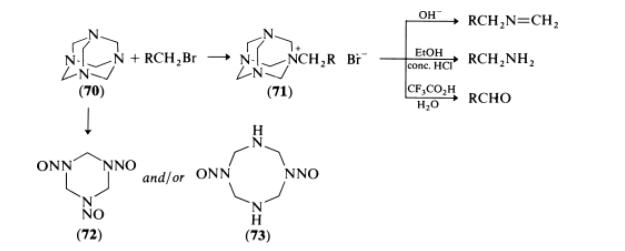
Hexamethylenetetramine has a symmetric adamantane-like structure and is quite stable. It hydrolyzes in hot inorganic acids to form formaldehyde and the corresponding ammonium salt but forms salts in cold dilute organic or inorganic acids. When reduced with zinc and inorganic acids, it converts to ammonia and formaldehyde. Treating hexamethylenetetramine with alkyl halides forms quaternary salts, which are valuable synthetic reagents for preparing amines, imines, and aldehydes, and for cyclization.
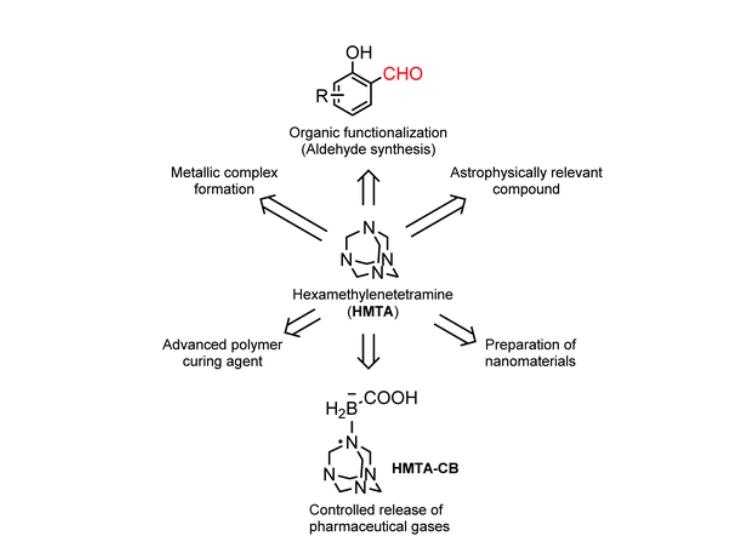
Hexamethylenetetramine has extensive applications. It is a common raw material for organic synthesis, used in the pharmaceutical industry to produce chloramphenicol. It acts as a disinfectant for the urinary system, effective against Gram-negative bacteria. Hexamethylenetetramine is also used as an additive, such as a blowing agent and catalyst for amino plastics, a shrink-proofing agent and finishing agent for textiles, and a vulcanization accelerator for rubber.
In the food industry, hexamethylenetetramine is used as a disinfectant.
In the military industry, hexamethylenetetramine reacts with fuming nitric acid to produce the highly explosive cyclonite, known as RDX.
In analytical chemistry, hexamethylenetetramine is a common analytical reagent used for testing various metals, bromides, iodides, and as a chromatography reagent.
Due to its unique properties, hexamethylenetetramine has been explored in various research and development applications. Promising fields include:
Hexamethylenetetramine is a urinary disinfectant effective against E. coli, a common cause of urinary tract infections. It works by releasing formaldehyde in acidic media, effectively combating common urinary pathogens. Hexamethylenetetramine salts (prescription drugs) act by converting to formaldehyde in acidic urine, giving it antibacterial properties.
Hexamethylenetetramine can be used as a precursor for synthesizing high-nitrogen explosives such as RDX and HMX. However, due to volatility and safety issues, its use in explosives is limited. Research focuses on developing less volatile, more stable hexamethylenetetramine-based explosives.
Hexamethylenetetramine can be used as a fuel additive to improve combustion efficiency and reduce emissions. It acts as a NOx (nitrogen oxides) scavenger, reducing the formation of harmful pollutants in exhaust gases. Research is ongoing to optimize hexamethylenetetramine's performance as a fuel additive and develop eco-friendly formulations.
The cage structure of hexamethylenetetramine makes it an interesting molecule in materials science research. It can be used as a building block for designing new materials with specific properties, such as metal-organic frameworks (MOFs) for gas storage and separation. Researchers are also exploring hexamethylenetetramine's potential in sensors, drug delivery systems, and flame retardants.
In conclusion, hexamethylenetetramine is a versatile compound with extensive applications in various fields. However, as understanding of its properties and impacts grows, there is increasing concern about its safety and environmental impact. Therefore, further research and regulation are needed to ensure the safe and sustainable use of hexamethylenetetramine in all its applications.
[1] Yang Dongmei. Study on the process of producing hexamethylenetetramine from formaldehyde waste liquid ammoniation [D]. Chongqing University, 2020. DOI:10.27670/d.cnki.gcqdu.2020.002002.
[2] Wu Zhen, Li Yangjie, Chen Lingjie. Detection of hexamethylenetetramine in cosmetics by high performance liquid chromatography [J]. Guangzhou Chemical Industry, 2017, 45 (10): 110-112.
[3] Peng Haoliang, Chen Liping, Lu Guibin, et al. Thermal decomposition kinetics of hexamethylenetetramine [J]. Energetic Materials, 2016, 24 (05): 497-502.
[4]https://en.wikipedia.org/wiki/
[5]https://www.sciencedirect.com/topics/chemistry/hexamethylenetetramine
[6]https://taylorandfrancis.com/knowledge/medicine-and-healthcare/pharmaceutical-medicine/methenamine/
[7]https://pubchem.ncbi.nlm.nih.gov/compound/4101
 |
 |
 |
 EN
EN
 Agricultural News
 Food News
 Industrial News
 Cosmetic News
 Pharmaceutical News
 Science News
