-
We detected your language preference as English. Would you like to switch to the English version for a better experience?
Switch to English
Stay here


This article explores the complexity of hexamethylenetetramine synthesis, from its production methods to shelf-life and safety considerations, providing a deeper understanding of this multifunctional compound.
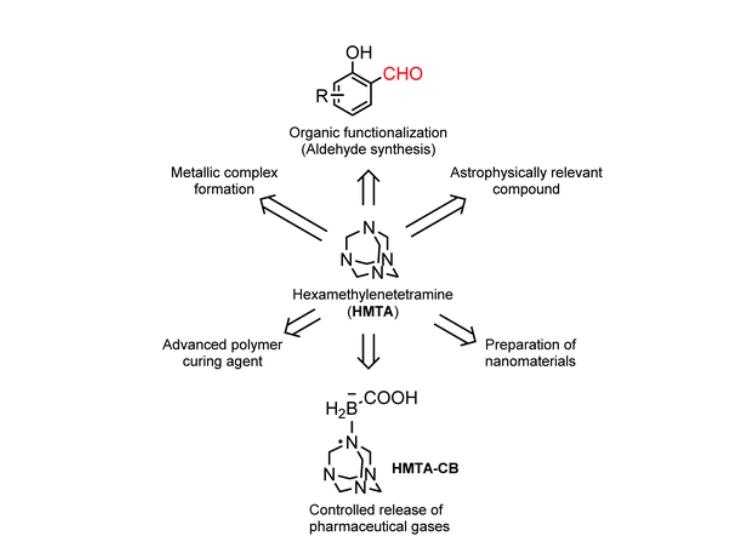
Hexamethylenetetramine (HMT), also known as methenamine, has the molecular formula C6H16N4. It is soluble in water, ethanol, and chloroform, but insoluble in solvents like carbon tetrachloride. HMT serves various industrial purposes such as curing agents for resins and plastics, sulfur accelerators for rubber (accelerator H), shrinkage agents for textiles, and corrosion inhibitors for metals. Additionally, it is used as a precursor in the production of pharmaceuticals like chloramphenicol. Clinically, it treats urinary tract infections and topically treats conditions such as axillary odor, sweaty feet, and tinea corporis.
Hexamethylenetetramine was discovered by Aleksandr Butlerov in 1859. Industrially, it is prepared by the condensation of formaldehyde and ammonia:

Currently, hexamethylenetetramine is produced using both liquid-phase and gas-phase methods.
Initially, methanol undergoes copper-catalyzed oxidation to produce formaldehyde gas under heating conditions. Subsequently, the high-temperature formaldehyde gas reacts directly with ammonia gas (purity ≥ 99%, filtered and metered) in the ammoniation reactor. This reaction occurs within the reactor's bubbling system with saturated mother liquor of hexamethylenetetramine, resulting in the production of hexamethylenetetramine product. Simultaneously, excess moisture evaporates under vacuum control. The resulting hexamethylenetetramine solution is concentrated and enters a centrifuge to separate the mother liquor phase, with the remaining mother liquor returned to the ammoniation reactor. The solid hexamethylenetetramine product then proceeds to a dryer for further dehydration to obtain the final product. Additionally, diluted ammonia water from the absorption tower enters the ammonia recovery tower to recycle ammonia, while excess methanol is recovered through a methanol recovery tower. The gas-phase production process of hexamethylenetetramine utilizes the latent heat of methanol heating to formaldehyde and the heat released during reaction, providing a heat source for subsequent processes, thereby saving a significant amount of steam. Experimental validation confirms high product purity from this process. Furthermore, the reaction equation for gas-phase production of hexamethylenetetramine is as follows:

The liquid-phase method involves feeding a solution of formaldehyde and ammonia gas, calculated and configured in a specific ratio, into a tubular reactor. The resulting hexamethylenetetramine solution generated from the condensation reaction of formaldehyde and ammonia circulates through a cooling system to remove the heat generated during the reaction, maintaining the reaction temperature at 60-65°C. The hexamethylenetetramine solution produced from the reaction is sent to a membrane evaporator for further dehydration. During concentration, a vacuum pump generates negative pressure, and evaporated moisture passes through a condenser for cooling. Under vacuum conditions, the concentrated liquid is fed into an evaporator for further dehydration and concentration. After concentrating to the point where some crystalline particles precipitate, the solution enters a centrifuge to separate the mother liquor, with the solid hexamethylenetetramine entering an airstream dryer. After separation through a separator and subsequent drying, the final hexamethylenetetramine product is obtained. The separated mother liquor undergoes filtration and decolorization before it can be returned to the crystallizer for recycling. The liquid-phase production process for hexamethylenetetramine involves extensive steam and thermal energy consumption. However, this method is advantageous due to its simple operation, mature process flow, and longer crystallization time leading to larger product particles. Currently, most hexamethylenetetramine factories in China employ the liquid-phase production method. The reaction equation for liquid-phase production of hexamethylenetetramine is as follows:

(1) Flammability: HMT is flammable and may combust when exposed to high temperatures or open flames.
(2) Skin and eye irritant: Contact with HMT can irritate the skin and eyes, causing redness, itching, and burns.
(3) Inhalation hazard: Inhaling HMT dust or fumes can irritate the respiratory tract, leading to coughing, breathing difficulties, and wheezing.
(1) Work in a well-ventilated fume hood.
(2) Wear appropriate personal protective equipment (PPE) to avoid skin and eye contact.
(3) Avoid inhaling dust or fumes.
(4) Handle HMT with care to minimize spills.
(5) Use proper disposal procedures to promptly clean up spills.
Always refer to the latest SDS before using HMT. The SDS provides detailed information on specific hazards, safe handling practices, first aid measures, and disposal procedures.
Comply with all relevant workplace safety regulations for handling hazardous chemicals. These regulations may vary depending on your location. Common regulations include the Globally Harmonized System of Classification and Labeling of Chemicals (GHS) and the Occupational Safety and Health Administration (OSHA) Hazard Communication Standard (HCS).
Wear safety goggles with chemical splash shields or safety glasses to protect your eyes from splashes or dust.
Wear gloves resistant to chemical corrosion to protect your hands from contact with HMT.
If there is a risk of inhaling dust or fumes, wear a respirator approved for organic vapors and dust.
Wear a laboratory coat or other protective clothing to protect your skin and clothes from contamination.
What is the shelf life of hexamethylenetetramine? Unfortunately, the specific shelf-life range for HMT has not been published. This is because HMT is a stable compound under normal storage conditions. However, factors such as:
(1) Temperature: High temperatures can accelerate the decomposition of HMT. It is recommended to store HMT in a cool, dry place.
(2) Moisture: Exposure to moisture can cause HMT to clump or cake.
(3) Light: Direct sunlight can also degrade HMT over time.
With proper storage, HMT is expected to remain usable for many years. However, it is always good practice to follow the manufacturer's storage and handling recommendations.
(1) Keep containers tightly sealed.
(2) Store containers in a well-ventilated area.
(3) Label containers with the purchase date.
(4) If you notice any changes in the appearance of HMT, such as discoloration or clumping, it is best to discard it.
(5) If stored under recommended conditions, it remains stable. After three years, chemical purity should be reanalyzed before use.
This compound is synthesized through the reaction between ammonia and formaldehyde. The process typically occurs in a controlled aqueous environment, where chemicals dissolve in water. While specific details may vary, the general approach involves combining these two starting materials under specific conditions, often requiring moderate heating and stirring to facilitate hexamethylenetetramine formation.
Hexamethylenetetramine is highly flammable. It can combust upon contact with an open flame. Fine dust presents a significant dust explosion hazard. It is soluble in water and may release formaldehyde gas and ammonia at high temperatures. Hexamethylenetetramine is classified as a flammable and explosive substance. Gurdip Singh et al. analyzed the thermal decomposition of hexamethylenetetramine mixed crystals with perchlorates, manganese, and zinc using thermal gravimetric testing and found that the mixture can explode at high temperatures.
With the continuous advancement of science and technology, research on hexamethylenetetramine synthesis methods continues to deepen. There is potential for more efficient and environmentally friendly synthesis routes in the future. Research in this field will further expand the application scope of hexamethylenetetramine and promote the development of related industries.
[1]https://www.cdnisotopes.com/d-0817?___store=default
[2]Yang Dongmei. Research on the process of producing hexamethylenetetramine by ammoniation of formaldehyde waste liquid[D]. Chongqing University, 2020. DOI:10.27670/d.cnki.gcqdu.2020.002002.
[3]Wu Zhen, Li Yangjie, Chen Lingjie. Detection of hexamethylenetetramine in cosmetics by high performance liquid chromatography[J]. Guangzhou Chemical Industry, 2017, 45 (10): 110-112.
[4]Peng Haoliang, Chen Liping, Lu Guibin, et al. Thermal decomposition kinetics of hexamethylenetetramine[J]. Energetic Materials, 2016, 24 (05): 497-502.
[5]https://en.wikipedia.org/wiki/Hexamethylenetetramine
[6]https://cameochemicals.noaa.gov/chemical/3581
[7]https://www.fishersci.com/
 |
 |
 |
 EN
EN
 Agricultural News
 Food News
 Industrial News
 Cosmetic News
 Pharmaceutical News
 Science News
