EN
EN


Esfenvalerate is a widely used insecticide in agriculture and horticulture, belonging to the synthetic pyrethroid class of compounds. It plays a significant role in pest control, offering advantages such as high efficacy, low toxicity, and low residue. This article explores the characteristics and mechanism of action of Esfenvalerate to better understand its application in agricultural production.
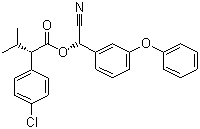
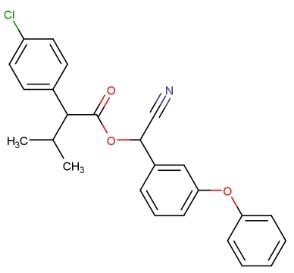
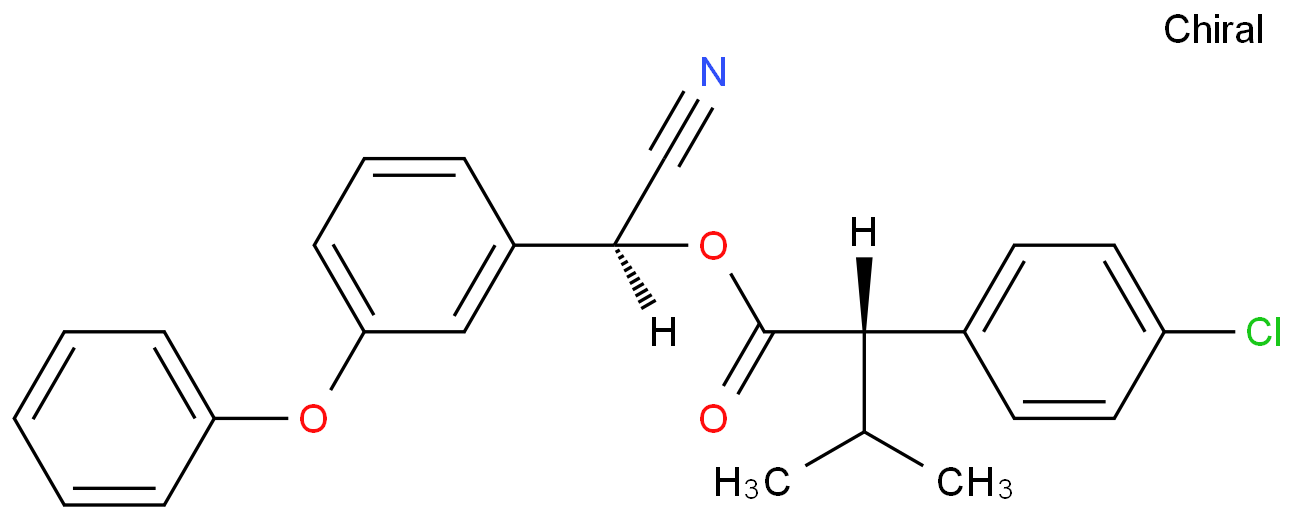
S-cyano (3-phenoxyphenyl) methyl (S)-4-chloro-alpha-(1-methylethyl) benzeneacetate, commonly known as Esfenvalerate, with CAS number 66230-04-4, has the molecular formula C25H22ClNO3. It appears as colorless to white crystalline solid with a density of 1.21 g/cm3. Esfenvalerate finds extensive use in agriculture and households to control various pests, including moths, flies, beetles, and other insects. It is also employed in some pet products to manage fleas and ticks. The structure of Esfenvalerate is depicted in the diagram below:

Esfenvalerate is a synthetic pyrethroid insecticide marketed under the brand Asana. It is the (S)-enantiomer of cypermethrin. In the United States, the tolerance level for chemical residues in food is 0.05 ppm.
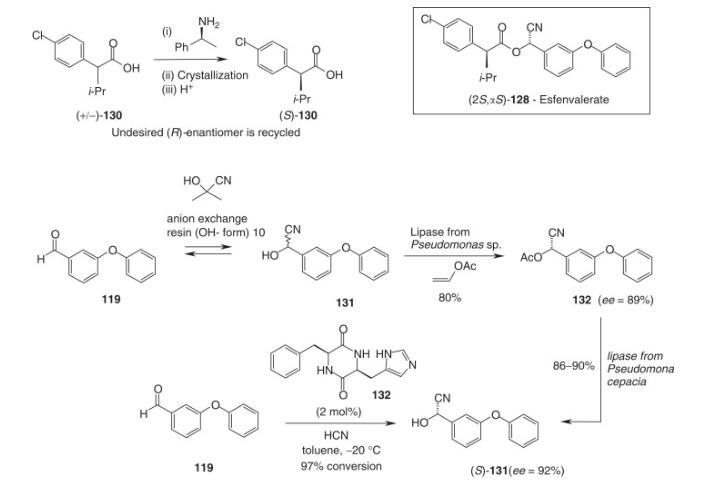
Pyrethroid insecticides have replaced organophosphates and become the most commonly used class of insecticides in agriculture and urban settings. The widespread use of pyrethroids has led to their detection in aquatic environments, where their concentrations can have sublethal effects on aquatic organisms. S-cyano (3-phenoxyphenyl) methyl (S)-4-chloro-alpha-(1-methylethyl) benzeneacetate, developed in 1976, is a widely used pyrethroid insecticide, a chiral compound with four stereoisomers, namely αS-2S; αR-2S; αS-2R; αR-2R. The αS-2S isomer, named Esfenvalerate, exhibits the highest biological activity among them. This compound demonstrates high efficacy against target species.
Esfenvalerate is widely favored for its quick knockdown and long residual control of various crawling and flying pests. Pest control professionals typically use Esfenvalerate products when tasked with eliminating pests. Esfenvalerate products can be used indoors or outdoors as crack-and-crevice or spot treatments for residual control of ants, centipedes, carpenter bees, various cockroaches, scorpions, and many other pests.
Esfenvalerate is effective against various pests, including ants, cockroaches, termites, crickets, spiders, and even some flies and mosquitoes. This could be a significant advantage if you are dealing with a variety of insect issues.
Esfenvalerate acts quickly to kill insects upon contact and provides a long-lasting residual effect as a protective barrier. This helps prevent new infestations.
Compared to some older pesticides, Esfenvalerate is considered to have moderate toxicity, resulting in a lower risk of severe poisoning to humans and pets when used according to label instructions.
Esfenvalerate is a broad-spectrum insecticide used to control various insects in agricultural and residential environments.
Esfenvalerate is used on multiple crops, including fruits, vegetables, cotton, and nuts, to control aphids, beetles, caterpillars, and leafhoppers, among other pests.
Esfenvalerate is also used in residential and commercial settings to control pests such as ants, cockroaches, crickets, spiders, and termites. It can be applied as crack-and-crevice treatments, spot treatments, or broadcast treatments.
This type of treatment involves applying the insecticide to cracks and crevices where pests may hide. It is a common method for controlling ants and cockroaches.
This type of treatment involves applying the insecticide to localized areas where pests are seen. It is a common method for controlling spiders and crickets.
This treatment involves applying the insecticide over a large area. It is a common method for controlling termites.
Although esfenvalerate insecticides can swiftly knock down pests, they are not instant kill products. Some insects may die within as little as 30 minutes, but for others, it may take longer. Depending on the lifecycle of the target pests, you may need to reapply esfenvalerate products within 14 to 21 days.
The residual effect of esfenvalerate varies depending on the season, lasting 3 months indoors and 1 to 2 months outdoors. It is recommended to spray monthly or quarterly for preventive pest control.
Esfenvalerate is a widely acclaimed product among pest control professionals for its effectiveness in controlling various insects and its wide range of applications. Esfenvalerate products are commonly used indoors and outdoors in both commercial and residential settings.
Esfenvalerate comes in many different formulations, ranging from microencapsulated formulations to liquid concentrate insecticides and aerosols. Whether you are dealing with spiders, fleas, scorpions, or just general preventative pest control, few active ingredients surpass esfenvalerate.
When used according to label instructions, esfenvalerate can be safely applied. It is essential to wear appropriate safety gear and equipment such as gloves, protective eyewear, safety masks, and long-sleeved clothing when handling this product. Ensure to avoid treated areas until the product has completely dried.
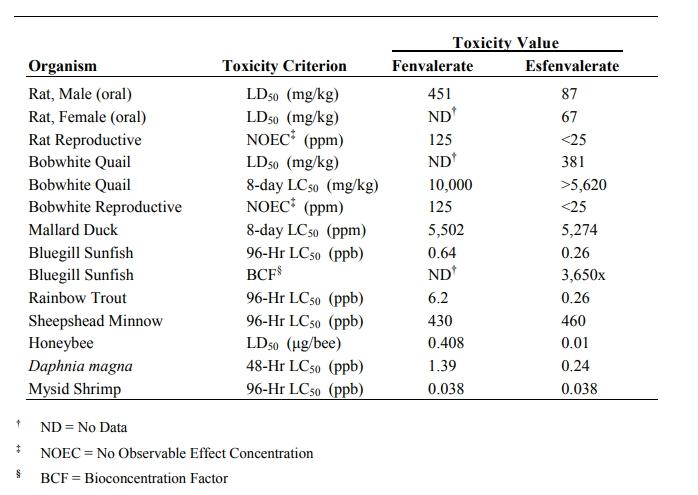
However, it's worth noting that esfenvalerate has been identified as highly toxic to fish, with LC50 values ranging from 0.07 to 0.69 μg/L. Surface runoff and spray drift in aquatic habitats may endanger aquatic organisms, with estimated concentrations of esfenvalerate in the environment ranging from 0.02 μg/L to 6.46 μg/L (0.02 μg/L to 1.11 μg/L for agricultural use and 0.05 μg/L to 6.47 μg/L for non-agricultural use). Additionally, esfenvalerate has been detected in aquatic environments in the United States (American River, Colusa Basin Drain, Sacramento River, and San Joaquin River) at concentrations ranging from 0.025 μg/L to 0.76 μg/L. Therefore, esfenvalerate remains an environmental concern in some aquatic habitats.
The carcinogenicity of esfenvalerate is not yet clear. Here's what we know:
Studies on esfenvalate, closely related to esfenvalerate, have not shown any clear link to cancer in rats and mice. Esfenvalate's carcinogenicity was tested in two mouse and two rat oral studies. There was no increase in tumor incidence in mice. In one study, the incidence of benign tumors in female rats increased. In another study with higher doses, there was no increase in tumor incidence in either male or female animals. Thus, there is insufficient evidence to prove esfenvalate's carcinogenicity in laboratory animals. The International Agency for Research on Cancer (IARC) classifies esfenvalate as Fenvalerate is not classifiable as to its carcinogenicity to humans (Group 3) based on this data.
Specific carcinogenicity studies on esfenvalerate itself are limited. Therefore, it is best to follow safety guidelines and avoid exposure when handling esfenvalerate. If you have any concerns about esfenvalerate, it's best to consult a medical professional.
Esfenvalerate, as an effective insecticide, plays a crucial role in agriculture and commercial sectors. A deeper understanding of its characteristics and mechanisms of action can better utilize this compound for pest control, increase crop yields, and ensure agricultural production safety. With ongoing technological advancements and further research, the future prospects of esfenvalerate's application in agriculture are expected to broaden.
[1] https://www.sciencedirect.com/science/article/abs/pii/S0045653519326566?via%3Dihub
[2] https://www.solutionsstores.com/esfenvalerate
[3] https://www.ncbi.nlm.nih.gov/books/NBK499654/
[4] https://www3.epa.gov/pesticides/chem_search/cleared_reviews/csr_PC-109303_undated_b.pdf
 |
 |
 |
 Agricultural News
 Food News
 Industrial News
 Cosmetic News
 Pharmaceutical News
 Science News

 2YRS
2YRS