-
We detected your language preference as English. Would you like to switch to the English version for a better experience?
Switch to English
Stay here


Structural steel loses roughly half of its load-bearing strength when it reaches approximately 550 °C — a temperature that an unprotected I-beam can hit in less than 15 minutes of a standard cellulosic fire. Intumescent paints are the coatings industry's answer to this problem: they look like ordinary decorative finishes at ambient temperature, yet swell 10 to 100 times their applied thickness when exposed to fire, forming an insulating char barrier that delays heat transfer to the substrate. Formulators who work with these systems know that the entire performance envelope — expansion ratio, char cohesion, adhesion, and durability — is dictated by a surprisingly short list of functional ingredients: an acid source, a carbon source, and a blowing agent, usually welded together by a suitable binder. Selecting and balancing these ingredients, most notably ammonium polyphosphate, melamine, and pentaerythritol, is the core technical challenge of intumescent coatings formulation.
| Function | Target Applications | Key Specifications | Compliance Status |
|---|---|---|---|
| Thin-film intumescent: acid source + carbon source + blowing agent form an insulating char foam | Structural steel beams and columns, hydrocarbon-exposed steel, cast iron, wood substrates in buildings | Expansion ratio 10–100×; dry film 0.5–3 mm; fire resistance 30–120 min at 500–1200 °C substrate temperature | Tested to ASTM E119, UL 1709, ISO 834; ingredients listed on TSCA inventory and EU REACH registered |
| Waterborne hybrid: acrylic dispersion binder with APP/melamine/PER trio for on-site and shop application | Architectural steel in schools, hospitals, parking garages; retrofitted heritage timber structures | VOC < 100 g/L; UV- and humidity-durable topcoat required; R30–R120 fire ratings per EN 13381-8 | EU Directive 2004/42/EC VOC limits; CE marking under EN 13381 series for construction products |
Intumescence is a chemically choreographed sequence, not a single reaction. In a classic three-component system, each ingredient has a defined role and a defined activation temperature, and the coating only performs if the sequence happens in the correct order. The process, as described by leading researchers in polymer flame retardancy, unfolds in four stages.
The acid source, typically ammonium polyphosphate (APP, CAS 68333-79-9), begins to decompose. APP releases polyphosphoric acid — a strong dehydrating agent — while liberating ammonia and water. The inorganic acid does not char by itself; it exists to attack the carbon source in the next stage.
The polyphosphoric acid esterifies and dehydrates the polyhydric carbon source, pentaerythritol, producing phosphorylated polyols that subsequently decompose into a carbonaceous char. This charring reaction is the heart of the system: it converts a thin organic film into a growing carbon skeleton.
Just as the char is forming, the blowing agent decomposes. Melamine sublimes and decomposes endothermically, releasing non-flammable gases — primarily ammonia, nitrogen, and melamine-derived volatiles. These gases blow the softening, viscous char mass into a multicellular foam, multiplying the coating's thickness by a factor of 10 to 100.
The binder resin melts, wetting the char and stiffening the cell walls so the foam does not collapse or blow away. A well-engineered char is a closed- or semi-closed-cell carbon foam with low thermal conductivity, which slows heat flux into the steel and can maintain the substrate below critical temperature for 30 to 120 minutes depending on film thickness.

An intumescent coating expands into a thick insulating char when exposed to fire.
Every intumescent formulation is built from functional classes rather than a single chemical. Within each class, formulators trade off cost, water sensitivity, thermal activation window, and char quality. The three classical pillars — acid source, carbon source, and blowing agent — are supported by the binder system and a cast of synergists.
Phosphorus-based compounds dominate this class. Ammonium polyphosphate is the workhorse: a linear polyphosphate with variable chain length, commercially split into water-insoluble crystalline Form II (the choice for coatings that must survive humidity and outdoor weathering) and more water-soluble, short-chain Form I (used where cost matters more than water resistance). APP supplies both the dehydrating polyphosphoric acid and part of the intumescing gas. Alternatives include monoammonium phosphate (MAP, CAS 7722-76-1) and diammonium phosphate (DAP, CAS 7783-28-0) — inexpensive but highly water-soluble, which limits them to interior dry environments — and melamine phosphate (CAS 20208-95-1) or melamine polyphosphate, which combine acid-source and blowing-agent functions in one molecule and offer better water resistance at a higher price.

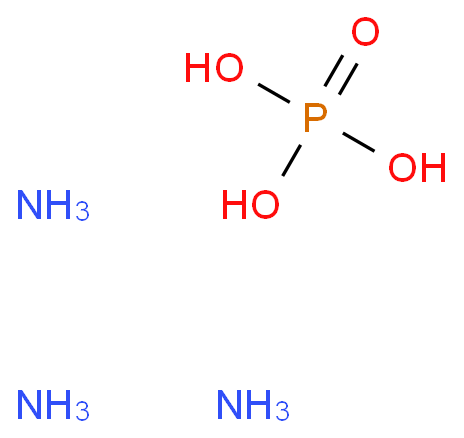
Chemical composition of ammonium polyphosphate (APP): a polyphosphate chain terminated by ammonium groups.
The carbon source must be a polyhydric compound rich in hydroxyl groups that the polyphosphoric acid can esterify. Pentaerythritol (PER, CAS 115-77-5) is the industry standard — its four symmetric hydroxyl groups char efficiently and its decomposition window (~250–350 °C) aligns well with APP-based acid release. Related polyols include dipentaerythritol (CAS 126-58-9), which chars at higher temperature and improves char integrity, and sorbitol (CAS 50-70-4), a lower-cost but more hygroscopic option. Starch and other carbohydrates are renewable alternatives historically used in older formulations, though their water sensitivity and inconsistent purity have pushed modern formulators back to synthetic polyols.

Chemical structure of pentaerythritol, C(CH2OH)4, the dominant carbon source in intumescent paints.
Melamine (CAS 108-78-1) is the near-universal choice. The 1,3,5-triazine ring sublimes at around 250 °C and then decomposes, absorbing heat and releasing ammonia and nitrogen-rich volatiles that inflate the char. Its sublimation is endothermic, giving melamine a bonus role as a heat sink. Substituted melamines (melamine borate, melamine cyanurate, CAS 37640-57-6) tailor the gas-release window or add smoke-suppressing boron; chlorinated paraffins can serve as auxiliary blowing and char-modifying agents but face increasing regulatory scrutiny under REACH and restrictions on persistent chlorinated substances.

Chemical structure of melamine, C3H6N6, a 1,3,5-triazine that sublimes and decomposes endothermically.
The binder must soften at the right moment to trap the foam yet remain hard and adherent in service. Acrylic dispersions dominate waterborne intumescents; epoxy and polyurethane binders dominate solventborne and hydrocarbon-fire (offshore) systems. Inorganic reinforcements such as kaolin clay (CAS 1332-58-7), expandable graphite — a powerful stand-alone intumescent for thick-film systems — titanium dioxide, and glass frits strengthen the char skeleton and prevent it from cracking or sloughing during long fires. Boron compounds (zinc borate, boric acid) both flux the char and suppress smoke. For a deeper treatment of phosphorus chemistry in flame retardancy, see the Guidechem flame retardant encyclopedia entry.
The table below compares the core intumescent ingredients and the leading alternatives within each functional class. Water solubility is the single most important durability differentiator: water-soluble acids and polyols leach out of films exposed to humidity, quietly destroying the fire rating.
| Ingredient | CAS Number | Function | Water Solubility | Activation Window | Key Strength / Limitation |
|---|---|---|---|---|---|
| Ammonium polyphosphate (Form II) | 68333-79-9 | Acid source | Insoluble (<1 g/L) | 150–280 °C | Industry standard, humidity-durable; premium price vs. Form I |
| Melamine | 108-78-1 | Blowing agent | Slightly soluble (~3 g/L) | 250–380 °C (sublimes) | Endothermic, releases non-flammable gases; can migrate out of film |
| Pentaerythritol | 115-77-5 | Carbon source | Slightly soluble (~6 g/100 mL) | 250–350 °C | Efficient char former; hygroscopic, needs encapsulation in wet service |
| Dipentaerythritol | 126-58-9 | Carbon source | Slightly soluble | 300–400 °C | Denser, stronger char; higher cost and higher charring temperature |
| Melamine polyphosphate | 218768-84-4 | Acid source + blowing agent | Insoluble | ~300–350 °C | Excellent water resistance, one-molecule dual function; expensive, high onset temperature |
| Monoammonium phosphate | 7722-76-1 | Acid source | Highly soluble (~40 g/100 mL) | ~150–200 °C | Very low cost; leaches in humidity, interior-dry use only |
| Expandable graphite | 7782-42-5 (graphite) | Intumescent char former | Insoluble | ~200–300 °C | Massive expansion, good for thick-film/hydrocarbon systems; black, needs hiding, weak char cohesion alone |
Formulators sourcing these materials should verify grade-specific data — APP chain length (degree of polymerization), melamine particle size, and PER mesh — directly with suppliers, because these parameters swing expansion behavior more than the chemical identity itself. A current comparison of APP suppliers and specifications is the practical starting point for most projects. For background chemistry on the melamine molecule itself, the Guidechem melamine encyclopedia article covers its synthesis and industrial uses.
A representative thin-film intumescent for interior structural steel is built around the APP/melamine/PER trio at a stoichiometrically balanced ratio, typically close to 3:1:1 by weight, dispersed in an acrylic binder at 20–30% resin solids on total formulation. The table below shows a typical white-pigmented waterborne intumescent base coat as a starting-point formulation.
| Component | Typical wt % | Role |
|---|---|---|
| Ammonium polyphosphate (Form II) | 25–32 | Acid source / dehydration catalyst |
| Pentaerythritol (or PER/dipentaerythritol blend) | 8–12 | Carbon source / char former |
| Melamine | 8–12 | Blowing agent / heat sink |
| Acrylic dispersion (binder) | 20–30 | Film former / char matrix binder |
| Titanium dioxide + kaolin / talc | 8–15 | Pigment, char reinforcement, rheology |
| Zinc borate / boric acid derivative | 2–5 | Char flux, smoke suppressant, synergist |
| Water, coalescent, defoamer, thickener, preservative | balance | Application and storage properties |
Application is as critical as chemistry. The base coat is spray- or roller-applied over an approved anti-corrosive primer in multiple passes to reach the specified dry film thickness (DFT), typically 0.5–3 mm, and is finished with a compatible weather- and UV-protective topcoat when the steel is exposed. Fire resistance scales with thickness: a common rule of thumb for cellulosic thin-film systems is that the protected steel reaches its critical temperature (usually 500–550 °C, corresponding to a 0.02 yield strength reduction factor) after a time roughly proportional to DFT. Never extrapolate — the rating must come from a furnace test of the exact system, primer to topcoat.
Intumescent coatings are regulated as construction products and as chemicals. The table below summarizes the main frameworks a formulator or specifier must satisfy in the major jurisdictions.
| Jurisdiction / Body | Framework | Relevance to Intumescent Ingredients |
|---|---|---|
| United States | ASTM E119 / UL 263 (fire resistance), UL 1709 (hydrocarbon fires), ASTM E84 (flame spread); TSCA inventory for chemical substances | Fire ratings must come from furnace tests of the full system; APP, melamine and PER are TSCA-listed; IBC Section 703 and NFPA 251 govern rated assemblies |
| European Union | EN 13381-8 (steel members), EN 13501-2 (classification), EN 13381-11 (intumescent for steel), Regulation (EU) 305/2011 (CPR, CE marking); REACH Regulation (EC) 1907/2006; CLP 1272/2008 | CE-marked systems need declared R30–R120 ratings from notified-body testing; all three core ingredients are REACH-registered; VOC limits set by Directive 2004/42/EC for decorative coatings |
| International / ISO | ISO 834-1 (standard fire curve), ISO 6184, ISO 5660 (cone calorimetry) | ISO 834 defines the cellulosic temperature curve used to qualify thin-film intumescents; cone calorimetry is the standard R&D screening method for formulation comparisons |
| Offshore / Petrochemical | UL 1709, ISO 22899-1 (jet fire), NORSOK M-501 | Hydrocarbon and jet-fire scenarios demand epoxy-based reactive systems with higher-temperature acid sources (e.g. melamine polyphosphate) and mineral-wool or glass-fiber char reinforcement |
| Worker Safety (all markets) | OSHA HazCom (29 CFR 1910.1200), GHS labeling, ACGIH TLV for respirable dust | APP and PER are combustible-dust and nuisance-dust hazards; melamine has a workplace exposure limit in several jurisdictions; SDS-driven PPE applies during spray application |
Form II APP has longer phosphate chains and a crystalline structure that is essentially insoluble in water (typically below 1 g/L), while short-chain Form I dissolves much more readily. In a coating film, water solubility equals leaching: rain, condensation or high humidity extracts the acid source, and the residual film no longer intumesces. Form I remains attractive for cost-sensitive interior dry-environment products, but any specification involving weathering, washing or condensation should call out Form II — ideally with a minimum degree of polymerization agreed with the supplier.
Yes, and this is an active area of formulation strategy. Melamine phosphate and melamine polyphosphate combine the acid source and the blowing agent in a single molecule, which improves water resistance and simplifies quality control. Chlorinated paraffins can act as both blowing-agent synergists and char modifiers, though their regulatory profile makes them a declining choice. The binder, too, is a functional ingredient: chlorine-containing resins contribute acid and radical-quenching behavior, and reactive epoxy binders in thick-film systems contribute substantially to the char itself.
It depends entirely on the required fire-resistance rating, the steel section factor (Hp/A), and the fire scenario. Thin-film waterborne systems typically run 0.5–3 mm dry film for 30–120 minutes of cellulosic fire resistance, applied in several passes. Thicker requirements — long-duration ratings or hydrocarbon/jet fires — move into epoxy-based reactive systems that can reach 5–15 mm or more. The only defensible way to set thickness is the manufacturer's fire-test data for the exact assembly: thickness tables derived from EN 13381-8 or ASTM E119 furnace tests define the approved dry film per steel section factor, and site DFT must be verified against them.
They can. The classic failure modes are water-driven: leaching of soluble acids or polyols through a breached topcoat, and UV-catalyzed degradation of exposed melamine and APP. Well-maintained interior systems have documented service lives of decades, but exterior, immersed or abrasively cleaned systems require periodic inspection, topcoat maintenance and — where degradation is found — reapplication to the specified DFT. Moisture-cycling and accelerated-weathering testing (e.g. ISO 12944 cyclic protocols followed by a furnace retest) is the accepted way to demonstrate durability of a specific system.
|
 |
 |
 |
 |
 EN
EN
 Agricultural News
 Food News
 Industrial News
 Cosmetic News
 Pharmaceutical News
 Science News

 1YR
1YR


