-
We detected your language preference as English. Would you like to switch to the English version for a better experience?
Switch to English
Stay here


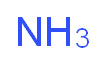
The ammonia Lewis structure is a central nitrogen bonded to three hydrogens with one lone pair on nitrogen (H3N:); the molecule is trigonal pyramidal, nitrogen is sp3-hybridized, the H–N–H angle is about 107°, and because the pyramidal shape prevents dipole cancellation, NH3 is polar.
 Figure 1: Lewis Structure of Ammonia (NH3)
| Chemical Formula | NH3 |
| CAS Number | 7664-41-7 |
| Total Valence Electrons | 8 |
| Lewis Structure | Central N with 3 N–H bonds + 1 lone pair |
| Electron-Domain Geometry | Tetrahedral |
| Molecular Geometry | Trigonal pyramidal |
| Hybridization Model | sp3 (nitrogen) |
| H–N–H Bond Angle | ≈ 107° |
| Polarity | Polar molecule |
Ammonia is one of the most-produced chemicals in the world, almost entirely via the Haber–Bosch process from nitrogen and hydrogen. The majority is used in fertilizers (urea, ammonium nitrate, ammonium phosphate), underpinning modern agriculture and food production.
Beyond fertilizer, NH3 is oxidized to nitric acid (Ostwald process), a precursor to explosives, nitrates and adipic acid; it is used as a refrigerant (especially in industrial and large-scale cooling), as a cleaning agent (ammonium hydroxide), and as a feedstock for nylon intermediates (caprolactam, adipic acid). Its alkaline, nucleophilic character makes it a versatile reagent across the chemical industry.
Count valence electrons for NH3: nitrogen is in Group 15 and contributes 5 valence electrons. Each of the three hydrogens contributes 1 valence electron.
Total valence electrons = 5 from N + 3 × 1 from H = 8 electrons.
Place nitrogen at the center and attach the three hydrogens: H–N–H (with a third H). Three N–H single bonds consume 6 of the 8 electrons, leaving 2 electrons as one lone pair on nitrogen.
Nitrogen now shares three bonding pairs (6 electrons) plus one lone pair (2 electrons) = 8 electrons (octet); each hydrogen has its duet. The structure H3N: has zero formal charge on every atom.
The Lewis structure gives four electron domains around nitrogen: three bonding domains and one lone pair. Four domains adopt an approximately tetrahedral electron-domain geometry to minimize repulsion.
Because one domain is a lone pair (not a vertex of the molecule), the molecular geometry is trigonal pyramidal, not tetrahedral. The lone pair repels the N–H bonds more strongly, compressing the H–N–H angle from 109.5° to about 107°.
The VSEPR ordering is lone pair–bonding pair repulsion > bonding pair–bonding pair repulsion. The nitrogen lone pair occupies more space and pushes the three N–H bonds downward, creating the pyramid and narrowing the bond angle slightly below the tetrahedral ideal.
In the localized-bond model, nitrogen in NH3 is described as sp3-hybridized: four electron domains correspond to four tetrahedral hybrids. Three form σ bonds to hydrogen and one holds the lone pair.
The lone pair occupies slightly more space than a bonding hybrid, which is why the geometry is pyramidal and the bond angle is slightly compressed relative to a perfect tetrahedron.
Formal charge = valence − nonbonding − ½ × bonding. Nitrogen in NH3: 5 − 2 − ½×6 = 0. Each hydrogen: 1 − 0 − ½×2 = 0. Every atom has zero formal charge, confirming the H3N: structure is dominant.
Ammonia is polar. Each N–H bond is polar because nitrogen is more electronegative than hydrogen, and the molecule is trigonal pyramidal rather than planar.
The three N–H bond dipoles do not cancel; their vector sum points roughly along the C3 symmetry axis toward the nitrogen lone pair, giving NH3 a substantial dipole moment (about 1.47 D). This polarity underlies ammonia's solubility in water and its behavior as a base.
"Ammonia's polarity and basicity both trace to the same feature: the nitrogen lone pair. It defines the pyramidal geometry (so bond dipoles don't cancel) and it is the site that accepts a proton to form ammonium."
Interpretation consistent with VSEPR and Brønsted–Lowry base behavior of ammonia.This lone-pair-driven polarity also explains why NH3 is highly soluble in water, forms hydrogen bonds, and readily accepts a proton to give NH4+ — the chemistry behind its use as a fertilizer nutrient and as a base in process chemistry.
| Species | Formula | Central Atom | Electron Domains | Molecular Geometry | Polarity |
|---|---|---|---|---|---|
| Ammonia | NH3 | N | 4 | Trigonal pyramidal | Polar |
| Water | H2O | O | 4 | Bent | Polar |
| Methane | CH4 | C | 4 | Tetrahedral | Nonpolar |
| Phosphine | PH3 | P | 4 | Trigonal pyramidal | Weakly polar |
| Ammonium ion | NH4+ | N | 4 | Tetrahedral | Ionic species |
A central N with three N–H bonds and one lone pair (H3N:). All 8 valence electrons are accounted for with zero formal charge.
Ammonia is polar. Its pyramidal shape prevents the three polar N–H bond dipoles from canceling.
The H–N–H angle is about 107°. Four electron domains give a tetrahedral arrangement compressed slightly by the lone pair.
Nitrogen is sp3-hybridized. Four domains (3 bonds + 1 lone pair) correspond to four tetrahedral hybrids.
The CAS number is 7664-41-7. PubChem (CID 222) and NIST identify this with NH3.
Technical scope: Lewis structures, VSEPR and hybridization are model-based descriptions for chemical communication; actual electronic structure is better described by molecular-orbital methods. Commercial ammonia is supplied as anhydrous liquid or aqueous solution in multiple grades; CAS 7664-41-7 identifies the substance, not a specific concentration or purity.
 |
|
 |
 EN
EN
 Agricultural News
 Food News
 Industrial News
 Cosmetic News
 Pharmaceutical News
 Science News