-
We detected your language preference as English. Would you like to switch to the English version for a better experience?
Switch to English
Stay here


Welcome to the world of molecular structures! Today, we'll explore the Lewis structure of Benzoic acid (C7H6O2), a compound widely used in various industries and known for its interesting chemical properties. Understanding its Lewis structure will give us insights into its bonding, geometry, and other characteristics.

Lewis structures, developed by Gilbert N. Lewis, are diagrams that represent the arrangement of atoms and valence electrons in a molecule. They are crucial in understanding the bonding and geometry of molecules. In Lewis structures, valence electrons are shown as dots around the atoms, and bonds are represented by lines. These structures follow the octet rule, where atoms strive to have eight electrons in their outermost shell to achieve stability.
Benzoic acid is a compound with the chemical formula C7H6O2. It is a colorless crystalline solid that is slightly soluble in water. It is commonly used as a food preservative (E210) and in the production of various chemicals, such as dyes, perfumes, and pharmaceuticals.
Step 5: Check for Formal Charges: Adjust electron distribution if necessary to minimize formal charges.
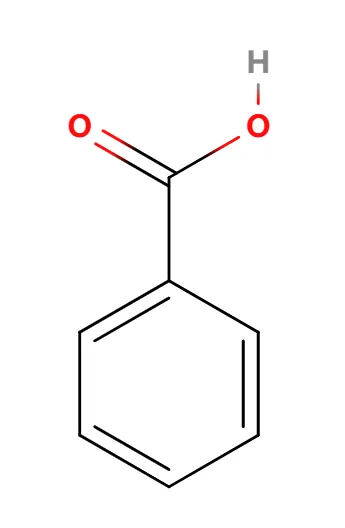
The Lewis structure suggests that Benzoic acid adopts a planar geometry. The benzene ring provides a flat structure, while the carboxyl group introduces a slight distortion. This planar arrangement influences its chemical properties and reactivity.
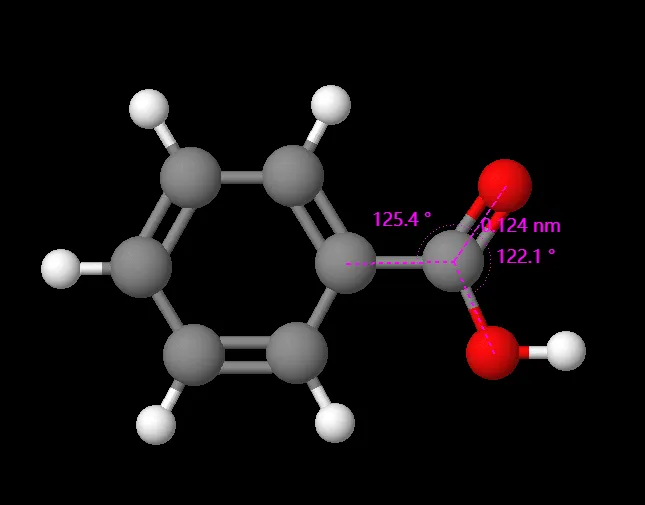
In Benzoic acid, the carbon atom undergoes sp2 hybridization. One s orbital and two p orbitals combine to form three sp2 hybrid orbitals. These orbitals then overlap with the orbitals of other atoms to form σ bonds, providing stability to the molecule.
Benzoic acid is polar. The presence of the carboxyl group (-COOH) introduces polarity into the molecule. The oxygen atom is more electronegative than carbon and hydrogen, leading to unequal sharing of electrons and creating a dipole moment.
Note: Actual bond angles and lengths may vary slightly due to factors such as resonance and steric effects.
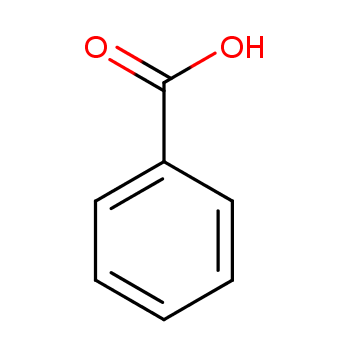
| Benzoic acid Cas 65-85-0 | |
| Molecular formula | C7H6O2 |
| Molecular shape | Planar |
| Polarity | polar |
| Hybridization | sp2 hybridization |
| Bond Angle | 125.4 degrees |
| Bond length | 124 pm |
 |
 |
 |
 |
 |
 |
 EN
EN
 Agricultural News
 Food News
 Industrial News
 Cosmetic News
 Pharmaceutical News
 Science News

 3YRS
3YRS

