-
We detected your language preference as English. Would you like to switch to the English version for a better experience?
Switch to English
Stay here


Methylhexahydrophthalic anhydride, also known as Methylhexahydrophthalic anhydride (MHHPA), has the chemical formula C9H12O3 and a molecular weight of 168.19.What is the CAS number of Methylhexahydrophthalic anhydride?Its CAS number is 25550-51-0. It is a colorless transparent liquid, soluble in benzene and acetone, with hygroscopic properties and a density of 1.162. This compound is primarily used as a hardener in epoxy resins. MHHPA is a heat-curable anhydride hardener, mainly employed in the electrical and electronic fields. It has advantages such as a low melting point, low viscosity when mixed with cycloaliphatic epoxy resins, long working time, high heat resistance of the cured product, and good high-temperature electrical performance. It is used in the impregnation of electrical equipment coils, casting of electrical components, and sealing of semiconductors, such as outdoor insulators, capacitors, LEDs, and digital tubes.
Guo Libing and others reported a new method for producing Methylhexahydrophthalic anhydride using phthalic anhydride and a cyclopentadiene mainly composed of isoprene and mesitylene as raw materials. In the presence of a catalyst, phthalic anhydride absorbs isoprene and mesitylene to form Methyltetrahydrophthalic anhydride, which is then hydrogenated in the presence of a composite catalyst to produce Methylhexahydrophthalic anhydride. The process is as follows:
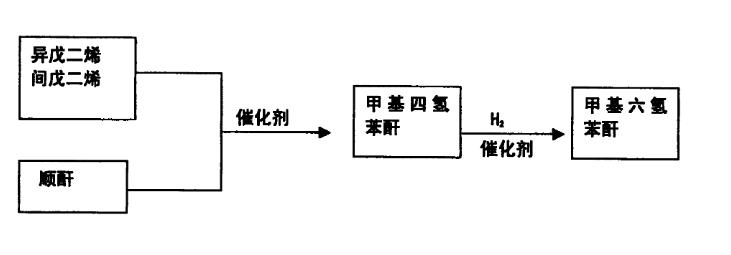
At a temperature of 50°C with 3 grams of aluminum chloride, 98 grams of phthalic anhydride is gradually added to cyclopentadiene (mainly composed of isoprene and mesitylene). Through the Diels-Alder reaction, Methyltetrahydrophthalic anhydride is produced. Then, 1 gram of nickel catalyst and 0.1 grams of (bis-diphenylphosphine oxide) tetrabromocopper polymer are added to the produced Methyltetrahydrophthalic anhydride. Under a temperature of 140°C and hydrogen pressure of 4 MPa in a high-pressure reactor, hydrogenation is carried out for 4 hours. After cooling, the catalyst is filtered, and under reduced pressure, 152 grams of colorless Methylhexahydrophthalic anhydride is obtained with a yield of 90.3%.
In current industrial production, the main method for producing Methylhexahydrophthalic anhydride involves catalytic hydrogenation of Methyltetrahydrophthalic anhydride, using Raney nickel as the catalyst. This method typically employs a stirred reactor and follows a batch production process. However, this method has a large footprint, high equipment costs, unstable product quality, and requires high hydrogenation temperatures (100–140°C) and pressures (above 8 MPa) with a hydrogenation time of 15–20 hours. After hydrogenation, direct distillation is performed, resulting in the mixing of catalysts with large amounts of residues, which are disposed of as waste, causing environmental pollution. Therefore, there is an urgent market need for methods that offer high product conversion rates, low energy consumption, stable quality, and are environmentally friendly. Continuous hydrogenation methods for producing Methylhexahydrophthalic anhydride are in demand.
Zhang Pengke and others reported a continuous hydrogenation method for producing Methylhexahydrophthalic anhydride, using a three-stage tubular fixed-bed reactor for cyclic continuous hydrogenation. The reactor features a tubular structure, with solid catalysts packed between the tubes and heat-conducting coal medium inside the shell. Hydrogen gas is fed from the bottom of each stage of the tubular reactor, with unreacted hydrogen returned to the hydrogen compressor after passing through the tubes. Methyltetrahydrophthalic anhydride is transported through high-pressure pipelines to the upper part of the tubular reactor, where it is sprayed evenly onto the surface of the solid catalysts and reacts with hydrogen. With the three-stage reactor, hydrogenation conversion rates approach 100%. This method achieves continuous production of Methylhexahydrophthalic anhydride, with a clean process and recyclable catalysts.
Methylhexahydrophthalic anhydride can be irritating to the skin and eyes, and inhalation may cause respiratory allergic reactions. Inhalation can lead to severe eye damage, allergic skin reactions, asthma symptoms, and respiratory difficulties. Prolonged exposure may cause bronchitis and asthma.
Skin Contact: May cause severe irritation and burns.
Eye Contact: May cause severe eye irritation, corneal damage, and burns.
Inhalation: May cause respiratory tract irritation and allergic reactions.
Avoid contact with skin and eyes, prevent dust and aerosol formation, and use non-sparking tools.
Wear appropriate personal protective equipment (such as gloves, goggles, and respirators) when handling Methylhexahydrophthalic anhydride.
Ensure good ventilation in the working area.
Avoid contact with skin, eyes, and clothing.
Follow safety procedures and waste disposal guidelines as specified in the Safety Data Sheet (SDS).
 |
|
 |
 |
 |
 EN
EN
 Agricultural News
 Food News
 Industrial News
 Cosmetic News
 Pharmaceutical News
 Science News

 1YR
1YR

