-
We detected your language preference as English. Would you like to switch to the English version for a better experience?
Switch to English
Stay here


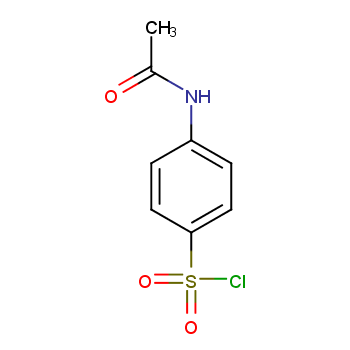
N-Acetylsulfanilyl chloride (N-acetylsulfanilyl chloride molecular formula: C8H8ClNO3S) is a chemical reagent with a slight acetic acid odor, easily hygroscopic, and rapidly decomposes in air. This chemical substance is corrosive and toxic, causing irritation to the skin and mucous membranes. Therefore, appropriate protective measures must be taken during production and use to avoid ingestion and skin contact. Operators need to wear suitable protective equipment. Due to its hygroscopic nature, leading to decomposition, it is usually recommended to use this product as soon as possible after production and store it under nitrogen gas to ensure its stability. N-Acetylsulfanilyl chloride is mainly used for synthesizing various sulfonamide drugs, such as sulfathiazole, sulfamethoxazole, sulfamethizole, sulfabenzpyrazine, and sulfamethazine, and also serves as an intermediate in dye production.
N-Acetylsulfanilyl chloride (p-Acetamidobenzenesulfonyl chloride, abbreviated as P-ASC) has a molecular formula of C8H8ClNO3S, a molecular weight of 233.67, CAS number 121-60-8, and n acetylsulfanilyl chloride density is 1.468 g/cm3. N-acetylsulfanilyl chloride boiling point is 426.8°C at 760 mmHg, n acetylsulfanilyl chloride melting point is 142-145°C (decomposition) (lit.). N-acetylsulfanilyl chloride's autoignition temperature remains unknown. N-acetylsulfanilyl chloride appearance is a white to light brown powder or crystalline with a slight acetic acid odor.
P-ASC is easily soluble in ethanol and ether solvents, and it also has good solubility in hot chloroform and hot benzene solvents. The crystals in air are easily oxidized to brown and absorb moisture to decompose, resulting in deterioration, so long-term storage is not recommended. The product is corrosive and toxic, and generally, manufacturers use it immediately after preparation for the production of other related products. Storage usually involves nitrogen gas sealing, and transportation requires corrosion-resistant alloys.
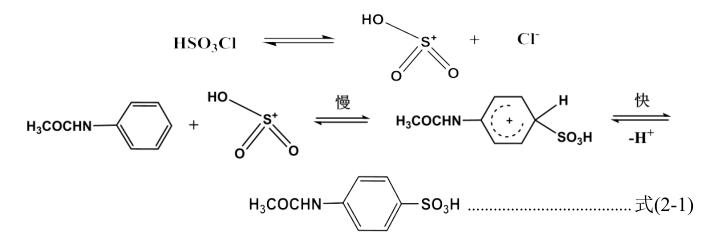
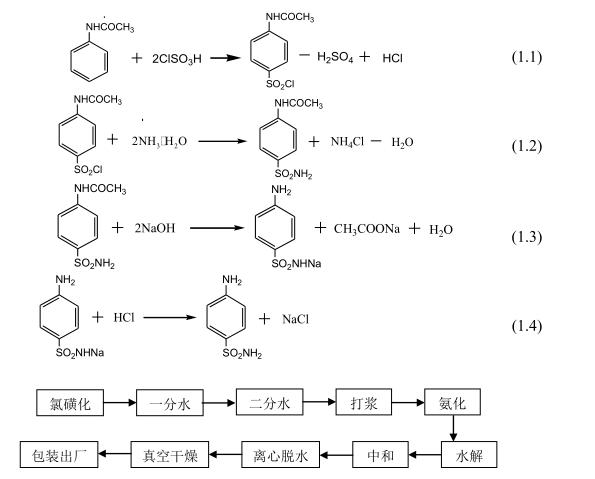
The traditional synthesis process uses acetanilide and chlorosulfonic acid as raw materials, with a stirred reactor and batch production method. The N-Acetylsulfanilyl chloride (P-ASC) is obtained through sulfonation and chlorination reactions. However, the sulfonation reaction releases a large amount of heat and significantly increases the viscosity of the material after the reaction. To improve mixing efficiency and control the reaction temperature, solid acetanilide is slowly added to a large excess of chlorosulfonic acid during industrial production. This not only reduces production efficiency but also leads to the generation of a large amount of wastewater due to the significant excess of chlorosulfonic acid. Researchers, such as Yu Xundong, have reduced the viscosity of the system by adding a solvent and prepared acetanilide slurry to achieve controlled addition of acetanilide. Additionally, they used a supergravity reactor as the sulfonation reactor to enhance the micro-mixing process between chlorosulfonic acid and acetanilide, avoiding the formation of local hot spots, and adopted a material circulation heat transfer method to control the temperature rise of the system, thereby reducing the amount of chlorosulfonic acid used and achieving continuous production. The specific steps are as follows:
Sulfonation stage
Chlorination stage

In the chlorination reaction between p-Acetamidobenzenesulfonic acid and chlorosulfonic acid, sulfuric acid is produced, which causes a reverse reaction, reducing the yield of P-ASC, as shown in equation (2-3).

The study used a micro melting point apparatus, infrared spectrometer (IR), and nuclear magnetic resonance (NMR) for qualitative analysis.
The melting point of chromatographically pure P-ASC standard samples and purified P-ASC samples obtained through recrystallization was measured using an X-4 digital micro melting point apparatus (Beijing Taike Instrument Co., Ltd.), and both were found to be 152°C. This result is higher than the literature-reported 140~143°C, indicating that the purified sample from the experiment is of very high purity.
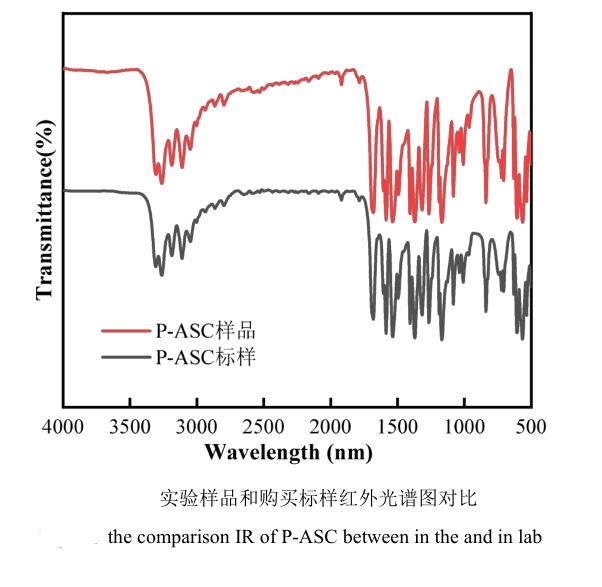
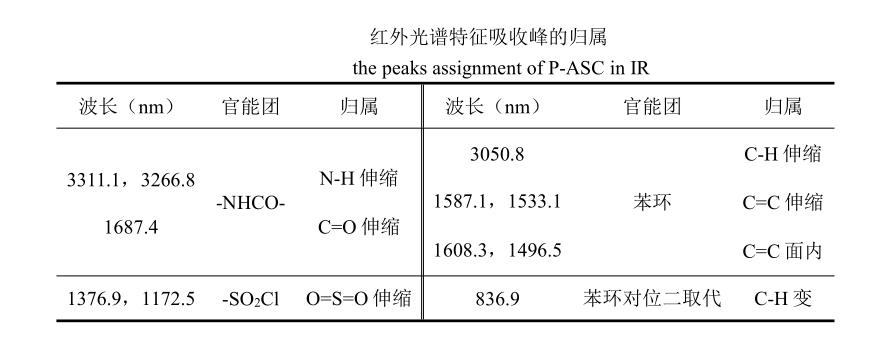
An infrared spectrometer was used to analyze the purchased standard and experimental samples, with the characteristic peaks of the experimental sample's infrared spectrum listed in the table below. The comparison of the IR spectra of the purchased P-ASC standard and the experimental sample is shown below. The characteristic peaks of the purchased P-ASC and the infrared absorption peaks of the experimental sample have the same wavelength range, indicating that P-ASC was successfully synthesized in the experiment.
The figure below shows the nuclear magnetic resonance spectrum of the P-ASC experimental sample purified with chloroform. The spectrum analysis shows a single peak at 2.04 ppm for -CH3, which defines its baseline area by the number of methyl hydrogens. Two doublets on the substituted benzene ring are located at 7.52 ppm, 7.53 ppm, 7.56 ppm, and 7.59 ppm. Meanwhile, at 7.52 ppm and 7.53 ppm, there is an overlapping peak of an active hydrogen (-NH-) that forms a doublet with an area of approximately 3. At 2.5 ppm, there is a solvent peak of deuterated DMSO. The structure and NMR spectrum of P-ASC fully conform to expectations based on spectrum analysis.

N-Acetylsulfanilyl chloride, as an important organic compound, is widely used in chemical synthesis and pharmaceutical development. Those interested in learning more about this compound or making a purchase can visit professional chemical supply platforms such as Guidechem to find reliable suppliers and ensure the acquisition of high-quality products. Through further study and exploration, you will be able to better understand its application value and potential!
 |
 |
|
 |
 |
 |
 EN
EN
 Agricultural News
 Food News
 Industrial News
 Cosmetic News
 Pharmaceutical News
 Science News

 3YRS
3YRS


