-
We detected your language preference as English. Would you like to switch to the English version for a better experience?
Switch to English
Stay here


Nicotinamide Riboside (NR) has emerged as one of the most commercially relevant NAD+ precursors in the longevity and healthy-aging sector. However, the success of any NR formulation depends far more on salt-form engineering than on the intrinsic activity of the free molecule. This article evaluates Nicotinamide Riboside Chloride (NR-Cl) and Nicotinamide Riboside Hydrogen Malate from the perspectives of crystalline stability, hygroscopicity, bioavailability, intellectual property positioning, and downstream manufacturing suitability for global nutraceutical and pharmaceutical supply chains.

Nicotinamide Riboside (NR, CAS 1341-23-7) is inherently unstable in its free-base form. Although procurement teams often assume that a “pure” free NR molecule should provide superior biological activity, the reality is dictated by solid-state chemistry rather than molecular intuition.
The NR molecule contains multiple hydroxyl (-OH) groups on the ribose moiety and a highly polar pyridinium-containing structure. This combination creates a strong affinity for atmospheric moisture, causing the free-base material to exist predominantly as an amorphous, highly hygroscopic solid, semi-solid gel, or viscous oil under ambient conditions.
From a degradation perspective, moisture uptake accelerates nucleophilic hydrolysis of the glycosidic bond connecting nicotinamide and ribose. The degradation pathway typically yields nicotinamide and ribose derivatives, reducing active NR content and compromising shelf-life.
The commercial breakthrough for NR was achieved through salt formation. By introducing a counterion, molecular mobility is reduced and a thermodynamically favorable crystalline lattice becomes possible.
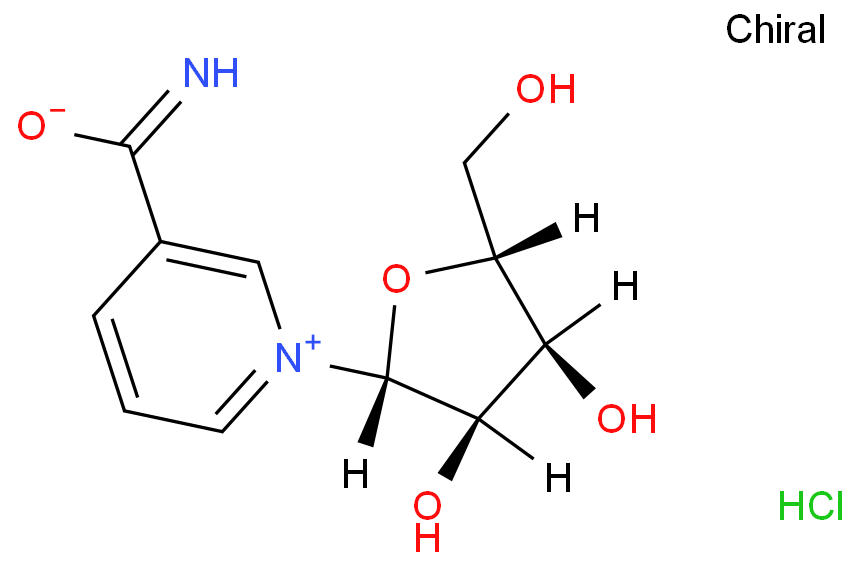
Nicotinamide Riboside Chloride (NR-Cl, CAS 23111-00-4) serves as the industry benchmark. The chloride anion participates in ionic interactions and extensive hydrogen-bonding networks that increase lattice energy, improve crystallinity, and dramatically enhance handling characteristics.
The resulting crystal structures exhibit greater resistance to moisture-induced phase transitions and improved storage stability compared with free-base NR. Regulatory monographs describe NR-Cl as a white-to-light-brown crystalline powder with water solubility exceeding 446 mg/mL and a melting point specification of approximately 115–125°C. Patent literature has further defined multiple crystalline forms (Form I and Form II), highlighting the critical role of crystal engineering in commercial production.
In practical terms, the question is not whether free NR is biologically active—it is. The question is whether it can survive manufacturing, transportation, warehousing, and shelf storage without unacceptable degradation. Salt selection therefore becomes a prerequisite for commercialization rather than a secondary formulation decision.
Although NR-Cl remains the dominant commercial form, its chloride counterion introduces formulation challenges under humid processing conditions. Dynamic Vapor Sorption (DVS) studies reported across industry development programs consistently show increasing moisture uptake once relative humidity exceeds approximately 60% RH.
The high polarity of chloride facilitates water association, which can lead to caking, sticking, and reduced powder flowability during tablet compression and encapsulation operations.
Hydrogen malate counterions offer a fundamentally different crystal-engineering strategy. Unlike chloride, hydrogen malate contains a larger organic framework with greater steric bulk. This larger molecular architecture modifies crystal packing density and reorganizes intermolecular hydrogen-bonding networks.
The resulting crystal lattice often demonstrates:
Thermal analysis further highlights these distinctions. Commercial NR-Cl typically exhibits melting or decomposition onset around 120–124°C, whereas well-designed hydrogen malate salts frequently demonstrate elevated decomposition thresholds before major structural collapse occurs.
Intellectual property has become one of the most important variables influencing NR salt-form selection. Multiple patent families covering crystalline NR chloride forms, manufacturing processes, and purification routes have been established globally.
For companies seeking greater Freedom-to-Operate (FTO), alternative counterions such as tartrate and hydrogen malate have attracted increasing attention. These salt forms may provide opportunities to develop differentiated formulations while reducing exposure to specific crystalline-form claims.
From a dissolution perspective, polyfunctional organic acids introduce additional formulation advantages. Hydrogen malate contains both hydroxyl and carboxyl functionalities, while tartrate contains two carboxyl groups and multiple hydroxyl groups. These features can influence local microenvironmental pH and improve intrinsic dissolution rates in simulated gastric fluid (SGF).
Another important manufacturing consideration involves residual solvent control. Crystallization systems employing ethanol, isopropanol, or ethyl acetate must satisfy increasingly strict global quality requirements. Advanced hydrogen malate crystallization processes often demonstrate lower solvent entrapment due to more favorable crystal growth kinetics and reduced lattice defects.
"Future NAD+ precursor innovation will increasingly depend on salt engineering rather than active ingredient discovery. The next generation of NR products will likely compete on manufacturability, stability, and patent positioning as much as on biological efficacy."
— Dr. Charles Brenner, NAD+ Metabolism Researcher
"Solid-form selection remains one of the most underestimated value drivers in nutraceutical commercialization. Crystal form can determine whether a formulation succeeds or fails at industrial scale."
— Erik C. Carlson, Inventor of Multiple Crystalline NR Technologies
Expert Commentary: Companies entering international longevity markets in 2026 should evaluate not only the biological performance of NR salts but also patent landscapes across North America, Europe, Japan, and China. A marginal improvement in crystal stability can translate into major advantages in global regulatory filings and supply-chain resilience.
Downstream Manufacturing Verdict: Matching Salt Forms to Final Delivery Systems
The ideal NR salt form depends heavily on the intended dosage format.
For hard-shell capsule filling and direct compression tablets, powder flowability becomes a primary concern. Key metrics include Hausner Ratio and Carr's Index, which directly influence feeder consistency and weight uniformity.
For instant beverage powders and stick-pack products, hydrogen malate and tartrate salts provide additional sensory advantages. Their intrinsic organic-acid character helps mask the bitter notes commonly associated with NR, reducing dependence on sweeteners and flavor systems.
From a supplier qualification perspective, Guidechem recommends auditing the following critical quality attributes:
In 2026, the most competitive NR supply chains are increasingly defined by analytical transparency. Suppliers capable of providing validated PXRD fingerprints, DSC thermograms, NMR spectra, and stability datasets are becoming preferred partners among premium longevity brands.
FAQs
Q1: Is free-base Nicotinamide Riboside more bioactive than NR chloride?
No. Free-base NR is chemically active but significantly less stable. In commercial products, stability and preservation of active content generally outweigh any theoretical advantages associated with the unbound molecule.
Q2: Why is hygroscopicity important for NR manufacturing?
Excessive moisture uptake can cause caking, reduced flowability, compression issues, and accelerated degradation, resulting in lower product quality and reduced shelf-life.
Q3: Does hydrogen malate offer better patent freedom than NR chloride?
Potentially yes. Alternative salt forms may provide greater formulation differentiation and reduced exposure to certain crystalline-form patent claims, though a jurisdiction-specific FTO analysis remains essential.
Q4: Which salt form is best for stick-pack beverage formulations?
Hydrogen malate and tartrate forms are often preferred because their organic-acid profiles can improve taste masking and support rapid dissolution.
References
[1] Carlson EC, Morrill WM, Standen MC. Crystalline Form of Nicotinamide Riboside. U.S. Patent 10,323,058 (2019).
[2] Carlson EC, Morrill WM, Standen MC. Crystalline Forms of Nicotinamide Riboside Chloride. U.S. Patent 11,414,407 (2022).
[3] Therapeutic Goods Administration (TGA). Nicotinamide Riboside Chloride Compositional Guideline, Australia, Updated February 2022.
[4] Trammell SAJ, Schmidt MS, Weidemann BJ et al. Nicotinamide Riboside Is Uniquely and Orally Bioavailable in Mice and Humans. Nature Communications. 2016;7:12948.
[5] Conze D, Brenner C, Kruger CL. Safety and Metabolism of Long-Term Administration of NIAGEN® (Nicotinamide Riboside Chloride). Scientific Reports. 2019;9:9772.
[6] International Council for Harmonisation (ICH) Q3C(R8): Impurities—Residual Solvents.
[7] USP <941>, USP <921>, and relevant PXRD/DSC characterization standards for pharmaceutical solid-state analysis.
Looking for stable, high-purity Nicotinamide Riboside Chloride, Nicotinamide Riboside Hydrogen Malate, or customized NR salt forms with full analytical documentation and regulatory support? Guidechem connects global buyers with qualified manufacturers capable of delivering pharmaceutical-grade and nutraceutical-grade NAD+ precursor ingredients.
 |
 |
|
 |
 |
 |
 EN
EN
 Agricultural News
 Food News
 Industrial News
 Cosmetic News
 Pharmaceutical News
 Science News

 2YRS
2YRS


Expert Commentary: In large-scale nutraceutical manufacturing, instability costs are often hidden. A material that loses 5–10% potency during storage may appear cheaper per kilogram but becomes significantly more expensive after batch rejection, overages, and regulatory testing. Experienced formulation teams therefore evaluate lattice stability and moisture sorption before considering raw material pricing.