-
We detected your language preference as English. Would you like to switch to the English version for a better experience?
Switch to English
Stay here


Sodium bicarbonate (NaHCO3), known commercially as baking soda, is one of the most widely used functional ingredients in the food and nutrition industry. Beyond its familiar role as a leavening agent in bakery, it also functions as an acidity regulator, an effervescence source, and a pH buffer across a surprisingly broad range of product matrices. For formulators, understanding how this inorganic salt behaves under heat, acid exposure, and processing stress is essential to controlling structure, texture, and shelf life.
For product developers, the key technical questions are not simply whether sodium bicarbonate works, but how its reaction kinetics, particle size, and dosage interact with the surrounding matrix. The following guide examines its chemistry, production, comparative behaviour against potassium bicarbonate, and the formulation and regulatory parameters that shape its practical use.
| Function | Suitable Users | Core Technical Indicators | Compliance Framework |
|---|---|---|---|
| Leavening / raising agent | Bakery, snack, and premix manufacturers | CO2 yield per gram; reaction rate with acid; decomposition onset near 108 °C | US 21 CFR 184.1736; EU E500(ii); JECFA INS 500(ii) |
| Acidity regulator / buffer | Beverage, dairy, and processed meat formulators | pH 8.3 at 0.1 M; pKa 6.3; buffering capacity in acidic media | GMP-limited in most categories; specific infant ceilings |
| Effervescence source | Tablet and powdered beverage producers | Stoichiometric balance against citric or malic acid; dissolution rate | Additive listing required; label declaration mandatory |
| Texture and viscosity modifier | Frozen dessert and dough developers | Overrun improvement; freeze-thaw tolerance; crumb softening | GMP when used as a processing aid |
| Antimicrobial / shelf-life aid | Fresh produce and post-harvest handlers | Surface pH elevation; reported fruit shelf-life extension up to 75 days | Varies by market; verify local residue and use rules |
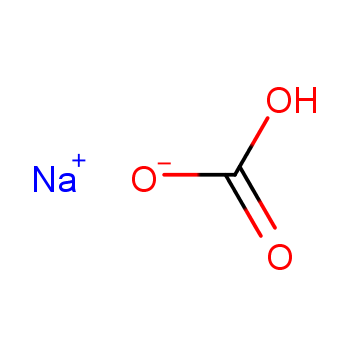
Sodium bicarbonate is an inorganic compound with the formula NaHCO3, consisting of a sodium cation (Na+) and a bicarbonate anion (HCO3-). It presents as a white, odourless crystalline powder with a faintly alkaline, slightly bitter taste. When dissolved in water it dissociates into these free ions, allowing them to participate in acid-base reactions with the acidic or basic species already present in a food matrix.
The defining reactivity of the molecule is its ability to release carbon dioxide. This happens by two distinct pathways: an acid-base reaction when sodium bicarbonate meets an acid such as cream of tartar, sodium acid pyrophosphate, or citric acid, and a thermal decomposition pathway that begins at approximately 108 °C and generates carbon dioxide along with water and a residual sodium salt. A formulator can exploit either pathway, or both in sequence, to control when aeration occurs during processing.
Because the bicarbonate anion is the conjugate base of carbonic acid, the salt functions as a buffer that resists rapid pH swings in mildly acidic environments. This buffering behaviour is what makes it useful well beyond bakery, in applications ranging from dairy neutrality control to effervescent beverage systems. The ion is also fully soluble and leaves no colour or characteristic odour in the finished product.
For a broader reference on nomenclature and identity data, see the encyclopedia entry at Guidechem Chemical Encyclopedia.
| IUPAC name | Sodium hydrogen carbonate |
| CAS number | 144-55-8 |
| EC number | 205-633-8 |
| Molecular weight | 84.007 g/mol |
| Food additive codes | INS 500(ii); E 500(ii) |
When the bicarbonate anion encounters a proton source, it is converted to carbonic acid, which rapidly decomposes into water and carbon dioxide. This is the faster of the two leavening pathways and is governed by the solubility and dissociation rate of the acid partner. A fast-acting acid such as monocalcium phosphate releases its CO2 largely in the mixing bowl, while a slower acid such as sodium acid pyrophosphate delays release until the batter reaches the oven, which determines whether a product sets thick or spreads thin.
Independently of any added acid, sodium bicarbonate begins to decompose above approximately 108 °C, liberating carbon dioxide and generating a residual alkaline sodium salt. In high-temperature processes this second pathway adds aeration depth and helps the structure set as starch gelatinises. That is why dry-heat products such as crackers and high-ratio cakes can gain volume even when the acid balance is deliberately kept low.
Because it is the conjugate base of carbonic acid, the bicarbonate ion can accept or donate protons around its pKa of 6.3, dampening pH drift in lightly acidic systems. This buffering action stabilises dairy proteins, controls the tartness of beverages, and can raise surface pH in fresh-produce applications where an alkaline environment is desirable for microbial control.
The dominant industrial route is the Solvay process, in which sodium chloride, ammonia, water, and carbon dioxide are combined. Carbon dioxide is bubbled through ammonia-saturated brine, causing relatively insoluble sodium bicarbonate to precipitate while ammonium chloride remains dissolved. The crude bicarbonate is then filtered, purified, and crystallised to the required particle-size distribution for food use.
The reaction sequence relies on the differing solubilities of the species involved, which is why low temperature is maintained during the carbonation step to favour bicarbonate precipitation. The process is valued for its efficiency and its comparatively contained environmental footprint, and it is the reason food-grade baking soda is inexpensive and consistently available at industrial scale.
A secondary supply comes from the natural mineral nahcolite, mined from Eocene-age deposits such as the Green River Formation in Colorado. Mineral-derived bicarbonate is typically milled and refined rather than synthesised, and in some markets it is marketed as a naturally sourced alternative.
Sodium bicarbonate belongs to the family of alkali metal bicarbonates and carbonates, a group of inorganic salts whose shared reactivity is carbon dioxide release and pH neutralisation. Within that family, several members are routinely selected for specific food and nutrition roles based on solubility, sodium content, and the texture profile they impart.
The standard leavening and buffering salt, used where sodium content is not a constraint. It provides the strongest carbon dioxide yield per unit weight among the bicarbonates and is the reference material against which the others are compared.
A sodium-free alternative used in low-sodium formulations. Its strength is nearly equal to sodium bicarbonate, and it is favoured in reduced-sodium baked goods and in potassium-fortified products where the potassium ion is a nutritional benefit rather than a burden.
Used in low-moisture products such as crackers and cookies, where it decomposes completely into volatile species and leaves no residual salt. It is unsuitable for high-moisture bakery, where residual ammonia would cause off-odour.
Structure-function relationship: the small size and high charge density of the bicarbonate anion allow rapid proton exchange, which translates directly into fast carbon dioxide evolution and dependable buffering. Because the cation varies while the anion stays constant, swapping sodium for potassium adjusts the nutritional sodium load without materially changing the leavening strength.
Sodium bicarbonate and potassium bicarbonate are frequently presented as interchangeable, but their differences in cation identity, taste, and nutritional impact mean the substitution should be deliberate. The table below compares the two on the parameters most relevant to formulation.
| Parameter | Sodium Bicarbonate | Potassium Bicarbonate |
|---|---|---|
| Formula | NaHCO3 | KHCO3 |
| Leavening strength | Reference standard; strong CO2 yield per gram | Nearly equal to sodium bicarbonate in practice |
| Typical pH | About 8.5 in 1% aqueous solution | About 8.3-8.4 in 0.1 M solution |
| Nutritional role | Contributes sodium; must be limited in low-sodium claims | Contributes potassium, an essential electrolyte nutrient |
| Best fit | Conventional bakery and general buffering | Sodium-reduced and potassium-fortified products |
| Physical form | White crystalline powder |
| Odour and taste | Odourless; slightly bitter, alkaline taste |
| pH (0.1 M) | 8.3 |
| pKa | 6.3 |
| Density | 2.20 g/cm3 |
| Solubility | About 100 g/L at 25 °C |
| Storage | Ambient temperature in a closed container |
Sodium bicarbonate spans a wider range of food categories than its bakery reputation suggests. The table below maps its principal functions to representative applications and the specific formulation objective each application pursues.
| Function | Typical Applications | Key Formulation Objective |
|---|---|---|
| Leavening agent | Cake, bread, cookies, tortillas, pizza, muffins, crackers, waffles, pancakes | Achieve target volume and crumb structure by matching CO2 release timing to the baking schedule |
| Effervescence source | Flavoured beverages, effervescent tablets, powdered drink mixes | Deliver controlled fizz and rapid dissolution without residual alkaline taste |
| Acidity regulator | Dough mixes, cake premixes, powdered beverages, batters | Hold pH in a stable window so that protein and starch functionality remain predictable |
| Texture and viscosity aid | Ice cream and frozen desserts | Improve overrun and produce a softer mouthfeel via small CO2 cavities |
| pH adjustment in protein systems | Processed meat, infant formulae | Maintain water-holding and emulsification within regulatory ceilings |
| Sugar crystalisation control | Hard candies, chocolates, chewables | Influence colour development and prevent unwanted crystallisation during conching or cooking |
In frozen desserts, the addition of baking soda at around 0.6 % has been reported to raise viscosity and overrun while holding pH near neutral. The small carbon dioxide cavities interrupt the bonding between ice crystals and the fat, sugar, and protein network, which softens the texture and contributes a creamier perception. This illustrates how the same gas that leavens a cake can be used to engineer mouthfeel in a frozen system.
Start by deciding whether the product needs a single-acting or double-acting system. Fast acids such as monocalcium phosphate release gas during mixing, while slow acids such as sodium acid pyrophosphate release it during baking. The ratio of soda to acid should be calculated from the neutralising value of the acid, not fixed by habit.
Working levels typically fall between 0.5 % and 1.5 % of the formula, or higher where a specific aeration target demands it. Confirm the chosen level against the acid balance and against any sodium-saving targets before committing to a pilot batch.
Finer grades dissolve and react faster, producing a tighter crumb, while coarser grades slow the reaction and can leave speckling. Match the particle-size distribution to the mixing intensity and hydration time of the process.
Keep the compound dry before use, since absorbed moisture will trigger premature reaction with any co-blended acid and reduce available gas. Store in a closed container at ambient temperature and verify that premixes remain within moisture specification.
The formulations below are illustrative starting points drawn from published examples. They are intended to show how sodium bicarbonate is combined with acid partners in practice and should be adapted to local ingredient specifications and process conditions rather than adopted unchanged.
| Ingredient | Illustrative Quantity | Technical Role |
|---|---|---|
| Pound cake - flour | 171.46 g | Structural base and starch source for gelatinisation |
| Pound cake - granulated sugar | 180.49 g | Sweetener, tenderiser, and moisture-retention aid |
| Pound cake - baking soda | 1.13 g | Primary leavening base reacting with the acid salts |
| Pound cake - sodium acid pyrophosphate | 1.04 g | Slow acid providing late gas release in the oven |
| Pound cake - coated monocalcium phosphate | 0.54 g | Coated fast acid for controlled early release |
| Baking powder - sodium bicarbonate | 30 % | The alkaline leavening base of the powder blend |
| Baking powder - sodium aluminium sulphate | 20 % | Slow acid contributing oven-stage gas release |
| Baking powder - monocalcium phosphate | 8.7 % | Fast acid for early bench-stage reaction |
| Baking powder - cornstarch | 27.1 % | Bulking and moisture-absorbing diluent preventing pre-reaction |
| Effervescent tablet - sodium bicarbonate | 750 mg | Alkaline partner generating the tablet's fizz |
| Effervescent tablet - citric acid | 850 mg | Acid partner driving rapid CO2 liberation on dissolution |
| Ice cream - baking soda | About 1.8 g (0.6 %) | Viscosity and overrun enhancer with pH stabilisation |
Sodium bicarbonate is approved as a food additive across most major markets, but the conditions of use, labelling obligations, and maximum levels vary by jurisdiction. The following overview is provided for orientation only and should not be interpreted as a substitute for the current legal text in the target market. Always verify current requirements with the relevant competent authority before commercialising a product.
| Market / Framework | Technical Relevance | Compliance Action |
|---|---|---|
| United States (21 CFR 184.1736) | Listed as a direct food additive and recognised as safe when used per good manufacturing practice | Confirm intended use falls within the permitted GMP basis and declare on the label |
| European Union (E 500(ii)) | Approved as a food additive under EFSA oversight with category-specific conditions of use | Check the EU food additives database for the exact maximum permitted level in each category |
| Codex / JECFA (INS 500(ii)) | ADI set as "not limited"; the GSFA gives GMP for most categories and 2000 mg/kg for some infant foods | Apply the category-specific maximum level and document the basis for any infant-food use |
| Sodium-declaration targets | Nutrient-content claims may cap the sodium contributed by the bicarbonate in a formula | Reconcile the level against any low-sodium or no-added-sodium claim, or switch to potassium bicarbonate |
Sodium bicarbonate has a long history of safe use in food and is generally recognised as safe when consumed as a normal ingredient. Small quantities used as a leavening agent or acidity regulator pose no known concern for the general population, and the WHO has set no numerical acceptable daily intake, describing it instead as "not limited" on the basis of its low toxicity.
The primary safety consideration is dose, particularly in concentrated antacid or therapeutic contexts rather than food use. Excessive intake of bicarbonate can neutralise stomach acid to an extent that shifts systemic acid-base balance toward metabolic alkalosis, and high sodium loads can be a concern for individuals on sodium-restricted diets or with cardiovascular conditions. Formulators should therefore keep added bicarbonate within the level actually required for the functional job rather than padding a formula.
For industrial handling, sodium bicarbonate is a fine, non-flammable powder that presents mainly a nuisance-dust consideration. Good practice includes local exhaust ventilation and dust control in blending areas to protect workers from inhalation and to prevent cross-contamination of other sensitive dry mixes.
| Reference Point | Value / Guidance |
|---|---|
| Typical use level | 0.5-1.5 % of formula, or higher for high-aeration products |
| Decomposition onset | Approximately 108 °C |
| Freeze-thaw benefit | Improved tolerance in frozen dough via reduced extractable protein and free sulfhydryl |
| Shelf-life indication | Fruit shelf life extended up to 75 days from 30 days under specific tested conditions |
| ADI | Not limited (WHO / JECFA) |
| Infant formula max level | 2000 mg/kg under the GSFA for certain infant categories |
Note: the values above are reference points for orientation and vary with product category, processing conditions, and the specific regulatory framework applied. Confirm all figures against current official sources before use in a commercial formulation.
Can sodium bicarbonate be replaced by potassium bicarbonate one-for-one?
Their leavening strengths are nearly equal, so a near one-for-one swap is often workable. However, potassium bicarbonate is slightly less alkaline in dilute solution and contributes potassium rather than sodium, so taste, pH, and any nutrient claim must be re-verified in the finished product.
Why does too much baking soda cause a soapy taste?
When bicarbonate is dosed above the amount the available acid can neutralise, the residual alkaline pool reacts with fats and proteins and is perceived as soapy or bitter. Balancing soda against total titratable acidity, not flour weight, is the reliable way to avoid it.
Does sodium bicarbonate keep working after the batter is mixed?
Gas release continues as long as acid, moisture, and heat are available. A fast acid reacts largely at the bench, while a slow acid such as sodium acid pyrophosphate keeps releasing gas in the oven, which is why double-acting systems are used for products that must hold structure through baking.
How should effervescent tablets be stored to preserve fizz?
Because any absorbed moisture lets the acid and bicarbonate pre-react, tablets and powders must be protected from humidity throughout storage. Use moisture-barrier packaging, control the production environment, and verify tablet integrity and gas yield during shelf-life testing.
The following identification data supports specification writing, incoming-goods verification, and supplier sourcing for food-grade sodium bicarbonate.
| Identifier | Value | Lookup Resource |
|---|---|---|
| CAS number | 144-55-8 | Dictionary entry |
| Supplier listings | Food-grade powder, multiple particle sizes | Supply channel |
| Verified suppliers | Regional and global food-ingredient distributors | Supplier directory |
 |
 |
 |
 |
 |
 EN
EN
 Agricultural News
 Food News
 Industrial News
 Cosmetic News
 Pharmaceutical News
 Science News

 1YR
1YR


