-
We detected your language preference as English. Would you like to switch to the English version for a better experience?
Switch to English
Stay here


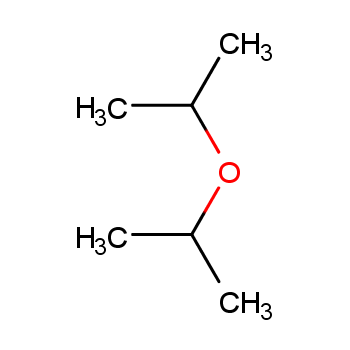
Diisopropyl ether (CAS 108-20-3, C6H14O, relative molecular mass 102.18), also written as isopropyl ether or DIPE, is a symmetrical secondary aliphatic ether boiling near 69 degrees Celsius with a closed-cup flash point around minus 28 degrees Celsius. It is an excellent solvent for oils, waxes, resins and neutral organics, it is only sparingly soluble in water, and its low water uptake makes it attractive for liquid-liquid extraction. It arises as a co-product of isopropanol manufacture from propylene and by addition of isopropanol to propylene, so supply and price are linked to the propylene chain.
The defining feature of this solvent is not its dissolving power but its hazard profile. Diisopropyl ether belongs to the most severe class of peroxidisable solvents: the alpha carbon bears a single, readily abstracted secondary hydrogen, so autoxidation in atmospheric oxygen proceeds faster than with diethyl ether, and the resulting peroxides are shock-sensitive and can crystallise inside container closures. Unlike many peroxidisable solvents, it can reach dangerous peroxide levels without any concentration step, which is why good practice treats it as a material with a hard expiry clock rather than a stable stock item.
This white paper sets out the chemistry of autoxidation, the inhibitor and testing controls that govern safe use, the production routes, application matrix and market structure, and the compliance framework spanning REACH, CLP and EU hazard statement EUH019, TSCA, OSHA flammable-liquids and laboratory standards, NFPA codes, and FDA and ICH Q3C residual-solvent expectations for pharmaceutical use. It then addresses VOC emissions and Scope 1, 2 and 3 accounting, the dangerous-goods logistics of UN1159, and a strategy guide for solvent suppliers and contract manufacturers serving industrial and research customers.
The two isopropyl groups create a sterically shielded, weakly hydrogen-bond-accepting oxygen that gives the solvent low polarity, low water solubility and limited miscibility with polar protic solvents. Its low boiling point and heat of vaporisation simplify recovery but create heavy evaporative losses and large flammable vapour clouds, since the vapour is roughly three and a half times denser than air and travels along floors toward ignition sources.
Commercial material arises largely as a co-product of isopropanol production, where propylene hydration or isopropanol dehydration chemistry yields an ether-rich stream that is separated by azeotropic and extractive distillation. Direct synthesis routes add isopropanol across propylene over acidic catalysts, a route historically developed for gasoline-oxygenate applications, or dehydrate isopropanol under conditions tuned to ether formation rather than to propene. Product quality therefore depends on downstream fractionation rather than on synthetic novelty.
Demand is mature and, in several segments, declining in relative terms. Extraction and process use persists where the solvent's selectivity and recovery economics remain superior, but substitution pressure is real: cyclopentyl methyl ether, 2-methyltetrahydrofuran, methyl tert-butyl ether and ethyl acetate are adopted specifically to reduce peroxide management burden, and solvent selection guides published by industry consortia now shape procurement policy in research and pilot facilities.
Capacity follows propylene and isopropanol assets, with production in North America, Europe and Asia-Pacific tied to large petrochemical complexes and China adding merchant solvent capacity for regional fine-chemical users. Trade is regional because transport costs and flammable-liquid rules penalise long-distance movement of a low-density solvent, so bulk volume moves by tanker and iso-tank within continents, with drummed, inhibited, peroxide-certified material shipped for laboratory use.
A bulk technical tier competes on price against propylene opportunity cost, while a premium tier sells assurance: stabilised material with declared inhibitor level and peroxide content, low water and acidity, nitrogen-packed dated packaging and full documentation for GMP users. Because that tier sells risk reduction rather than litres, it is far less price-elastic, and suppliers unable to certify peroxide status are excluded from pharmaceutical qualification entirely.
Diisopropyl ether is regulated simultaneously as an extremely flammable liquid, as a volatile organic compound and as a peroxidisable substance, and each dimension generates its own obligations. Suppliers must supply an accurate safety data sheet, declared inhibitor and peroxide status, and guidance on retest intervals, while users must implement written peroxide-control procedures and training, since the hazard is created by storage conditions rather than by the act of purchase.
Solvent strategy is now an ESG topic in its own right. Customers with published emissions targets are reorganising solvent inventories around inherent safety, recoverability and volatile organic compound performance, and procurement teams increasingly screen ethereal solvents against published solvent selection guides before approving them for pilot or commercial campaigns.
For users, the dominant impact is Scope 1 volatile organic compound emission and end-of-life solvent disposal, while for producers the footprint sits in propylene-derived feedstock and distillation energy. Best practice combines closed transfer and vapour recovery, thermal oxidation or carbon adsorption on vents, and on-site recovery by fractionation, provided that recovery stills are fed only peroxide-tested material and are never run to dryness. Sites typically operate ISO 14001 systems and report solvent losses and greenhouse-gas intensity per tonne recovered.
Traceability for this solvent means documented chain of custody from producer through inhibitor addition, packaging date and peroxide testing, supported by certificates of analysis giving assay, water, acidity, inhibitor level and peroxide value. Suppliers that add take-back and re-refining services, provide dating data and publish Scope 1, 2 and 3 emissions alongside ISO 9001 and ISO 14001 certification give customers a defensible alternative to wholesale substitution where a peroxidisable solvent is genuinely the best process fit.
Resilience here is a function of stock rotation discipline. Because the product ages into a hazard, large buffer inventories are themselves a risk, so buyers should align deliveries to consumption, agree maximum age at receipt, and require date of manufacture and retest date on every container. Dual sourcing still matters for continuity during propylene disruptions.
Diisopropyl ether is consigned as UN1159, a Class 3 flammable liquid of packing group II, requiring UN-approved packaging, GHS flammable-liquid markings and segregation from oxidisers; air movement is limited to the small quantities permitted by dangerous-goods rules, so bulk volumes move by road tanker, rail tank car or sea freight. Transfer requires earthing and bonding, vapour recovery where required, storage in ventilated flammable-liquid cabinets or tank farms with temperature control, and shipment with a safety data sheet, inhibitor declaration, peroxide certificate and conservative shelf-life statement so the receiving site can start its dating clock correctly.
Competing in a commodity solvent whose demand is structurally flat requires selling certainty. The priorities below reflect how responsible suppliers position peroxidisable solvent programmes in 2026.
Diisopropyl ether remains a useful, selective, low-polarity solvent whose commercial value is inseparable from its behaviour in storage. Its single abstractable alpha hydrogen makes it one of the most aggressive peroxide formers in common industrial use, and that property, rather than its solvency, determines how it must be specified, packed, dated, tested and disposed of. Suppliers who internalise that reality can sell a controlled programme; those who treat it as an ordinary solvent create liability for themselves and their customers.
Looking forward, demand will continue to erode at the margins as inherently safer ethers and ester solvents are adopted, but the remaining applications are defensible where selectivity, low water solubility and easy recovery are decisive. The winners will be suppliers and contract manufacturers that combine peroxide-certified, inhibitor-controlled supply with honest substitution advice, validated residual-solvent analytics, VOC abatement and transparent Scope 1, 2 and 3 reporting, treating every dated container as a controlled item with a finite documented life.
Powered by Guidechem
This white paper is exclusively compiled by the Guidechem Intelligence Team based on global customs data, regulatory databases, and industry research. Guidechem is a leading global B2B chemical platform, dedicated to connecting global buyers with verified, high-quality manufacturers.
Relying on Guidechem's extensive global database, we have mapped the core participants in the current global Diisopropyl ether supply chain:
Disclaimer: The content of this white paper is compiled based on public market data and regulatory information available as of 2026. Global chemical regulations are subject to dynamic adjustments. In actual export operations, enterprises must consult professional regulatory advisors or relevant competent authorities to obtain the latest compliance guidance.
|
 |
 |
 |
 EN
EN
 Agricultural News
 Food News
 Industrial News
 Cosmetic News
 Pharmaceutical News
 Science News

 1YR
1YR

