-
We detected your language preference as English. Would you like to switch to the English version for a better experience?
Switch to English
Stay here


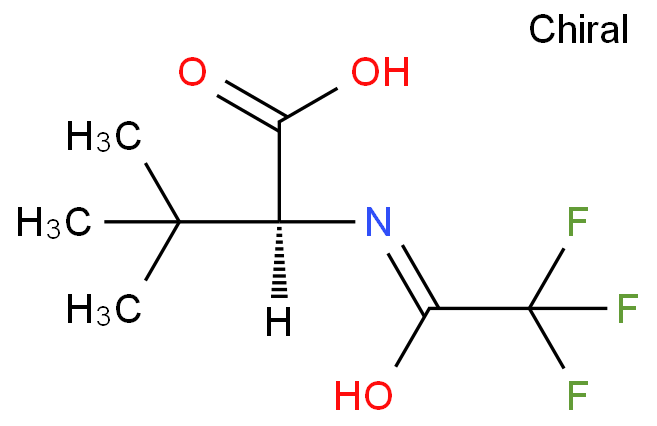
N-Trifluoroacetyl-L-tert-leucine (Tfa-L-Tle-OH; CAS 666832-71-9; C8H12F3NO3, MW 227.18) is the trifluoroacetamide-protected form of L-tert-leucine, a gamma-branched, sterically congested non-proteinogenic amino acid. It is not a commodity but a chirally defined, fluorine-tagged building block used wherever a chemist needs a residue that is bulky, conformationally restrictive, lipophilic and analytically visible. Commercial material is a white crystalline solid, typically at 98 to 99 percent assay with enantiomeric excess of 99.0 percent or better, sold in gram-to-multi-kilogram campaigns. Its value lies in the integrity of its single stereocentre and in the controlled behaviour of its trifluoroacetamide group.
Two technical issues decide whether a supplier is credible here. The first is chiral integrity: N-acyl amino acids bearing an electron-withdrawing acyl group can racemise through oxazolone intermediates once the carboxyl group is activated, and the tert-butyl side chain slows that pathway but does not eliminate it. The second is trifluoroacetamide stability: the group resists acid but is labile to base and to strong nucleophiles, so incomplete deprotection leaves a trifluoroacetylated fragment that is hard to purge and that silently depresses assay. Both are measurable, specification-able and negotiable, and both are treated in Section IV.
The third defining feature in 2026 is regulatory. A single trifluoromethyl group puts the substance at the edge of the PFAS debate: it is not a perfluoroalkyl acid and not the target of the long-chain restrictions in force, but it is captured by broad PFAS screening questions from pharmaceutical and electronics customers and falls within the reporting universe of the EPA rule under TSCA section 8(a)(7). Trifluoroacetic acid, as both residue and degradation product, is why. Add ICH Q7, Q11, Q1A, Q3C and Q3D expectations, DMF support and the GMP-versus-research-use choice, and the perimeter around a 227-dalton amino-acid derivative is surprisingly demanding.
Everything this molecule does follows from three features: the tert-butyl group, the trifluoroacetamide and the free carboxylic acid. The tert-butyl side chain is the classic gamma-branched hydrophobic element used to fill deep pockets in protease active sites and to pre-organise a peptide backbone. The trifluoroacetamide removes the nucleophilicity of the alpha-amino group, so the molecule behaves as a clean, non-basic coupling partner, and installs a fluorine handle that makes the residue traceable by 19F NMR. The acid is the handle through which the residue is activated, coupled and, on badly run processes, racemised.
Two layers matter to a buyer: how the trifluoroacetyl group is installed, and how the expensive chiral raw material is produced. Both are mature and are described at route-class level only, because operating detail is supplier intellectual property and because buyers should be assessing controls and specifications rather than recipes. Every route class is driven by the same imperatives: keep residual trifluoroacetic acid low and keep the stereocentre intact.
Demand tracks three things: the peptide and peptidomimetic pipeline, the protease-inhibitor generics and follow-on business, and the expansion of non-natural amino acids into clinical candidates. The peptide contract-manufacturing boom of the early 2020s pulled protected amino-acid capacity into long-term CDMO agreements, and the incretin peptide wave has tightened supply of high-purity protected residues, raising lead times even for niche fluorinated derivatives. Against that, PFAS screening acts as a brake, with some European and Japanese customers requiring a fluorinated-building-block justification before qualifying a supplier.
Production is concentrated in China and India, with a smaller, higher-specification tier in Western Europe, Japan and the United States. Chinese capacity clusters in the fluorinated and amino-acid belts of Zhejiang, Shandong, Jiangsu and Sichuan, where trifluoroacetic anhydride and enzymatic amino-acid technology are co-located; this tier competes on cost and on integration back to fluorspar-derived fluorine. Indian capacity sits in the Hyderabad, Bengaluru and Gujarat CDMO corridors and competes on GMP documentation, DMF experience and English-language regulatory interaction. Western capacity is smaller and usually tied to a specific programme.
The market is sharply bifurcated. Catalogue and research-use-only material in gram packs is priced as a research chemical, with assay, enantiomeric excess and a basic certificate of analysis. GMP-like material, with a validated chiral method, full impurity profile, residual solvent and elemental impurity data, DMF letter of access, stability commitment and change control, costs several times more and is quoted per campaign with minimum batch sizes. Two cost drivers dominate: trifluoroacetic anhydride pricing, sensitive to fluorspar and hydrogen fluoride availability and to Chinese fluorine export policy, and the analytical load, high relative to tonnage.
The regulatory surface is wide. The molecule sits simultaneously under general chemical inventory law, under pharmaceutical GMP expectations when sold into API supply chains, and, because of the CF3 group, under the fast-moving PFAS policy perimeter. None of this makes the product untradeable; it makes undocumented supply untradeable. The subsections below map the instruments a serious exporter must address.
ESG scrutiny of fluorinated building blocks has moved from a reputational issue to a procurement criterion. Customers in pharma and electronics now ask suppliers to quantify fluorochemical inputs, to account for fluorine-containing waste and to show that trifluoroacetate-bearing streams are not simply discharged. For a small, high-value intermediate the fluorine mass involved is low but its visibility is high.
Most of the cradle-to-gate footprint sits upstream, in hydrogen fluoride and trifluoroacetic anhydride manufacture, because fluorochemical production is electricity-intensive and often runs on grid mixes with high Scope 2 intensity. Inside the plant the levers are solvent selection and recovery, since aprotic amide and halogenated solvents dominate mass intensity, acyl-donor stoichiometry, and the energy cost of low-temperature activation and crystallisation. Practical programmes include solvent recovery by distillation with a documented mass balance and batch-level carbon-footprint reporting for customers building Scope 3 inventories.
Traceability here means two chains. The fluorine chain runs back to fluorspar and hydrogen fluoride: Chinese export licensing and quota policy on fluorspar, plus the concentration of fluorine capacity in few producers, are genuine single-point-of-failure risks, and sophisticated buyers now ask where the fluorinated carbon originated. The chirality chain runs back to L-tert-leucine and its biocatalytic or resolution route, with questions of enzyme provenance and exclusion of animal-derived materials, since TSE/BSE statements are routinely requested. ISO 9001 and ISO 14001 certification plus a supplier-audit programme covering both chains is the minimum credible answer.
Physically, Tfa-L-Tle-OH is an unremarkable crystalline solid and most consignments move as ordinary cargo. Chemically, it is moisture- and base-sensitive enough that packaging discipline decides whether a lot arrives on specification. The logistics programme is therefore less about dangerous-goods classification and more about moisture control, temperature-excursion management and document integrity.
Most shipments are not dangerous goods for transport, but that must be determined from the actual safety data sheet rather than assumed: confirm the UN number, packing group and any marine-pollutant designation per consignment and apply IMDG, IATA dangerous goods regulations or ADR accordingly. Ambient air freight is generally acceptable for development quantities; for summer sea lanes through tropical ports or multi-week transits, a controlled-ambient chain with temperature loggers is worth the cost. HS classification within Chapter 29 for amino-acid derivatives determines duty treatment, and importers should seek a binding opinion where volumes justify it.
Commercial success here is a documentation exercise as much as a chemistry exercise. The three moves below distinguish exporters who win repeat programmes from those who win one-off catalogue orders.
Tfa-L-Tle-OH is a small molecule with an outsized documentation footprint. tert-Leucine does a job no other residue does quite as well, the trifluoroacetyl group makes it easy to handle and trace, and the building block is bought in small quantities at high value by customers who cannot afford a chiral or fluorine-related compliance surprise. What separates a serious supplier from a catalogue listing is not the ability to run the acylation, which is commodity chemistry, but the ability to prove, lot after lot, that the stereocentre survived and that residual trifluoroacetic acid is controlled.
For buyers, the agenda is to specify what actually fails: enantiomeric excess by a named chiral method, residual trifluoroacetic acid and anhydride, water, heavy metals, residual solvent, and the related-substances profile including incompletely deprotected species. For sellers, it is to build the PFAS answer, the DMF answer and the change-control answer before the first quotation is sent.
Powered by Guidechem
This white paper is exclusively compiled by the Guidechem Intelligence Team based on global customs data, regulatory databases, and industry research. Guidechem is a leading global B2B chemical platform, dedicated to connecting global buyers with verified, high-quality manufacturers.
Relying on Guidechem's extensive global database, we have mapped the core participants in the current global (S)-3,3-Dimethyl-2-(2,2,2-trifluoroacetamido)butanoic acid (N-trifluoroacetyl-L-tert-leucine) supply chain:
Disclaimer: The content of this white paper is compiled based on public market data and regulatory information available as of 2026. Global chemical regulations are subject to dynamic adjustments. In actual export operations, enterprises must consult professional regulatory advisors or relevant competent authorities to obtain the latest compliance guidance.
|
 |
 |
|
 EN
EN
 Agricultural News
 Food News
 Industrial News
 Cosmetic News
 Pharmaceutical News
 Science News

 14YRS
14YRS


