
I. Executive Summary
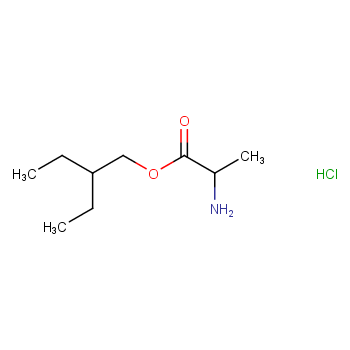
(S)-2-Ethylbutyl 2-aminopropanoate hydrochloride, CAS 946511-97-3, is the hydrochloride salt of L-alanine esterified with 2-ethylbutanol, supplied as the chiral side-chain building block for phosphoramidate prodrugs known generically as ProTides in nucleotide analogue programmes of the remdesivir class, and bought by licensed manufacturers and their contract partners. Material is offered research-use-only or under GMP-aligned campaigns depending on programme stage, stated explicitly at quotation. Nothing in this paper is a therapeutic claim, and no dosing, clinical or administration guidance is given.
Sourcing turns on chiral integrity. The stereocentre is the alanine centre itself, and acid-catalysed esterification is precisely the operation that can erode it, so enantiomeric excess is examined first and must be measured by a validated chiral method rather than assumed from the L-alanine input. Alongside it, four items decide usability downstream: salt stoichiometry and hydrochloride content, water content because water competes in the phosphorylation step, related substances including free alanine and diester-type species, and residual 2-ethylbutanol and solvents.
The commercial setting is unusually volatile. Demand rose sharply with pandemic-era scale-up of nucleotide prodrugs, drew large new capacity into China and India, then contracted as programmes normalised, leaving suppliers the classic lessons about dedicated chiral capacity and customer concentration. Buyers now qualify on documentation depth, on willingness to support DMF or ASMF filings and audits, and on know-your-customer screening, end-use declaration and respect for intellectual-property boundaries.
II. Product Deep Dive: Molecular Mechanisms and Production Evolution
2.1 Physicochemical Properties and Mechanisms
The substance is an ammonium chloride salt of a primary amine ester: a small, polar, hygroscopic crystalline solid, freely soluble in water and lower alcohols, with a branched ester group dominating its lipophilicity. Its behaviour is governed by ester lability to hydrolysis under moisture and heat, the acidity of the ammonium centre, and stereocentre sensitivity to the conditions used to make and isolate it. Because the salt is hygroscopic, water content is a release-critical attribute rather than a routine line on the certificate.
- Chiral Integrity and Racemisation Risk: The stereocentre sits alpha to the carbonyl, and although it lacks a strongly acidic proton as the salt, prolonged exposure to acid, heat or base during esterification and work-up can still erode configuration. Racemisation is therefore a process risk tied to temperature, acid strength, residence time and the pH of any aqueous wash. Control means measuring ee on the isolated salt by a validated chiral method, usually chiral HPLC or chiral GC after derivatisation, and confirming no drift during drying or storage.
- Branched Alkyl Ester and Prodrug Design Logic: At a general design level, the branched alkyl group is what makes this side chain useful: branching raises lipophilicity and steric bulk at the ester carbonyl, slowing non-specific esterase cleavage and ordering the sequence of enzymatic unmasking. Changing the alcohol changes lipophilicity and cleavage rate, and therefore the exposure profile. This paper discusses that logic only in general terms, with no synthetic detail, formulation guidance or dosing information.
2.2 Synthesis and Manufacturing Technologies
Manufacture is a short route class: esterify L-alanine with 2-ethylbutanol under acid, form the hydrochloride and isolate. Because the sequence is short, the challenge is control rather than construction, and the differentiator is holding chirality, stoichiometry and water simultaneously at scale. Discussion stays at route-class level.
- Esterification Route Class and Racemisation Control: The ester is formed by acid-catalysed condensation of L-alanine with 2-ethylbutanol, with removal of the water formed to drive conversion. Critical controls are temperature, acid strength and residence time, which trade conversion against racemisation, plus moisture exclusion before isolation. Impurities to control include unreacted alanine, diester-type species from over-reaction or transesterification, and residual alcohol, and the route normally runs to partial conversion with recovery rather than being forced to completion.
- Salt Formation, Isolation and Solid-Form Control: The free amine is converted to the hydrochloride and crystallised, and the controls are stoichiometric: hydrochloride content must match theory, since excess acid accelerates ester hydrolysis on storage while a deficit leaves free amine that is volatile, odorous and nitrosamine-relevant. Crystallisation also sets solid form and residual solvent, affecting flow, filtration and water uptake. Drying runs below the temperature at which ester hydrolysis or enantiomeric drift becomes measurable.
2.3 Core Application Matrix
- ProTide Phosphoramidate Side-Chain Intermediate: The principal use is as the chiral amino-acid ester component coupled into phosphoramidate prodrugs, supplied under quality agreements. Buyers require the full specification, change control notified before any route or site change, and documentation supporting their filing position.
- Process Development and Custom Synthesis: Contract organisations buy or make the material while developing phosphorylation and coupling steps and the chiral and related-substance methods later validated. This is where ee method development, water-control and salt-stoichiometry work happen, and where research-use-only supply is normal.
- Reference and Impurity Standards: Characterised specimens of the opposite enantiomer, the free amine, the diester-type impurity and residual alcohol are required as analytical standards. These are supplied in small quantities with the highest characterised purity and certified content.
III. Global Market Supply-Demand Landscape and Export Trends
3.1 Demand Drivers and Market Shifts
Demand is tied to nucleotide prodrug programmes and is lumpy rather than smooth. The pandemic period produced exceptional pull as antiviral programmes scaled, followed by sharp contraction once emergency demand normalised. That cycle changed buyer behaviour permanently: safety stock is held further up the chain, second sources are qualified earlier, and forecasts are shared under confidentiality. No therapeutic claim is implied; the point is that programme volatility drives intermediate planning.
3.2 Capacity Distribution and Export Flows
China and India added most new capacity during the surge, leveraging chiral amino-acid and esterification capability, and both export to Western customers. China's strength is scale, speed and integration back to feedstocks; India's is documented, GMP-aligned supply and inspection experience. European and North American capacity remains modest, focused on development campaigns, analytical development and rapid tech transfer. The lasting lesson is that dedicated chiral ester capacity built for one programme carries concentrated risk when that programme changes.
3.3 Market Bifurcation and Pricing Dynamics
Pricing bifurcates by campaign type and enantiomeric specification. Research-use-only material with a short certificate is cheap and quick; GMP-aligned material with validated chiral methods, elemental-impurity assessment, stability data and filing support carries a premium. Prices softened as surge capacity arrived then stabilised as weaker producers exited, while lead times stay governed by validated chiral testing and campaign scheduling, so the lowest price often brings the longest qualification.
IV. In-depth Analysis of Global Compliance and Regulatory Barriers
Because this is an intermediate in medicines, review runs through the finished-substance filing: where the synthesis begins, how chirality is justified, how elemental impurities and solvents are controlled, how stability is established. Chemical inventory, classification and responsible-supply obligations sit underneath.
4.1 European Market: REACH, CLP, and Sector-Specific Directives
- REACH Registration and CLP Classification: European supply at or above one tonne per year requires registration, and intermediates may qualify for reduced requirements only where strictly controlled conditions are demonstrable across the lifecycle, difficult for material shipped to third parties. Classification must reflect the actual salt form and its acidity rather than a generic amino-acid ester template, and the safety data sheet must be coherent with the transport documentation. Suppliers should expect identity questions whenever the salt form or counter-ion changes.
- EU GMP Part II and ASMF Support: Declared a key intermediate, manufacture follows API good-manufacturing-practice principles and the supplier supports an active-substance master file or European equivalent covering route, chirality control, impurity fate and specification justification. Declared a registered starting material, the GMP expectation is lighter but the applicant carries the burden. Suppliers supporting both positions and hosting audits are preferred.
4.2 North American Market: TSCA, EPA, and FDA Regulations
- TSCA Status and FDA DMF Support: United States supply requires correct TSCA inventory positioning, with a pre-manufacture notice or exemption before import where the substance is not listed. The intermediate is normally supported through an FDA drug master file containing confidential route and control detail referenced by letter of authorisation, kept current against the process operated.
- ICH Q1A, Q3C and Q3D Expectations: Stability is established under standard climatic conditions, and because the ester can hydrolyse and the salt is hygroscopic, water and ee should be stability-indicating tests rather than assay alone. Residual solvents are classified and limited under the residual-solvent guidance, and elemental impurities assessed against permitted daily exposure by route. Microbial limits are set where aqueous operations or parenteral-adjacent use apply.
4.3 The Critical Hurdle: Quality Control and Safety Limits
Compliance Warning: Chiral purity is the decisive acceptance criterion. Purchasers should require enantiomeric excess measured by a validated chiral method, normally chiral HPLC or chiral GC after derivatisation, with a defined limit on the D-enantiomer and evidence that ee does not drift during drying or storage; salt stoichiometry expressed as hydrochloride content against theory, since a deficit leaves free amine and an excess accelerates hydrolysis; water content at a level appropriate to the downstream phosphorylation step; related substances covering free alanine and diester-type species; residual 2-ethylbutanol and solvents; heavy metals; and microbial limits where applicable. Because this is an amine salt, the supplier should provide a documented nitrosamine risk assessment; this paper deliberately provides no nitrosating conditions, and nitrosamine control in the finished substance belongs to the manufacturer's own validated process.
V. Green Trade Barriers and ESG in Manufacturing
The route is short, so its environmental profile is dominated by solvent use, the energy of drying and water removal, and the fate of alcohol and acid streams. Auditing customers look for solvent recovery, credible waste treatment and transparent carbon reporting.
5.1 Carbon Footprint and Circular Economy
Because the molecule is small and the sequence short, atom economy is favourable and the dominant burdens are per-kilogram solvent consumption and the energy of azeotropic water removal and low-temperature drying. The levers are solvent recovery from the mother liquor, recovery of excess 2-ethylbutanol and heat integration around distillation. Credible reporting separates Scope 1 and 2 emissions from purchased precursors and reports solvent intensity per kilogram.
5.2 Sustainable Sourcing and Traceability
Traceability has an ethical as well as a chemical dimension. Responsible suppliers run know-your-customer screening and end-use declarations, restrict supply to qualified pharmaceutical, contract-manufacturing and research customers, and respect intellectual-property boundaries by declining work that would breach a protected process. Lot genealogy linking the L-alanine input, the alcohol and the salt-formation campaign to the finished lot supports audits and later specification investigations.
VI. Supply Chain Resilience and Export Logistics
The material is a hygroscopic, heat-sensitive salt whose logistics risk is moisture and temperature rather than acute transport hazard. Resilience rests on cool, dry and light-protected conditions held end to end, on moisture-barrier packaging, and on documentation that releases quickly at the receiving site.
6.1 Packaging Standards and Moisture/Contamination Control
- Moisture-Barrier, Light-Protected Primary Packaging: Material is packed in moisture-barrier liners with desiccant under nitrogen, sealed in opaque outers and stored cool, dry and light-protected. Water uptake is doubly damaging, hydrolysing the ester and competing in the phosphorylation step, so packaging should state maximum water uptake across shelf life.
- Dedicated, Clearly Identified Pharmaceutical Outers: Outers are dedicated and cleaned, identified as a pharmaceutical intermediate and segregated from industrial cargo. Because free amine is volatile and odorous, packaging should be odour-tight and containers carry lot, retest date and storage statement, with shipping documentation cross-referencing the certificate of analysis.
6.2 Dangerous Goods Identification and Transit Protocols
Most consignments ship as non-dangerous goods, but classification must be confirmed for the supplied salt form, and where one applies the declaration follows ADR, the IMDG Code or IATA. Temperature-monitored transit within the validated range is standard, with calibrated loggers and an agreed excursion procedure. Given high value per kilogram, direct routings, sealed vehicles and documentation prepared in advance are normal.
VII. Enterprise Global Expansion Strategy Guide
Participants should sequence three decisions in order: chiral and salt specification first, filing posture second, capacity and dual sourcing third. Reversing that order is why programmes qualify suppliers whose material they cannot use.
- Qualify on Chiral Purity, Stoichiometry and Water: Require the validated ee method with resolution and quantitation data, hydrochloride content against theory, water appropriate to the phosphorylation step, and related-substance limits covering free alanine, diester-type species and residual alcohol, and confirm method transfer before committing volume.
- Decide the Filing Posture and Keep RUO Separate: Agree whether the supplier will support a DMF or ASMF and host audits, and keep research-use-only campaigns distinct from GMP-aligned ones in scheduling, documentation and equipment. Request the amine-salt nitrosamine risk assessment as part of the package, while recognising that finished-substance nitrosamine control sits with the manufacturer's own validated process.
- Dual-Source with IP and KYC Discipline: Pair a cost-competitive Asian source with a Western partner for development-scale work and rapid tech transfer, applying know-your-customer screening and end-use declaration to both. The second source buys continuity through demand-cycle swings, exactly when single-source chiral supply fails.
VIII. Conclusion
This intermediate is a small molecule with a disproportionate technical burden: the stereocentre must survive esterification, the salt must be stoichiometric, and water must be low enough not to interfere with phosphorylation. Those three, plus a defensible related-substance and elemental-impurity position, decide usability, and no price advantage compensates for failing any of them.
The outlook is steadier but still cyclical demand, continued Asian capacity leadership, and rising expectations on documentation, audit readiness and responsible supply. Suppliers investing in chiral analytics, water control and filing support, and buyers who verify rather than assume, will hold their positions through the next cycle. This is a sourcing document only and makes no therapeutic claim.
IX. Industry Resource Connection and Supplier Ecosystem
Powered by Guidechem
This white paper is exclusively compiled by the Guidechem Intelligence Team based on global customs data, regulatory databases, and industry research. Guidechem is a leading global B2B chemical platform, dedicated to connecting global buyers with verified, high-quality manufacturers.
Relying on Guidechem's extensive global database, we have mapped the core participants in the current global (S)-2-Ethylbutyl 2-aminopropanoate hydrochloride supply chain:
- China Chiral Amino-Acid Derivative Cluster: The volume leader, integrating back to amino-acid and branched alcohol feedstocks with rapid scale-up built during the pandemic surge. Strengths are cost and speed; qualification focuses on validated ee methods, hydrochloride stoichiometry, water control and willingness to support audits.
- India GMP-Aligned Custom-Synthesis Ecosystem: Strong in documented supply for regulated customers, with experience of DMF support, chiral method validation, elemental-impurity assessment and inspection readiness, and commonly the partner of choice once a programme enters development.
- European and North American Development Network: Smaller, higher-cost capacity for development-scale campaigns, analytical development and rapid tech transfer, typically the second source or the technical arm of a programme eventually sourced in Asia, and the usual source of enantiomer and impurity reference standards.
Disclaimer: The content of this white paper is compiled based on public market data and regulatory information available as of 2026. Global chemical regulations are subject to dynamic adjustments. In actual export operations, enterprises must consult professional regulatory advisors or relevant competent authorities to obtain the latest compliance guidance.


 EN
EN
 Agricultural News
 Food News
 Industrial News
 Cosmetic News
 Pharmaceutical News
 Science News

 14YRS
14YRS

